Kudos to the ARISE Coalition
![]() |
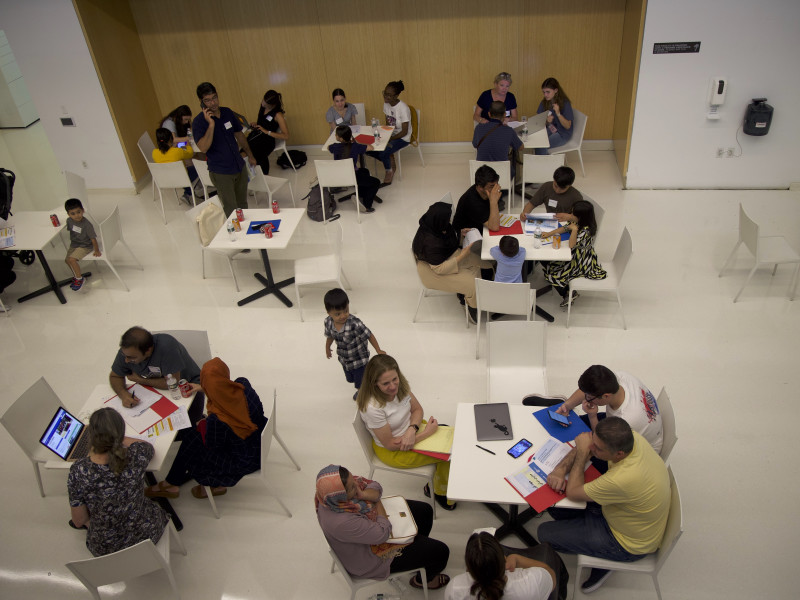
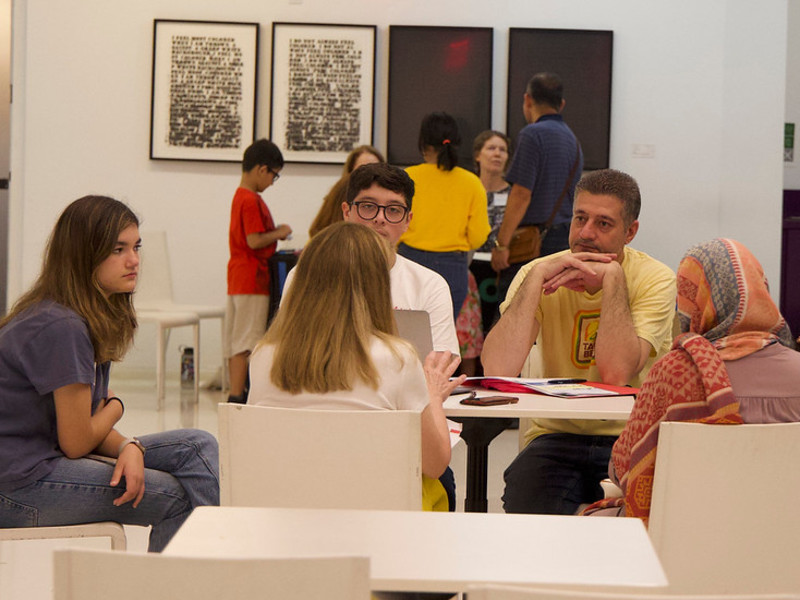
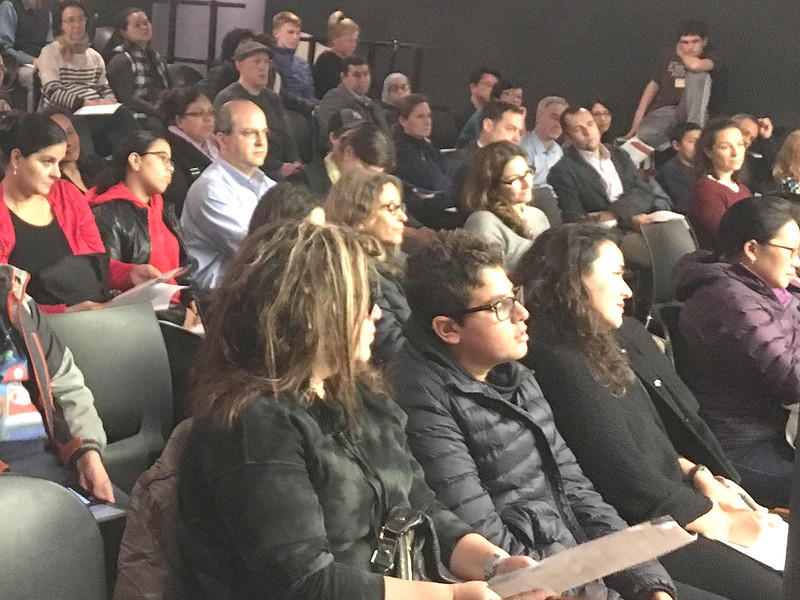
I was fortunate enough to attend a Speak Out event in the Bronx this past Thursday evening that was co-sponsored by the ARISE Coalition and Parents for Inclusive Education (PIE). These advocacy groups are working hard to ensure that NYC special ed students get the appropriate and free public education that they are entitled to by law, and they have recently hosted public forums for parents in all five boroughs.
As a special needs parent myself, I’ve often wondered how other New York City families, especially those with fewer resources, cope with an autistic or developmentally delayed child. My husband and I both have college degrees and English is our first language, and we still have trouble reading an IEP (Individualized Educational Plan), which is often more complicated than a tax form. We have made it our business to seek out the best resources to help us navigate the DOE and ultimately to get Brooks the services he needs. We’ve been fortunate in that the countless hours we’ve committed to our son’s education have paid off. But for those who lack higher education and often don’t speak the language—not to mention, don’t have the time to devote to the process —not only does the diagnosis often come later, which makes everything more difficult, they are frequently left to fend for themselves in terms of advocating for their children. Thanks to the efforts of groups like ARISE, the families I met on Thursday night are getting the assistance they desperately need.
Single-digit temperatures did not deter these Bronx parents from taking advantage of the opportunity to tell their stories, and many spoke of their heartbreaking attempts to do right by their children.
“Why is my son not receiving physical therapy?” That’s what one committed mom asked the teachers and administrators at her son’s school. They responded that even though physical therapy was on her son’s IEP, it was not available at their school, and they referred her to the district. The district’s response was that he is indeed getting physical therapy. He is indeed getting physical therapy?!
Whether these kinds of bureaucratic exchanges are a result of bad record-keeping, which the DOE openly admits to with respect to special education records, or bald-faced lies, which is the interpretation of this Bronx mom, the bottom line is that a public school child who requires physical therapy as an integral part of his education is not getting it.
Other parents spoke of long automated phone calls to the DOE that provided nothing more than numbers to press for information they already had. They spoke of teachers who gave up on kids as soon as they heard the word “autism.” They spoke of high-functioning children with autism coming home from school beaten up because they had been placed in classes with violent, emotionally disturbed children.
What was remarkable about the evening is that regardless of how horrible these stories were, they were underscored by hope. These parents didn’t hesitate to remind each other that there are some really good teachers out there. Even though more than one speaker recommended that the CSE (Committee for Special Education) in the Bronx be shut down and then rebuilt from scratch, they all believed that this system could somehow be saved, and that they could help to make that happen.
Unfortunately, the one representative from the Office of Special Education Initiatives that attended the meeting left well before many of the parents had a chance to speak.
At the start of the meeting, AHRC and PIE advocate Chris Trieber encouraged parents to get up and speak in order to dispute this quote from the DOE: “90 percent of parents are satisfied with the quality of education their children received.” Near the end of the meeting, one parent responded: “Maybe they should change that to 90 percent of parents are NOT satisfied.”


Subscribe to 

Everyone who works for the D.O.E. knows that the services and classes for special education students have been decimated.
Several manuevers have been made to reduce expenses for the most vulnerable children in our school system. But who working for the schools wants to speak out? No one. Parents are afraid as well. Why is this? Principals have a tremendous amount of power and can bar children from their schools now as never before. Teachers are afraid to speak up for possible reprocussions.
Comment by myra kressner — January 21, 2009 @ 7:58 pm
I am the mother of a 13 year old boy. He carries the diagnosis of Type 1 Diabetes Mellitus since age 11 years. His life depends on 2 injections of insulin he has to take daily. He attends the 8th grade at a public school in Queens. I have been requesting that his school make “reasonable” accommodations to meet his special dietary needs on school premises, to no avail. The only response I received from a top official from the Department of Education was that “my son is not a Kindergarten nor a second grade student; he is old enough to watch what to eat and count his own carbs from the school menu.” To date, the only thing that his school does is to monitor his blood sugar level. He does not even have an emergency care plan developed by a team, with parent involvement.
Because of my failed attempts at different levels of the Department of Education in order to obtain reasonable dietary accommodations for my son, I filed for an Impartial Hearing, but I lost at the city level. I am now appealing the decision. However, I do not have an attorney to represent us. I am not eligible for pro bono counsel because of the income guidelines. I cannot retain a private attorney because it is too costly.
I feel that people with disability should be entitled to pro bono or free legal representation. Just having a disability is painful for the ill and their families, and they should not be penalized. We should not let the system abuse their rights because they cannot afford a private attorney to seek justice. They deserve to live!!!!Please look into this matter. My son has a future and I do not want him to fail. Diabetes is a life-threatening condition if untreated. I am advocating for all disabled students, not for my son only. Thank you for listening!!!
Aura Moody
A Concerned Parent
Comment by Aura Moodt — January 21, 2009 @ 8:53 pm
The advocates are right - the only thing that makes real change is People Power and if parents speak up, the administration has not choice but to respond.
This is very important work from ARISE. Here’s hoping that the Obama administration - with his notion that rebuilding is OUR SHARED work - inspires all of us to realize that democracy is hollow without real participation. Parents have authority that many don’t know they have and most don’t exercise. It’s time to ARISE!
Comment by KitchenSink — January 22, 2009 @ 8:23 am
I am so grateful to Chris Trieber’s work with PIE and ARISE. He spoke at my son’s school and helped parents understand IEP’s and how to navigate the special ed system. Like the parent quoted above, I’m a native English speaker and very involved, and if I have trouble navigating, I can only imagine how difficult it must be for other parents who have fewer resources available. Advocates like Mr. Trieber are so important for us parents! No matter who’s in political office, I’m firmly convinced that an advocating parent, or better yet, group of parents, is the best hope for any child.
Comment by Robin T — January 22, 2009 @ 10:23 am
I would like to state that my daughter is a high functioning DOWNS child, who is in public school. I have been trying to get her re-evaluated, so that I can be sure that this is the right setting for her. She is repeating Kindergarden and I don’t want her to have to repeat it again just to catch up with the peers. It is very difficult to find a school for her as there are not alot of shool which focuses on on children with DOWN Syndrome.
I am a strong believer that advocating for your child is important. I feel that all parents that has a child with a disability should fight to get them the services they need.
Comment by Reshma V. — January 22, 2009 @ 3:45 pm
Hi there,
I’m an advocate myself in East Harlem and I must say that the bureaucracy of the CSP sucks to the bone. I feel that we need a mass movement to stop the abuse children are subject in schools.
Traditionally, Schools and Hospitals call ACS for parental negligence. Those Institutions should, by means of a change in legislation, should be held accoutable to the same standard as a parent for negligence.
In addition to that, the Insurance companies, which business is to constantly switch HMO’s for thousands of families. They should be charged with something when they suspend a child’s medical coverage for no reason, while a poor child needs despetattely her/his medication.
There is the case of a child with severe asthma which HMO recertification was due. The recertification papers were sent off on time, but the damn worker claimed that he never received the papers.
So what’s the child safeguard against this new kind of criminal who hides behind the massive anonymity of the systems that were supposedly designed to protect our children’s welfare?
The child I’m speaking of could have died without this important asthma medication, whose cost was $200.00
We need more people, we need to grow stronger.
Comment by Rene Nuss-Caneda — January 23, 2009 @ 8:17 pm
more blogging from marni, please!
Comment by maggie — January 28, 2009 @ 12:33 am
I work in the schools and even from the inside it is impossible to get information on how to proceed when one is trying to find help for a child with learning disabilities. With all the people who are supposed to be educated, why is it so difficult to get a straight answer. Even the phone system can be a nightmare. The only way to proceed is to hire a lawyer who specializes in educational law. Unfortunately many people cannot afford this unless they sue the BOE to pay the fees. Some system! They have to be sued on a regular basis just to get them to do a job that is “mandated.”
Comment by M.Schatz — April 2, 2009 @ 12:04 pm
First of all there needs to be less of a monetary incentive surrounding ALL aspects of Special Education and more ACEDEMIC incentive initiative to teach children to advance FROM special ed.
The term “Special Education” became to broadly overused in the 80’s and too much money was circulation around anyone who was enrolled in a special ed class. An example of misuse: children who had asthma and missed lots of days of school were left back or put in special ed classes; the parents would get SSI because they are in “Special Ed.”. The monthly checks are pretty attractive, so the incentive is not always there to MOVE these children back into general ed. Another senario that is just sickening is the children that misbehave in class. Many of them are bored, in many cases these children complete the work faster than others around them in some subjects and “act-out”. These children are sent to numerous appointments (keeping them out of class) to have an IEP produced to place them in Special Ed. classes. Once again the monetary “carrot” dangled and little incentive to mainstream these children back into general ed.
Now counselors and the such need a job too, but look at the big picture. There were so many children in the 80’s (who are now in their early to mid twenties) in special ed. That many of them are now underskilled.
Special ed needs to be broken up, yes, broken up: the physically challenged and those who are developmentally disabled (mentally challenged, ie. have Down’s Syndrome) should be in one group and those who have behavioral issues, asthmatics, bi-polar, ADHD, etc…in another.
All with the goal of incorporating those who can back into general ed. Only the first group of students should be allowed to recieve SSI payments, for the others - 1% of what would normally be given should go to case appropiate behavioral skills training for student AS WELL AS their families.
Some may think my point of view harsh, but I HAD a child who was a 90 student, behaved poorly as was placed in special ed, eventually sent to a residential treatment center. I asked for SSI payments and after 2 or 3 years in that setting and he improved greatly, I fought dilligently to have my child go to a school where the special ed students are mainstreamed into general ed. They wound up taking 6 out of 8 general ed classes before they left high school. I also knew children who were in the same grade as my child who entered special ed (for falling behind in their grades, then diagnosed as having a low IQ). Tutoring would have been good for some of them, but instead they were placed in special ed without any incentive to encourage these young people to progress in their studies and do the best they can or perhaps go on to college. but these youth did something great for the GNP — they bought every new style of sneakers, coats, jeans, nails, jewerly, cell phones that came out every month. That’s what needs to change. Don’t make it financially attractive - make it academically rewarding for EACH child to go on to college and do their best.
Comment by C. Brown — April 23, 2009 @ 10:17 pm