Charter school lottery: Why am I here?
Abigail Kramer is a public policy journalist at the Center for New York City Affairs and the parent of a 4-year-old in Brooklyn.
I’m running up two flights of concrete stairwell, on my way to torture myself.
I applied for a kindergarten spot for my son at Community Roots Charter, a small, progressive school in Fort Greene, and I really want to get in—as, I suspect, do the parents of the 457 other four-year-olds who applied, all vying for 50 spots, about 20 of which will go to siblings.
Like a lot of charter schools, Community Roots holds a public lottery, proving the transparency of its admissions by drawing names in front of a professional auditor and anyone else who cares to watch. I’m here, at least in part, to figure out who comes. The odds of getting in are abysmal, so why would any parent put themselves through this?
“We have a lot more people who leave disappointed than happy,” says Allison Keil, one of the co-directors.
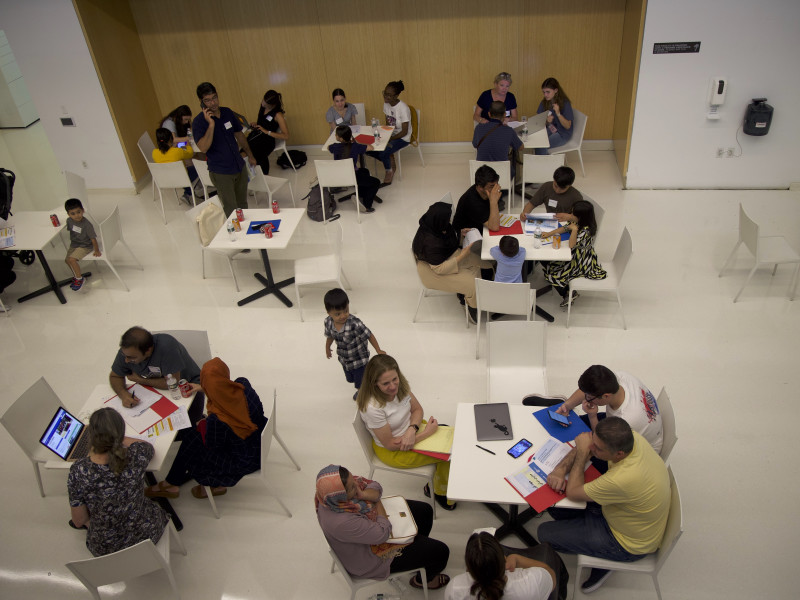
And yet, about 25 grownups sit in the room, along with five or six kids, one of whom really, really doesn’t want to be here. At the front, the school’s office manager pulls tiny squares of paper from a spinning, plastic bucket. It’s like watching those Lotto clips on TV, where the balls bounce around in a box and the lady who pulls them out has a really nice manicure, except what’s at stake is your kid.
A round guy named Joe sits behind them in a pricy-looking suit and tie, one ankle propped on a knee. The auditor. Every few minutes he tells the name-reader to spin the bucket, reshuffling the fates of the kids who are left. The woman next to me is literally biting her nails.
Kindergarten fills up in about 15 minutes, and then the waitlist starts. I figure if my kid lands in the first 20 or so, then we might have a shot. He doesn’t. By the 50s, people are filtering out. Mom and dad of #89 give each other a sarcastic high-five. I’m glad someone still has a sense of humor.
Like so many things about raising a child in NYC, entering kindergarten is an intense encounter with scale and inequity. Some kids have guaranteed spots at schools with million-dollar PTAs. Some will be lucky to get an art class. If I weren’t a parent, my feelings on this would be clear: All the energy and angst that I’m spending in this room would be so much better spent on my neighborhood school, where any kid in a 12-block radius should have the right to the attention and quality that I’m trying to get from a charter. There’s nothing in my values or politics that makes it okay to prioritize one kid over another, except that I am a parent and I have no idea how to do right by my own child while also doing right. So here I am, staring at a projector screen and hoping that my kid will beat out somebody else’s.
We’re into the hundreds, and I know by now that we don’t stand a chance but suddenly it starts to mean something to me—that I’m here, that someone will care when my little kid’s unpronounceable name gets called. That to one person in this room, he’s not just another paper in a bottomless bucket. He’s my kid, who just wants to crash toy cars and be with me all the time. Whose circumstances I’ve done everything in my power to control since the day he was born.
Which, of course, is what all the parents in this room are doing here: Trying to find some sense of control as we send our kids into this gargantuan system that will define the next phase of their lives. I went on school tours and read about test scores and attendance rates and nodded or shook my head but, really, what do I know? My son is about to enter a world in which I will have very little access and even less power. A giant, haphazard machine that’s charged with educating 1.1 million kids every day—and which loses track of plenty of them along the way. Where he will be subject to all the vagaries and accidents and happenstance of the world—a bad teacher, an overcrowded classroom, this brutal anonymity that starts with 458 pieces of paper in a bucket
Number 107. I feel a small, piercing sense of gratitude that the bucket spinner said my son’s name correctly. It’s a stupid thing to care about but, two hours later, it’s why I’m here: Because I’m the person who cares more than anything in the world about what happens to waitlist kid # 107.
Kindergarten waitlist meetings in Park Slope & Upper East Side
The Department of Education is hosting meetings this week and next for families of incoming kindergartners who have been waitlisted at schools for next fall. At the meetings, to be held District 15 in Brooklyn and District 2 in Manhattan, two of the districts with the most extensive waitlists, enrollment officials will give an overview of the admissions process, discuss the status of waitlists, and clarify next steps.
Last week more than 2500 families found out they were on the waiting list for kindergarten at their zoned schools, a figure the DOE emphasized will decrease sharply over the spring and summer as families decide on other options, including charter schools or gifted and talented programs.
Still the process has been worrisome for many families new to public schools who often choose where they are going to live based on the school zone. That's particularly true in Brooklyn's District 15 where for the first time many popular schools are having to waitlist prospective kindergartners. There are waitlists at PS 29, PS 39, PS 58, PS 107, PS 130, and 169 inSunset Park which, as of last week, had the longest list in the city.
There has already been movement at some schools. The waitlist of about 50 students at PS 107 was cut nearly in half when the school decided to make a pre-kindergarten classroom available for kindergarten and move the pre-K students elsewhere, City Councilmember Brad Landor's office reported. (It's not clear where the pre-K will move yet.)
The District 15 meeting will be tonight, Thursday, at 6 p.m. at the John Jay High School building, 237 7th Avenue, between 4th and 5th Streets.
Next Monday, enrollment officials will meet with Upper East Side families in District 2 who have children on waitlists at schools such as PS 290, PS 59, PS 151, PS 158, and the brand new PS 267, among others in the district.
The meeting will be at 6 p.m., April 11 in the auditorium of Wagner Middle School at 220 East 76th Street.
Parents whose children are still waitlisted by the end of May will be given another placement as close to their zoned school as possible, according to DOE officials. They may continue to stay on the waitlist even into the fall. Children are entitled to attend school the year they turn five, although they are not obligated to attend school until they turn 6.
Elementary Dad: When "doing your best" isn't enough
Joyous squeals mixed with heart-rending sobs March 31 as I fetched my daughter from kindergarten. Eighth-graders from a nearby middle school had just received letters informing them what New York high school they would attend, and sidewalks were jammed with clusters of anxious students ripping open envelopes that would reveal their futures.
New York can be a rough place for kids, but no day packs more joy and dejection than the moment high school assignments are announced. Dreams were dying. Friends were being ripped apart. The city’s method for assigning high schools has its defenders, but few believe this system is kind to 13-year-olds.
My 5-year-old daughter couldn’t ignore the cheers and tears, so I hurriedly looked for a way to turn the scene into what modern parents call a “teachable moment.” I told her the kids who were happy had done their best and won admission to a good high school. “The ones who are sad didn’t always do their best, so they didn’t get into the school they wanted,” I said. “Right now, they are probably wishing they had worked harder and studied more.”
When I related this explanation to my wife, she was horrified. “Plenty of kids did do their best and yet still didn’t get into their first-choice school,” she argued. Doing your best does not guarantee success in New York, she said, and it was wrong to make a child believe such a lie.
As usual, my wife is correct. The city doesn't have enough great high schools for all its hardworking teens, just as it doesn't have enough high-achieving neighborhood elementaries for all incoming kindergarteners. But a more complex question is: What lesson should a 5-year-old take from eighth-graders’ joy and pain? And what does “Do your best” really mean?
My lesson seems to have been cribbed from Battle Hymn of the Tiger Mother, Amy Chua’s memoir of her ultra-demanding parenting style. In one notorious anecdote, Chua rejected the birthday cards presented by her young daughters because the hand-drawn cards didn’t display enough effort. Similarly, I once chided my daughter when a homework assignment (yes, NYC kindergartners have homework) was dashed off carelessly. “But I did my best,” she protested. No you didn’t, I replied. I’ve seen your best, and that’s not it.
Fact is, few if any of us do our best (Amy Chua notwithstanding), since the nebulous goal is virtually unattainable. The admonishment “Do your best” is meant to signal a direction, not a destination. My teachable moment was not perfect (just ask my wife, or any parent of a heartbroken eighth-grader), but the message that we should strive to reach our full potential is worthwhile, at least for a kindergartner. Certainly the opposite holds true: If you don’t try to do your best, you will surely be disappointed with your high school.
Support for tough love comes from the Tiger Mother’s successful and happy daughter. In “Why I Love My Strict Chinese Mom,” Sophia Chua-Rubenfeld told her mother (via an open letter in the New York Post) that her strict, demanding upbringing didn’t leave scars, and the rejected birthday card is Exhibit A. “The card was feeble, and I was busted. It took me 30 seconds; I didn’t even sharpen the pencil,” she wrote. “If I actually tried my best at something, you’d never throw it back in my face.”
I’ll continue to urge my daughter to do great things, particularly in school. But in the future I’ll think twice before turning eighth-graders’ anguish into a teachable moment. I admit: On this one, I didn’t do my best.
Kindergartners waitlisted at more than 150 schools
More than 2,600 children are on the waiting list for kindergarten at their zoned school, with another 553 awaiting spots at an out-of-zone school their sibling attends. A total of 3,195 children are on waitlists at 157 schools, many more than the 2,200 at 88 schools who were on waitlists this time last year.
While waitlists cause high anxiety among parents, they tend to shrink or disappear over the spring and summer as children are admitted to private schools, public gifted programs, charter schools or move out of the city, Department of Education officials say. By the end of September last year, there were 23 schools that turned kindergartners away.
Perennially over-crowded PS 169 in Sunset Park has the longest list with 99 students, four of whom are unzoned siblings. Next come two schools in Corona: PS 307, an elementary school which opened in 2008 tiny new early childhood, and giant PS 143, each with nearly 80 students waitlisted. District 24 in Queens, District 2 in Manhattan, and District 15 in Brooklyn all have at least three schools with significant waitlists.
Rezoning and the opening of new schools hasn’t solved the problem of overcrowding at some popular Manhattan elementary schools. On the Upper East Side, PS 290 has 71 students on its waitlist, PS 59 has 63. PS 151, which was reopened in 2009 to alleviate overcrowding, has a waitlist of 40 students. In downtown Manhattan, PS 234 in Tribeca (where two new elementary schools opened in 2009) and PS 41 and PS 3 which share a zone in Greenwich Village, have waitlists of more than 50 students. On the Upper West Side, PS 199 has 60.
In Brownstone Brooklyn, PS 107 in Park Slope has more than 50 students on its waitlist and PS 8 in Brookyn Heights has 46, including seven out of zone siblings.
The longest waitlist in the Bronx was at PS/MS 194 in District 11 with 38 students, including six out of zone siblings. On Staten Island, two schools which opened in 2009, the Staten Island School of Civic Leadership and PS 74, Future Leaders Elementary School have waitlists of more than 20 students.
Some parents apply to multiple schools, so the waitlists tend to shrink as plans become firm. Parents whose children are still waitlisted by the end of May will be given another placement as close to their zoned school as possible, according to DOE officials. They may continue to stay on the waitlist even into the fall. Children are entitled to attend school the year they turn five, although they are not obligated to attend school until they turn 6.
Here's a list of schools with a waitlist as of March 30 2011. NOTE: The DOE cautions that these numbers change daily, as families continue to register and schools continue to add data. Parents should double-check with the schools to get the most up-to-date figure.
Elementary Dad: Real men carry pink umbrellas
After dropping off my kindergartner one rainy morning, I found myself exiting the schoolyard behind a father who worked at one of those knuckle-busting jobs where a man gets intimately acquainted with dirt, steel and sweat. He wore an oil-stained cap, dust-covered boots and a quilt-lined Carhartt jacket, and in his thick hands he held his daughter’s tiny pink lunchbox.
I complimented him on his accessory, and he in turn praised the pink Dora umbrella I carried. There was a time, we both agreed, when toting such items in public might have made us self-conscious of our manhood. But fatherhood had changed us, given us perspective. The needs of our school-age daughters came first, our public image ranked way down the list, and we expressed no regrets.
In fact, virtually all fathers I meet most mornings at the elementary school seem happy. This could be related to the fact that we’re dropping off our kids. (The mood is more somber at afternoon pick-up, where I’m one of the few fathers in a crowd made up mostly of mothers and baby sitters, all braced for the tasks ahead.) But I’m convinced joy can be found in simply being a father, particularly for those of us who take an active role in our children’s lives.
Not that it’s easy. In my case, I’ve set myself up for failure because I’ve adopted what I call the Atticus Finch Ideal of fatherhood, named for the wise and principled dad in Harper Lee’s “To Kill a Mockingbird” (and memorably played by Gregory Peck in the 1962 film). I shouldn’t hold myself to this unattainable ideal, but I can’t help it. I want my daughter to learn right from wrong based on my noble example, and I won’t be convinced of my success until that day when the oppressed whisper in my girl’s ear, “Stand up. Your father’s passing.” Wish me luck.
Meanwhile, I do what I can to add a little testosterone to my child's elementary school environment, a place where men tend to play supporting roles. When it was my turn to be the surprise "mystery reader," I did a dramatic rendition of "Casey at the Bat," fiercely swinging a Louisville Slugger as I re-created Casey's futile third strike. (My daughter's appraisal: She was a little embarrassed. My reply: Won't be the last time, kid.)
And I derive comfort and happiness from small services rendered, like carrying home a cherished pink umbrella so it’s not lost amid the chaos of the classroom.
Also, there’s a long-term payoff to developing a close, nurturing relationship with your child. Among them: A recent study showed college-age women were less likely to abuse alcohol or drugs if they had involved fathers who set rules and closely monitored their behavior. (The same was true for mothers and sons, suggesting significant influence by the opposite-gender parent.) We fathers might not always rise to the level of Atticus Finch, but we don’t have to sink to the depths of Homer Simpson.
Applications for kindergarten due March 4. See our new reviews
Parents whose children will turn five this year should submit their applications for kindergarten by Friday. You may apply at your zoned neighborhood school as well as any other schools that may interest you. The good news: Overcrowding in Manhattan has eased a bit as new schools have opened. The bad news: there are still children on the waiting list at some very popular schools.
Children who have been tested for a gifted program won’t find out whether they are eligible until May. So parents need to apply to their neighborhood school regardless of whether they have had their child tested.
Parents of special needs children should fill out an application at their neighborhood school and any other school to which they are applying. They may also wish to attend special Department of Education orientation sessions on how to best get special services. Advocates for Children has a brochure for special needs children who are turning five.
Charter schools have separate applications, due April 1. For some charter schools, you need to apply in person. For others, you may fill out on a new online application at the New York City Charter School Center.
We recently visited some Manhattan schools that are open to children outside their immediate neighborhood, including Central Park East I, Central Park East II, The Twenty-first Century Academy (open to District 6 children) and Midtown West (open to District 2 children). We also visited a new Upper East Side school, PS 267, that may have room for children outside its attendance zone this year. A new Upper West Side school, PS 452, is off to a promising start.
We’ve posted new reviews of some well-known Manhattan schools: Manhattan New School, PS 183, PS 11, PS 199, PS 452, PS/IS 217, PS 198 and PS 158.
In Brooklyn, we visited PS 20, PS 189, and PAVE Academy Charter school. In Queens, we visited PS 201. (PS/IS 217 on Roosevelt Island also accepts children from Queens in the gifted program.) In the Bronx, we visited Girls Prep Charter School and PS 279. We’ll continue to update our school profiles this spring.
Parents who have been touring schools this winter, please share your insights in comments below or on school profile pages. We welcome your views.
Elementary Dad: Mean girls meet the Old Maid
If trend-watchers are correct, today’s girls will feel the cruel sting of social bullying at a younger age and with more lasting damage than girls of their mothers’ generation. I want to shield my daughter against this gathering Mean Girl storm of rejection, snarky gossip and social ostracism. So she and I play Old Maid.
The logic goes like this: Card games involve groups, strategy, winners and losers — many of the same factors involved in social relationships. Learning to obey rules, to play wisely, and to win and lose gracefully can help children master some of the social skills they will need to successfully navigate a schoolyard dotted with backstabbing enemies and two-faced friends.
This strategy is found in the book Little Girls Can Be Mean and others like it. I interviewed Little Girls co-author Dr. Michelle Anthony last year when I worked for the New York Post. Many school districts have anti-bullying campaigns (like New York's Respect For All initiative, which several anti-discrimination groups recently criticized as ineffective), but they largely target physical violence and pranks (often boy vs. boy). Anthony believes such campaigns overlook a more complex and crippling pain that occurs as young girls stumble their way toward higher social status, often leaving victims in their wake.
“With boys, a lot of times, when you’re being bullied physically by someone, this person is not your friend. At all. And you know it, and you’re afraid of them, and you try to avoid them,” Anthony told me. “But with girls, more often it actually is your best friend. And you are sitting next to her in math class. And she does do wonderful things for you. So to just walk away leaves you socially isolated. And that’s a very different experience to have.”
Anthony describes ways parents can respond when daughters come home in tears because they have been a victim of gossip or betrayal, and these bandages seem helpful. I want to help my child avoid such emotional wounds in the first place, but here social scientists offer few tips for what most say is an inevitable part of growing up. Developing social skills through Old Maid is about the best you can do. So I shuffle and deal — and watch a 5-year-old mind begin to grasp strategic nuances that stretch beyond a card game.
“When I have the Old Maid, I hold it out in front so it looks special and people will take it,” my daughter told me during one of our early games. (Lesson One: Bait your opponent.) I said that’s a good plan — so long as you don’t tell others what you’re doing. (Lesson Two: If you’re going to be sneaky, be quiet about it.)
Since then, her skill set has expanded. Playing last week, she held out her final two cards, one noticeably front and center. I reached behind it, sidestepping her bait. (Lesson Three: Friends won’t let you win all the time.) I was surprised to find I’d fallen for a bluff and picked the Old Maid. (Lesson Four: Uh, something from The Art of War about varying your tactics and feigning inferiority, I guess.) A wicked smile crossed her innocent face.
Congratulations, kid. The schoolyard can be a rough place for little girls, but I think you’re going to be OK.
Elementary Dad: What kids learn on the way to school
Confused cries of “Leave me alone!” rang down our street, and I gripped my daughter’s hand a bit tighter. Ahead, directly in our morning path, a cluster of New York police officers were carefully but firmly leading a disheveled elderly woman down the stairs of a brownstone toward a waiting ambulance. My 5-year-old silently took in the sad scene, and I hurried past the ruckus as quickly as the icy sidewalks would allow. I braced against the cold, then braced myself for questions.
Like many NYC kids, my daughter often gets an education before we even reach the schoolyard. On this morning, I had to explain that people sometimes become confused and need medical help, yet their confusion makes them not realize they are sick. Previously, I’ve had to give sidewalk lessons on homelessness and poverty. As my daughter learns to read, I’m sure I’ll have to explain some New York Post headlines. The city doesn’t have a “Pause” button you can hit while your child walks to school.
But lately the folks at Equinox gyms and Titan advertising have made parents’ jobs even tougher. Since January, poster-size ads featuring sexed-up images have appeared on phone booths around Equinox’s Upper West Side branch at 76th Street and Amsterdam Avenue. The racy ads are unavoidable on the routes young children (including mine) take to reach PS87, PS452 and the Anderson School, as well as three middle schools and the privately run Collegiate School. DNAinfo.com reports that parents who complained to Equinox got a rude response – hardly surprising from a company that once promoted itself with staged photos of nuns lustily sketching a nude man.
Titan Outdoor Holdings, which put the Equinox ads in children's paths, doesn't have an untarnished reputation, either. Titan made news last year when the Metropolitan Transit Authority revoked Titan’s contract to place ads on buses and commuter trains after Titan failed to pay $18 million it owed the transit agency. Amy Berlin, a spokeswoman for Titan, said the company had received no complaints about the Equinox ads from parents – but she noted the Equinox campaign was near the end of its run, and the ads would soon come down.
If my 5-year-old daughter is confused by the Equinox’s lite porn, she hasn’t said anything. She was more concerned about the woman being led to the ambulance. She wanted to know: Who would care for that woman? What would happen if she had children? If she had pets? Would everyone be all right?
I stumbled through my answers, offering reassurances. It was a bitterly cold morning, but I felt the warmth that comes from proximity to a child’s innocence. New York may throw any number of unsuitable scenes in your path, kid, but the city has not hardened your heart.
Elementary Dad: First step in a grade journey
On Friday, the kindergarten teacher sent home my 5-year-old daughter’s first report card, and I ripped open the sealed envelope with a tingly mix of anxiety and sorrow. The first report card marks a rite of passage in a child’s life, the start of many official judgments. The winter breeze blowing through the schoolyard now carries faint whiffs of assessments yet to come: Regents exams, SAT scores, and a disheartening performance review written by some idiot corporate middle manager.
Her report card contained some surprises, few of which had anything to do with my daughter’s abilities. Her teacher’s opinion pretty much confirms my own: My child does well in some areas but needs to work harder in others. The comments were a mix of praise and constructive feedback. All fine.
But I was surprised by how precisely the report card charted my kid’s specific strengths and needs. The old A, B, C grades are history, and New York’s 1 through 4 levels haven’t yet arrived. Instead, kindergartners at my daughter’s school are judged on whether they meet certain social benchmarks “Consistently,” “Usually,” “Sometimes” or “Rarely.” And the checklist can be oddly specific. For example, my kid earned high marks for “Fits into group without needing excessive attention,” which is more than can be said for Paris Hilton. In areas such as “Able to stay on topic” and “Able to elaborate ideas,” my little girl scores better than I do.
In academic categories such as reading and arithmetic, the grades (if you call them that) are one of three descriptions: “Meets/Exceeds expectations,” “Making progress” or “Area of concern.” This beats the obsolete A ("Excellent"), S ("Satisfactory") or N ("Needs improvement") that I received in elementary school. My daughter’s rating system suggests the classroom expectations are high, therefore meeting them merits the top grade. “Making progress” assumes progress will be made, particularly now that parents are in the loop. As for “Area of concern” … well, a cover letter noted that parent-teacher conferences take place in March.
The cover letter also informed me kindergarten report cards are private communication between teachers and parents “and are not placed in your child’s permanent record.” That was news. I assumed the “permanent record” was fiction, a schoolyard myth concocted in the 1950s as an unseen threat to prevent kids from smoking, wearing dungarees, or rocking out to Buddy Holly, but in fact it is the subject of a Chancellor's Regulation.
This week I will sign off on my daughter’s report card, add a few comments to prove I read it, then send it back to school. Welcome to the world of educational assessment, kid. You’re doing well so far. But watch out: There’s a permanent record lurking in some file cabinet that will follow you everywhere.
Saturday kindergarten fair offers info on dual language programs
Parents who want New York’s schools to help their children become bilingual can learn details about the city’s dual language programs on Saturday, Jan. 22, at a kindergarten information fair on Manhattan’s Upper West Side.
The 60-minute documentary Speaking in Tongues, about four students who become fluent in two languages while attending public schools, will be shown Saturday from 1 to 2 p.m. during the District 3 Elementary School Fair. A 30-minute panel discussion titled “Why Dual Language?” will follow the film.
Saturday’s fair and dual language information session are designed for parents of children who will attend kindergarten in District 3, however the information about dual language programs is applicable citywide. The fair is at PS 165, located at 234 West 109th Street, between Broadway and Amsterdam Avenue and runs from 11 a.m. to 2:30 p.m.
The most common dual language programs offer instruction in Spanish and English, but some schools offer programs in French, Chinese, Korean, Haitian Creole, and Russian. A list of schools with dual-language classes is available from the Department of Education website.
Most dual language courses offer full-immersion instruction, with instructors speaking English half the day and a foreign language the other half. Dual language classes typically feature a mix of kids who are native English speakers alongside kids who speak a foreign language at home.
Application to a dual language program for native English-speakers is made once your child is registered and admitted at a New York school that offers a dual language class. Space in dual language classes is sometimes limited, and spots cannot always be guaranteed during the registration period. Preference may be given to parents who can prove their child will be encouraged to speak both languages at home as well as in school. Students who are still learning to speak English, or who are native speakers of another language, have the option of enrolling in dual language, English as a Second Language, or bilingual programs.