June 17, 2009

Report gives small schools reforms mixed review

Written by Vanessa Witenko @ 4:35 pm

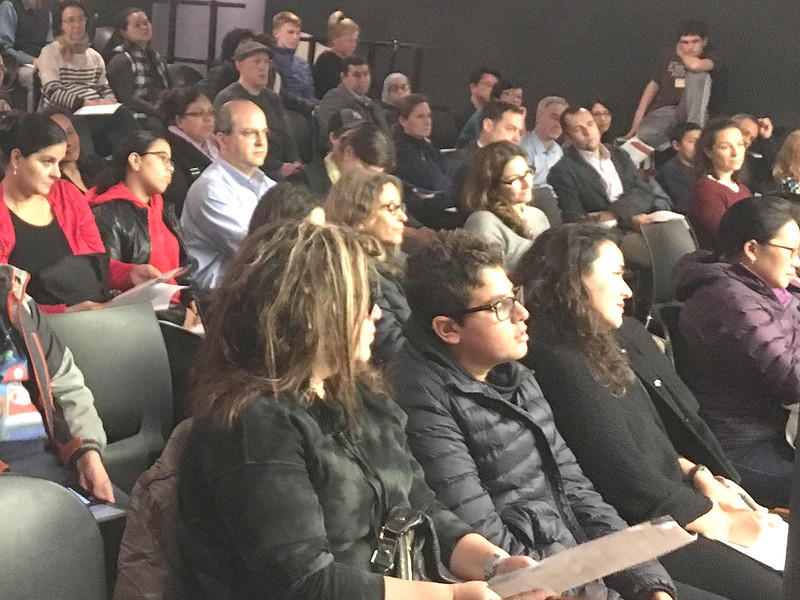
Since 2002, under the leadership of Mayor Michael Bloomberg, the city has closed more than two dozen large, unruly high schools and replaced them with small high schools, each enrolling fewer than 600 students. Many hoped the more intimate environment of the smaller schools would allow more students to thrive. A 68-page report released today during a conference at The New School, gives the small schools reform effort mixed reviews.

Small schools offer a more personalized setting, where staff knows students’ names and attendance and graduation rates are higher than at large schools, the report documents. It cautions, however, that teachers and principals at small high schools leave their jobs at a higher rate, and that attendance and graduation rates drop the longer schools stay open. The report, the culmination of an 18 month investigation by the Center for New York City Affairs, also finds that the opening of small schools and the closing of large schools,  has “had a harmful impact on thousands of students,” who still attend large high schools. Those schools have had to absorb increasing numbers of high-needs students.

Schools Chancellor Joel Klein, who spoke at the meeting, disputed some of the report’s findings. He pointed out that, over the past few years, the “graduation rate went up in all schools,” not just the new small schools. He defended the practice of closing failing high schools. “[Placing] low-performing students together in large high schools, is impersonal and it’s not going to work.”

Some large high schools have found success by emulating the small schools model within their buildings. Stephen Duch, principal of Hillcrest High School, in Queens, said his neighborhood school improved by dividing students into seven smaller learning communities.

Duch sat on the panel of education experts who spoke about some of the complex issues underlying large urban school districts and the convoluted high school admission and choice process in New York City. Clara Hemphill, one of the report’s authors and former Insideschools.org director, moderated the panel. According to Hemphill, “parents who are well-educated and speak English are better off to navigate the system.”

Pedro Noguera, a New York University professor and public school parent said that while middle class parents “will do everything they can to get their kids into a good school,” the “poor kids are being left out of the better schools.”

He also raised the civil rights issue of segregation in public schools. “Racial integration does not get talked about at all,” Noguera said.  ”Looking at black and Latino males, not has much changed. They’re overrepresented in the failing schools,” many of which are large schools in poor neighborhoods, he said.

Eric Nadelstern, Chief Schools Officer at the Department of Education said, “Simply the act of closing those large failing schools made schools less segregated. Our schools have never been more integrated than before.”

The report recommends that the DOE do more to help large high schools be successful; create more midsize high schools, which post similar rates of graduation and attendance as small schools; offer more support to special education students and English Language Learners, and not “assume that all 13-year-olds have good judgment” when selecting a high school.

Editor’s Note: Insideschools’ blogger Helen Zelon was one of the report’s authors.

June 16, 2009

Seats open in new transfer schools

Written by Vanessa Witenko @ 3:27 pm

In New York City where about half of the high school students don’t graduate in four years, transfer schools, which offer smaller class size, and programs tailored to individual students’ needs, are an increasingly important option for students who haven’t been successful at a traditional high school.

Since Fall 2005, the city’s Department of Education has opened 19 new transfer schools designed to help struggling students earn their high school diploma. While most transfer schools have long waitlists, new schools typically have empty seats waiting to be filled. Four new transfer schools will open in September bringing the total number in the city to 41. Programs fill up quickly, so now is the time to contact the schools and apply.

Here’s a rundown on the newest schools. East Brooklyn Community High School will open in a new building in Canarsie. It is targeting students who have been truant or who have dropped out of high school, and will provide intense counseling for students and their families. Innovation Diploma Plus, opening in the Brandeis High School building on the Upper West Side, will accept students ages 16-20. Emma Lazarus High School for English Language Learners is the first transfer school to exclusively serve students who are not proficient in English. The school will accept students with zero credits, and who have attended high school for one year. The High School for Excellence and Innovation is the first transfer school to open to 8th graders who are over-age for their grade and who have failed to graduate from middle school.

Unlike regular high schools which require students to apply through a central application process in the fall, transfer schools accept students on a rolling basis throughout the school year and students apply directly to the school. Transfer schools differ from regular schools, in that class sizes are usually very small, there are more social services to support students, students can enroll and graduate mid-year, and they can earn credits by taking non-traditional courses after school or on the weekend. For example, a student may take bowling on Saturday to earn gym credits. Some transfer schools accept only students who have accumulated a minimum number of credits and coursework, while others accept students with no credits.

A few transfer schools, such as The Urban Academy, James Baldwin School, and Humanities Preparatory help a range of students, including kids who didn’t fit the mold at their original high school and are looking for a different environment.

Other special programs assist students who are facing difficult life challenges. Young Adult Borough Centers (YABC) offer evening classes for students age 17.5 and older with at least 17 credits. There are also programs that provide daycare for teen parents, help court-involved youth, and programs for students with substance and drug abuse.

Every student in New York City has the right to attend school to obtain a high school diploma through the school year in which they turn 21. To find a transfer school in your area, use the advanced search in our Find a School section.

June 2, 2009

Few voted in CEC elections

Written by Vanessa Witenko @ 3:33 pm

Only 1,190 PTA officials out of an estimated 4,500 potential voters cast ballots this spring in the election for the 34 Community Education Councils, according to the Department of Education press office. Despite an extensive publicity campaign through the DOE’s Powertotheparents.org organizers and website, 18 councils will require another round of elections to break a tie or add an uncontested candidate. The district and citywide councils are considered to be the parent voice under mayoral control.

Only a school’s three PTA officials can vote for CEC candidates. During the first round of elections, PTA officials each had two votes to cast; during the second round, they will each have one vote.

Six CECs will hold an election for a candidate who received no votes during the first round of elections. “They were on the original ballot, but they just didn’t receive any votes,” said Nicole Duiginan, a DOE spokesperson. “[The chancellor’s regulation] requires an affirmative vote take place.” CECs must have at least six members to hold an official meeting, and several districts operated without a quorum for much of this school year. In the recent election, District 8 in the Bronx and District 16 in Brooklyn only elected five members, so they will each hold a second “election” to obtain one more member, chosen from the candidates who received no votes during the first round.
Eight CECs will have true tiebreakers, where several candidates all received the same number of votes. (more…)

June 1, 2009

Charter schools can use public funds to build

Written by Vanessa Witenko @ 5:42 pm

A big budget hurdle for charter schools was just lowered.

“Despite a prohibition on using state funds to build charter schools, the city has quietly expanded available funding for charter school construction to as much as $3.8 billion,” writes the New York Post. The extra money is part of a provision in the capital construction plan.

To date, charter schools have not received public funds for facility expenses. Many charter schools in New York City have been able to survive because Mayor Bloomberg has allowed them to use Department of Education buildings rent-free. Charter school advocates have long lobbied for the ban on state funds to be lifted, since depending on who controls the school system next, charter schools could have to start paying steep city rent prices.

May 19, 2009

Most vulnerable students shut out of charter schools

Written by Vanessa Witenko @ 3:40 pm

When Lydia Bellahcene’s son “E.E.,” who struggles with a reading disability, was picked from a lottery to attend Williamsburg Charter High School, she was elated. “I thought my son could be successful. He would be given the support he needed. I had no red light, yellow light to be cautious because they had an IEP team [a group of administrators who ensure special education students receive services].” Although her son worked with a special education reading instructor every day for 45 minutes beginning in 3rd grade at a regular Department of Education school, when he began 9th grade at Williamsburg Charter in 2007, the specialist was promised, but never appeared. As a result, he failed 9th-grade English, became depressed, and was forced to continue to wear the 9th-grade green uniform the following year, while his friends wore the gold 10th-grade Williamsburg Charter shirt, said Bellahcene.

Charter schools, which operate outside the city Department of Education and select students through a lottery, have become increasingly controversial as their numbers have grown. This fall an additional 24 charter schools are expected to open, bringing the total in New York City to more than 100 schools. As charter schools proliferate, and in many instances, post higher test scores than neighboring regular schools, some parents and advocates claim the schools are “creaming,” enrolling only the best students and ignoring disadvantaged populations.

“Those charter schools are not serving the main population,” said Aixa Rodriguez, a Spanish teacher who worked at International Leadership Charter School in the Bronx. She said students requiring extra services were pushed out. “They’re serving a boutique population…You’re not going to have a whole line of parents on welfare whose kids are PINS,” referring to the warrants parents place on run-away youth.

Charter school advocates disagree. “When somebody says a charter school is creaming, what they’re not telling you is there’s no way on God’s Earth you know who you’re getting,” said Jeffery Litt, superintendent of the Carl C. Icahn charter schools.

Charter schools claim they outperform neighborhood schools while enrolling the same student demographic. Opponents argue that charter schools only attract children whose parents are involved and invested in their education, since the parents had to seek out a charter school and fill out an application by the April 1 deadline. Additionally, because charter schools operate independently of the city DOE, opponents say there is no oversight to protect the most vulnerable students – those who don’t speak English or require special education services.

An analysis of student data involving some of the most challenging students to educate, students who are homeless, special education students, and English Language Learners (ELL), shows that charter schools don’t serve or enroll the same students as local public schools. Homeless students

In New York City, 51,316 public school students are homeless, and only 111 of them attend a charter school, according to Jennifer Pringle, director of NYS-TEACHS, a state-funded group that provides assistance to schools, social service providers, and families about the educational rights of homeless students.

Charter school enrollment table

“With many charter schools, you have an application process. It’s not just you can show up at the school on September 1st and register your child,” Pringle said, “and many families in crisis aren’t in a position to see that process through.” Although most city charter schools are located in low-income neighborhoods, 34 charter schools enroll no homeless students. In East New York, Brooklyn, a politically-forgotten neighborhood with decrepit buildings and the infamous Pink housing projects, nine homeless shelters are located near Achievement First East New York Charter School. The school does not enroll any homeless students.

(more…)

May 5, 2009

Parents want “gifted” but not a commute

Written by Vanessa Witenko @ 3:48 pm

Thirty Bronx parents gathered in a small Riverdale office suite on Monday evening to discuss the gifted and talented admissions process, following the Department of Education announcement that 45 percent more students qualified for kindergarten “gifted” programs this year. The chatter quickly highlighted the logistical and moral challenges of where to place gifted programs in a socio-economically disparate district.

District 10 is home to Riverdale, a quiet, secluded neighborhood that borders the Hudson River and Westchester County. Residents live in comfortable apartments and large estates hidden by a canopy of tree-covered, lush green lawns. District 10 also includes neighborhoods such as Fordham, Kingsbridge, and Tremont, where there are few trees, public housing, and noisy, congested streets.

This year, District 10 parents can choose among three district-wide gifted programs: PS 24 in Riverdale, PS 7 in Kingsbridge, and PS 54 in Fordham. Some parents say PS 24 is the only logical choice, others disagree. (more…)

April 29, 2009

Kids in foster care brush up on their rights

Written by Vanessa Witenko @ 3:55 pm

copyofffyflyerfinal.jpgKids in foster care from across the city gathered Friday afternoon in the Lewis Auditorium at Hunter College to watch Speak for Yourself, a passionate documentary which describes the challenging lives of New York City foster youth and clarifies their legal rights. The film, produced by Friends of Foster Youth, will be publicly released within the next two weeks.

The film emphasizes ten of the basic rights afforded to foster youth. For example, foster youth can request to go home to their biological parents; they can suggest who should be their foster parent, such as a family member, a friend’s mom, or neighbor; they can fire their attorney; and they cannot be discharged to a homeless shelter at age 21. (more…)

April 7, 2009

CEC candidate forums attract few parents

Written by Vanessa Witenko @ 3:15 pm

When Community Education Councils (CEC) candidates walked into school cafeterias and auditoriums across the city this month to declare why parents should vote for them, they got a shocking reality — few parents showed up. During the past two weeks, public school parents were invited to meet the CEC candidates who would represent them as the parent voice within the Department of Education bureaucracy .“Who are we talking to? Nobody’s here,” said District 12 CEC Candidate Winifred Coulton, looking out at only five parents in a large school auditorium. This sentiment was echoed at a District 13 meeting in Brooklyn, attended by about 12 parents. “Are there any PTA presidents, secretaries, or treasurers here? They ain’t here. We don’t see any of them here. That’s a problem,” said the Rev. Robert Townsley. Only votes from PTA officers count toward electing a CEC member, however, this year, all public school parents can vote at an online straw poll, April 6-22, to advise their PTA officers on how to vote.

In 2002, when Mayor Mike Bloomberg took control of city schools, he abolished community school boards. One year later, he created the Community Education Councils to be the new parent voice. Critics say they have far less authority than the old school boards. “The word out there is that the CEC has no power,” said Carmen Taveras, a District 12 CEC member appointed by the Bronx Borough President. “They think, ‘for what? Why would I go out there [to a CEC meeting]?’”

(more…)

March 18, 2009

Apply now for free prep program

Written by Vanessa Witenko @ 5:10 pm

Most 6th-graders aren’t yet thinking about high school, but students who aspire to attend the city’s most selective high schools, should start planning now. The Specialized High School Institute, a free 16-month, tutoring and test-prep program geared to help kids prepare for the specialized high school exam, is accepting applications for its 2009-2010 program. Eligible students should have received an application from their school guidance counselor. The application due date is Monday, March 23.

To be eligible for the program, which is sponsored by the city Department of Education, students must be in the 6th grade, qualify for free lunch under the Federal Title 1 program, have scored a level 3 or 4 on the 5th grade state ELA and math tests, and have at least a 90 percent attendance rate. Last year 2000 students participated in SHSI. Sandy Ferguson, executive director of middle school enrollment, said he anticipates that about the same number will enroll this year.

The DOE pre-selects students based on the above criteria, and applications for those students are sent to the student’s school, said a Bronx middle school guidance counselor who asked not to be identified. At his school, where more than 90 percent of the nearly 900 students are poor enough to qualify for free lunch, only four 6th graders are eligible this year.

Admitted students will attend five-week summer sessions in 2009 and 2010. Breakfast and lunch are included, although the schedule is still being finalized, Ferguson said. During the school year students will meet on Wednesday afternoons and Saturdays.

In past years, some parents have complained that their school’s guidance counselor was unaware of the Specialized High School Institute application and thus their children missed the deadline. When asked if parents could submit their application directly to his office, Ferguson replied, “No, there’s a process and they should follow it.” Parents who haven’t received an application but think their children are eligible should contact the school’s guidance counselor. Non-public school students should mail their applications to the Office of Student Enrollment.

Got a question about the process? Contact Paul Shapiro, SHSI program director at PShapiro2@schools.nyc.gov or e-mail SHSI@schools.nyc.gov.

March 11, 2009

Charter schools search for a home

Written by Vanessa Witenko @ 4:55 pm

In April, just a few weeks away, all charter schools in New York City will hold lotteries to select their students for the 2009-2010 school year. Most of the new charter schools, however, still don’t have a building. Of the 24 charter schools expected to open in fall 2009, only seven schools have an address, four of which cannot disclose their location until March 12.

The last-minute rush to find space for a new charter school is not new. When Voice Charter School opened in Queens last year, they didn’t find a home until ten days before their lottery. “Everything was tentative. We really couldn’t say where we would be,” said Principal Frank Headley. “It did confuse parents.”

Charter schools are approved one year prior to their opening in September, but the Department of Education doesn’t determine whether DOE space is available until January, said Mike Duffy, executive director of the city’s charter school office. Although charter schools can choose to obtain private space and determine their location sooner, most decide not to for financial reasons.

In New York State, charter schools do not receive money for operating expenses, such as facilities, but in New York City, charter schools housed in a DOE facility reside rent-free. “They don’t pay a dollar,” said Duffy. As a result, charter schools play the waiting game and often amend their charters to fit their new location. “A charter is applied for a specific neighborhood… if they end up getting sited in a different district they need to amend their charter,” said Duffy. “The law requires them to admit kids in their district.”

Girls Prep of East Harlem planned to serve English Language Learners in District 4. They recently learned there is no space in East Harlem, and they will be moved to the South Bronx. Equality Charter School asked to be in District 12, but will be placed in District 11. Duffy says some schools don’t care where they are located, while others are “so focused on the neighborhood they get private space because it’s so integral to their mission,” he said.

Still others may end up not opening at all if they can’t find adequate facilities. Principal Jeffrey Litt at Carl C. Icahn Charter School says he needs 10 classrooms and an office in order to open Icahn #4 in September 2009. The space would be temporary. Icahn is currently building a “multi-million dollar facility,” to house both Icahn #3 and Icahn #4, but it won’t be ready for a few years, said Litt.

When will the locations be announced? Stay tuned to Insideschools.org for updates.

February 24, 2009

Charter network sponsors Harlem school choice fair

Written by Vanessa Witenko @ 4:43 pm

Harlem parents seeking alternatives to their zoned public schools will find options at the Harlem Education Fair on Saturday, Feb. 28. Unlike the city’s Department of Education fairs, which only feature public schools, this fair, sponsored by Harlem Success Charter School network and several community groups, will bring together 52 schools, including private and parochial schools.

“I don’t think children should be condemned to failing schools because of their zip code. It’s my right as a parent to choose my child’s school. I helped organize this fair because parents need to know they are not bound to their zoned school, they have options,” Sabrina Williams, a member of Harlem Parents United, a group of parents whose children attend Harlem Success Charter Schools, wrote in an e-mail to Insideschools.org.

In New York City, most elementary school students attend their zoned school, which is determined by a student’s address, but many parents remain unaware that their children have other options. Central Park East, whose representatives will be at the fair, admits students based on their interest in the school, not on their test scores or their zipcode. Other schools, such as the Columbia Secondary School for Math, Science and Engineering middle school, accept students who score above average on state tests. Like new posh restaurants, charter schools in Harlem are sprouting up and spreading across the neighborhood each year. Representatives from 22 charter schools, which admit students through a lottery, will be at the fair.

Organizers expect as many as 3000 people to attend, due to extensive mailings reaching homes in the far reaches of the Bronx as well as Upper Manhattan. Harlem Parents United members slipped fliers under apartment doors in every Harlem public housing building, organizers said.

The fair, to be held from 11 a.m. to 2 p.m. at the Nat Holman Gymnasium at City College (138th St. and Convent Ave.), will also include free food. Chancellor Joel Klein is expected to attend and speak. Also in attendance will be representatives from community organizations such as Advocates for Children, Insideschools.org, the Children’s Aid Society, and the Children’s Scholarship Fund.

Powered by WordPress