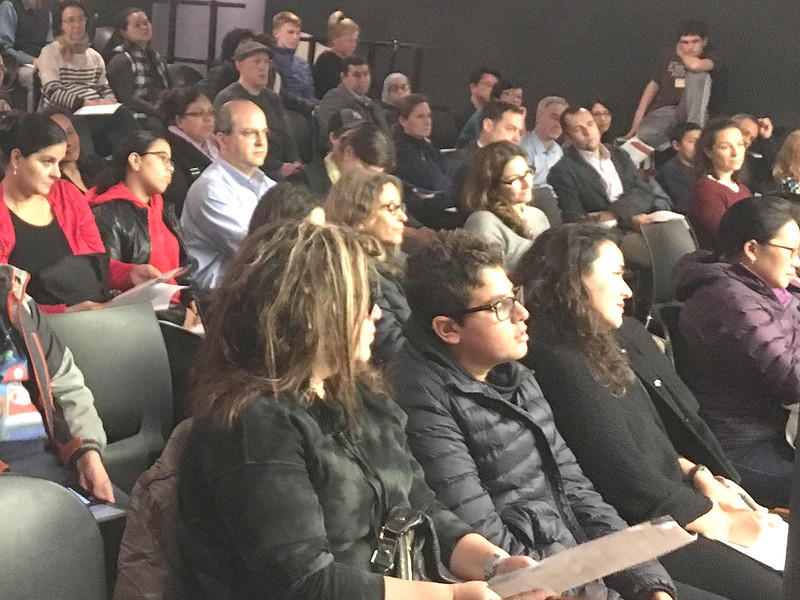
By all accounts, Legacy School for Integrated Studies is one of the worst high schools in the city. Barely 40 percent of the kids graduate on time, and most of those who do aren't prepared for college. Attendance is poor and the kids' reading and math skills are way below par. The Department of Education has announced plans to shut it down. So why would 100 parents and students rally to keep the school open?
The Department of Education sent a representative to a public hearing at the school last Wednesday night to explain that the school had failed and should be "phased out," the DOE's term for letting a school die a slow death by not admitting any new students and closing it once the current students have graduated or drifted away. But the crowd was not convinced. Sure things were bad under the previous principal, parents and students agreed. But a new principal, Joan Mosley, named in 2010, was turning things around.
"I failed global (history) four times, and when Ms. Mosley came I passed," said a recent graduate, a hearing-impaired young man with a speech impediment who graduated with a Regents diploma. "You're missing a chance to improve this school." "
"Everything changed when Ms. Mosley came," a senior girl said. "What happens if this year we prove you wrong, the attendance goes up and the graduation rate goes up?"
The DOE typically depicts the defenders of schools like Legacy as delusional; DOE officials suggest the students who come to hearings like this one are stooges of the teachers union, which naturally objects to school closings because it means teachers will lose their jobs. There were representatives of the United Federation of Teachers at the meeting, but the most passionate pleas to keep the school open came from the kids themselves. Why would a school like Legacy, filled with chronic truants, be able to turn out a crowd like this? I visited the school the next day to find out.
Housed in on the 4th and 5th floors of a windowless office building on West 14th Street between a city welfare office and a discount electronics store, Legacy offers a second chance to kids who are way behind in their studies. Some start 9th grade reading at a 2nd grade level; the strongest students read at a 7th grade level, teachers told me. About one-third of the 360 students are either learning to speak English or have learning disabilities. Some missed more than 100 out of 180 school days in their 8th grade year. Half are overage for their grade. Many arrive mid-year; last year a dozen students enrolled after being released from juvenile detention facilities. Another dozen came from homeless shelters. Three brothers, ages 21, 19 and 16, are living on their own after the death of their foster mother.
Why these students were promoted to high school at all is one of the mysteries of the Department of Education. Still, once they are at Legacy, their teachers are expected to graduate them in four years, prepared for college. A lot of kids don't make it. They give up and drop out. But some do.
At Legacy, they find teachers who care, who encourage them to succeed, who give them personal attention. There's a social worker to help them deal with emotional problems and a drop-out prevention program that uses drama as therapy. A sailing program sponsored by the Hudson River Community Sailing uses trips on the river to teach math and science. I saw a class in which a teacher showed kids how to fill out financial aid forms for college; another where kids discussed the abolitionist movement; a third in which kids learned basic math skills like adding fractions. Ms. Mosley has introduced an art program, and student artwork was on display.
If this school is phased out, its budget will shrink as its enrollment shrinks. The administration will be forced to eliminate the sailing program, the seminar on how to fill out financial aid forms, the Advanced Placement classes and the so-called College Now classes designed to prepare students for college. The drop-out prevention program will go.
"My daughter has been failing for a long time, but this school gave her a fresh start," a father told the public hearing.
"I love this school and I want it to stay open," a girl chimed in.
Is the Department of Education listening to them?
Please post comments