Recent comments
Search News & Views
Our columnists
Blogger alums
Donate
29 new dual language programs to open
The city plans to open 29 new dual language programs in elementary, middle and high schools in September, according to a list of new programs released by the Department of Education. New York City's public school students speak over 185 languages at home, as reported in the city's recent Internal Budget Office audit of city schools, and there are dual language programs in at least a half-dozen of those languages.
Dual language programs offer English speakers the opportunity to learn a second language alongside native speakers of another language who become proficient in both English and their native tongue. Ten percent of the city's more than 150,000 English language learners were in dual language programs in 2011, according to the IBO.
Spanish is the second-most common language spoken at home -- nearly a quarter of New Yorkers are native Spanish speakers -- and many of the city's new and established dual language programs are in Spanish. But the programs opening this fall will expand the city's dual language offerings to include three languages not offered previously in elementary school. The Polish enclave of Greenpoint, Brooklyn will get a Polish dual language program at PS 34 Oliver H. Perry; PS 214 in East New York will open a Bengali program; and PS/IS 30 Mary White Ovington in Bay Ridge will start an Arabic program. A handful of new Chinese programs are in the works for the fall, as well.
Advocates say "no" to de-zoning D5 and D6
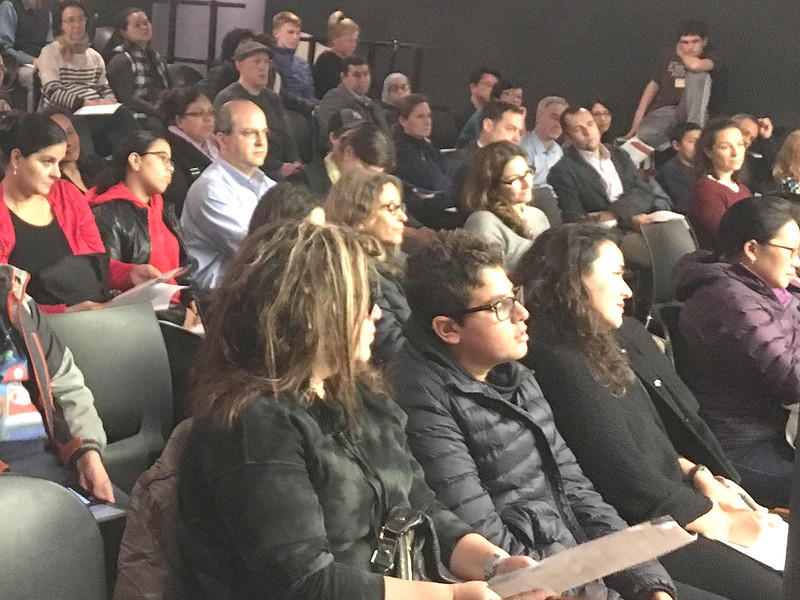
At a public forum Tuesday night in Washington Heights, Community Education Council 5 President Sonia Jones said her council plans to vote "no" on a resolution to de-zone when it meets on June 13th.
Jones said CEC 5 is submitting an anti-de-zoning resolution to clearly state its position on record: “Teachers, parents and principals are standing with CEC 5 against de-zoning,” Jones said while sitting on a panel at the Public Forum on Elementary School De-zoning, hosted by Councilperson Robert Jackson, head of the City Council's education committee.
Jones acknowledged that the idea of “choice” sounds appealing, but, she said, “you don’t get to choose what school your child really goes to, because there is someone in the office who decides where your child goes.” Jones advised District 6's Community Education Council, which is also considering a de-zoning proposal, to “slow down.”
Middle school rankings rankle parents
Many New York City families who send their children to neighborhood elementary schools are in for a rude awakening when their child reaches 5th grade and they learn that choosing a middle school is not so straightforward. Applying to middle school can be just as nerve-wracking and time consuming as applying to college.
“Kind of feels like you’re going to see Oz behind the curtain,” said a Cobble Hill dad in District 15, whose 5th grader didn't get accepted by any of the schools he applied to. “Who is making these decisions? The DOE? The middle schools?”
The answer? It depends on where you live.
Unlike high school admissions – a mostly uniform, citywide process – the middle school process is decentralized and different rules apply in different districts.
High School Hustle: Will digital distractions derail finals?
Finals will begin in many New York City high schools next week, and I already have a vision of what "studying,'' will look like in my household.
Banish forever any image of notebooks, highlighters, textbooks, index cards and teenagers hunched over a desk.
Instead, picture headphones or ear buds and dozens of open windows – the digital kind – with sites ranging from Facebook to i-Chat, spark notes, Twitter, Hulu or even Netflix. One hand will undoubtedly hold a cell phone with multiple text messages coming in and out.
As a parent, you may be tempted to shout: "Turn it off! You have finals! Study!"
It's most likely a losing battle; in their minds, they are studying – and to some extent, they are. How much is being retained is subject to debate.
Parents win victory in PCB removal
The Department of Education's announcement yesterday that it will accelerate the removal of light fixtures that may be contaminated with polychlorinated biphenyl (PCBs) from more than 730 school buildings by December 2016 is an important victory for New York City school children and their families.
Prompted by a lawsuit brought by parent and advocacy groups, the city agreed to halve the timeline for the PCB removal from flourescent lights.The clean-up was supposed to be done by 2021 but the city will expedite the process to be completed in the next 3.5 years.
The renegotiated timeline is a result of more than two years of litigation brought by New York Lawyers for the Public Interest (NYLPI) on behalf of New York Communities for Change. The advocacy groups sued the DOE in 2011 over its intentions to remove the PCB contaminated fixtures over a ten year period. In March, a federal judge ruled against the city's motion to dismiss the suit, admonishing the city for its "foot-dragging" and "spurious" arguments over the clean-up of school buildings. In a stinging decision, the judge said that he was troubled over the city's dismissive attitude to potential health risks faced by children in schools with PCB-contaminated light fixtures. The settlement will require the DOE to provide semi-annual progress reports and the NYLPI and the court will continue to monitor the city's work until the last light fixture is removed.
High School Hustle: You are not wearing that!
A catalogue arrived the other day from Urban Outfitters, the ubiquitous clothing chain that dresses so many U.S. teenagers. Along with hipster uniforms of skinny jeans, chunky jewelry and platform sandals, I saw photographs of long-limbed girls wearing shorts so skimpy they might as well have been bathing suit bottoms.
With so little left to the imagination, I couldn't help asking the teenage boys who reside in my household if this was how girls dress at their New York City public high school.
"All the time,'' was their answer, and I should not have been surprised. Since middle school, I've repeatedly noticed girls coming to school wearing not much at all.
Apparently, I'm not the only one who has taken note. A lot of New York City public school officials aren't terribly happy about the scantily clad students whose desire to shed layers increases as the weather warms up.
Get ready for kindergarten? Workshops begin
If you've got a child entering public school kindergarten in September 2013, you may want to attend one of this month's "Getting Ready for Kindergarten" workshops led by the Department of Education's Office of Early Childhood. The evening workshops will be held in every borough from May 16-30 in public schools and libraries.
The goal is to give parents an introduction to "who's who" in elementary schools, what to expect in kindergarten and how to become involved in your child's school. Childcare will be provided, as will snacks and activities for kids. The DOE will also provide information about local library and summer programs.
All workshops are from 6-8 p.m. See a flier on the DOE's website [pdf] for dates and locations. Call 212-374-0351 for more information.
Candidates face off on mayoral control, testing
Six mayoral hopefuls showed up on Tuesday night for the Democratic Mayoral Candidate forum for parents at Eagle Academy for Young Men in the Bronx. Below are highlights of most of the questions asked and answered, reported by Jacquie Wayans, assignment editor at Insideschools and the mother of an Eagle student. The statements are not direct quotes but a synopsis of each candidate's response.
Q1: What would you seek to accomplish within your first 100 days of office?
|
John C. Liu |
Christine Quinn |
WilliamThompson |
Adolfo Carrion |
Bill DeBlasio |
|
Stop the pipeline to prison and create cradle to career instead.
|
Allocate resources so that every neighborhood can have good schools. Extend the school day and expand successful models of existing schools.
|
Choose a chancellor who is an educator. Encourage critical thinking and not memorization for standardized tests. Form a parent academy with a clear message that families should be involved. |
Jobs where our children contribute to the economy and climb up the employment ladder.
|
Tax the wealthiest to improve schools. Implement Full day Universal Pre-k. Guaranteed 3 hour after school for middle school.
|
Q2: By show of hands, how many would still support mayoral control?”
All candidates raised their hands, but all said they would implement changes.
Q3: What major initiatives of mayoral control would you keep? What would you get rid of?
|
Lui |
Quinn |
Thompson |
Carrion |
DeBlasio |
Albanese |
|
Keep - “The buck stops with the Mayor” but mean it. Rid - shutting down failing schools and move from testing to teaching.
|
Rid- living and dying by test and move more schools to portfolio model. |
Keep - More Eagle Academies (lol). More career & technical education. Rid - from day one – stop closing schools.
|
Keep – accountability and responsibility on mayor. Rid – stop posturing with the teachers union.
|
Keep testing but utilize a better system so that it can be done right. Rid – parents being disrespected.
|
Rid – high stakes testing. Invest in teaching corps with 1 year internship. Promote pediatric wellness.
|
- DeBlasio challenged Quinn on the issue of high stakes testing. Click to see NY1 coverage.
Q3: Would you continue to support single gender education?
All said yes.
Q4: Cathy Black – Show of hands that believe next chancellor must be an educator?
All hands went up, except Quinn's.
|
Quinn |
DeBlasio |
Liu |
Carrion |
Thompson |
|
I don’t believe the next chancellor has to be an educator and I will look at all options.
|
Disagreed sharply. We need an educator, the whole system will not respect non-educator.
|
State law requires an educator to be chancellor. As mayor, I would follow state law. Handling schools like business divisions is not fostering learning .
|
(No longer present. He left early for another panel discussion)
|
We haven’t had a serious discussion on an educational vision and direction in 12 years.
|
Q6: Do you support the teacher evaluation system supporting teacher terminations?
|
DeBlasio |
Albanese |
Liu |
Quinn |
Thompson |
|
Yes, I think it is right – the 2 year timeline can work. Bigger challenge is teacher retention.
|
Need to recruit and support teachers. Need to train and use best practices.
|
Teacher evals should be about making teachers better not getting rid of them. The evaluations should be done by educators and not outside consultants. Peer reviews are also important; other teachers don’t want bad teachers in the classroom. |
Implement teacher modeling based upon a Texas model. |
Use a combination of test, principal evaluations and peer evaluations.
|
Q7: Describe a time when the UFT was wrong on a position
See Gotham Schools for a description of their different perspectives. (DeBlasio & Albanese left after that question.)
Q8: Would you continue the co-locations of DOE schools and charters
|
Liu |
Quinn |
Thompson |
|
I don’t think the co-locations work. I see stark differences in charters from other public schools and it sends a terrible message to kids. This is classism. It’s playing shell games with our children’s lives. |
Both sides say co-locations are not working. I don’t want to eliminate charters as an option, but it is not the answer – however, there is no way to do that without co-location. I would clarify the process and make it transparent.
|
I agree with Liu. Put an end to co-locations. Schools are closed without consultation. Announcements of 72 new schools and only 2 are actually new. Students can’t be second class citizens in their own building.
|
Last Question: Budget – How would you hold the DOE accountable?
|
Quinn |
Thompson |
Liu |
|
I’d make the budget municipal-controlled and then parents can get involved and go to the city office to raise their voices. Make a full city agency for balance of power, as every other city agency, and clear reporting.
|
Agrees with Quinn. Would also have annual budgets published and go back to a budget breakdown.
|
I agree but I am more concerned about ending the millions spent at headquarters on no-bid contracts.
|
Each remaining candidate had one minute for a closing statement.
|
Quinn |
Liu |
Thompson |
|
I want NYC to have the best schools and best choices. Engage all stake holders in conversation, bringing resources into schools and not central. Take a look at what we are doing well and replicate it. Schedule longer school days, evaluate teachers and move from testing. |
I am a product of NYC public schools, came here as an immigrant and didn’t know the language. My wife and my kids are also products of NYC public education. We have some of the best schools in the country and we must reinforce and reinvigorate the system. |
Mayor Bloomerg wanted to be known for education. I want NYC to be known as the education city. We must involve all stakeholders again. I would select a chancellor with a background in education. I would move away from this “One size fits all” mentality for our schools. I will not sentence our kids to poverty. |
Is there a place for G&T kids with IEPs?
As the May 10 deadline for parents to rank gifted and talented applications approaches, one Insideschools message board became a hotbed of anxiety. “Do you know what G&T is supposed to do with kids who get accepted to a G&T school but have IEP's requiring ICT placement?” asked one parent. “My son also has an IEP and is in ICT and is G&T. No place for him....” echoed another. The questions about inclusive gifted classes didn’t stop.
Parents want it, educators applaud it, and the DOE supports the idea—at least in theory. But a year after special education reform, there is still not a single combined G&T/ICT class in the city. No one seems to understand why.
"Twice exceptional” or "2e" kids are cognitively gifted children who also struggle with learning and attention disorders. Many of these students' Individualized Education Programs (IEPs) call for an Integrated Co-Teaching (ICT) class, which has two teachers, one of whom is trained in special education. The special education reform rolled out in all schools last year is meant to allow students to attend their school of choice and still receive needed special services, including these team-taught classes.
Tonight: Mayoral hopefuls talk to parents
The start of the 2013 mayoral race began in earnest in February when Christine Quinn was the first out of the gate to release her education plan at The Center for NYC Affairs. Since then, there have been numerous forums with mayoral candidates - separately or collectively - with many more to be scheduled before election day. However, there has yet to be an event targeted specifically to parents, an after-work forum that gives parents the opportunity to address potential candidates about issues close to their heart.
Such an event is finally happening on Tuesday, May 7, at Eagle Academy for Young Men in the Bronx. David Banks, head of the Eagle Foundation, invited all of the candidates to come and answer parent questions. The forum is part of Eagle Week, a series of events designed to give Eagle students an opportunity to do community service as well as exposure to engaging speakers and workshops. Banks opened the policy forum to the public so that city parents, educators and community leaders can pose their concerns directly to the mayoral candidates, and. in return, hear their proposed solutions.
Confirmed candidate attendees are: Sal Albanese, Bill DeBlasio, John Liu, Christine Quinn and Bill Thompson. It will be moderated by Elinor Tatum, Publisher of the New York Amsterdam Newsand Gerson Borrero, columist for El Diario/La Prensa. A nice community touch is that WBLS will be present in order to run a live audience poll.
As an Eagle parent, former CEC & PTA member, I encourage all parents to take advantage of this moment. Let's show up and be prepared with the hard, intelligent questions that need to be asked!
See the details on our calendar.