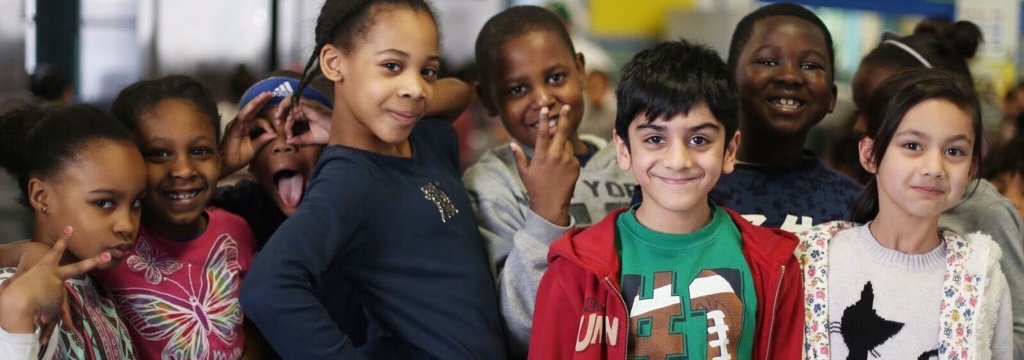
P.S. 161 Arthur Ashe School

101-33 124 STREET
QUEENS NY 11419 Map
Phone: (718) 441-5493
Admissions: Neighborhood school
Wheelchair accessible
Noteworthy
Principal: JILL HODER
Neighborhood: Richmond Hill
District: 28
Grade range: 0K thru 05
Parent coordinator: Kathy Knowles

What's special:

Beautiful, modern new building; rich global studies curriculum

The downside:

Over-enrolled school

Statistics

Enrollment:
Attendance:
Free Lunch:
Ethnicity %:
Reading:
Math:
English Language Learners:
Special Education:

Our review

SEPTEMBER 2011 UPDATE: The Panel for Education Policy approved the petition to truncate PS 161 in order to make the transition to middle school smoother. Beginning fall 2012, the school will no longer serve 6th grade. The school will serve students in grades PK-5.

JANUARY 2005 REVIEW: By the time it was only three years old, PS 161 had gone from under-enrolled to overcrowded. "It's a beautiful school in a very nice neighborhood," said one parent, echoing what many parents feel about this increasingly popular institution. The school features hallway alcoves and wooden benches, a modern auditorium, and a view of surrounding neighborhoods through the towering windows of its second-story, brick-floored cafeteria. But PS 161 has more going for it than architecture. A magnet grant, which ended in 2005, enabled it to integrate an arts- and technology-based global studies program into the city-mandated curriculum.

The grant has paid for a number of artist residencies, in which students make books, musical instruments, even Tiffany-style lamps. One artist's diversity-themed workshop had children making dolls that were later exhibited at the Queens Museum of Art. Performers have given all-school assemblies, exposing children to music, storytelling, and dance from other countries.

We watched 6th graders brainstorm with their teacher about topics for a persuasive essay. Kindergartners laid paper cutouts of their feet end to end as part of a discussion on early systems of measurement. We watched students play volleyball over a freestanding net in a college-size gymnasium.

Since opening its doors in spring 2001, PS 161 has found that the surrounding neighborhood is also a magnet of sorts -- one that attracts immigrants from countries like Guyana and India. A local population explosion, combined with the school's growing popularity, caused enrollment to skyrocket. In spring 2003, 754 children were enrolled, putting the building at 108 percent intended capacity. At the time of our tour, enrollment had risen to 854. "If I could improve anything," said a teacher, "it would be to have smaller class sizes and more teachers -- more one-to-one with children."

In the 5th and 6th grades, class size, at 32 pupils, is big. We found the rapport between administration and faculty to be harmonious, but in one unavoidable instance the United Federation of Teachers filed a grievance over a 5th grade class with 34 children. The enrollment boom has also brought to light an architectural oversight. Designers of the building failed to take into consideration that children get bigger as they get older, so most classrooms are the same size. Second and 3rd grade rooms hold 28 pupils comfortably while 6th grade rooms seem too small for more than 25 older students.

"The classes are big," acknowledged one parent, but added that "no child is left out. They all get a lot of attention." To increase the adult-to-student ratio, Assistant Principal Janice Egan is piloting a program in which she personally trains adult volunteers as tutors. At the time of our tour, she had trained almost 20, many of whom are also part of Learning Leaders, a city program that trains adult tutors. Most of Egan's volunteers help children with math and reading, while some perform other tasks.

Children in the school's Talented and Gifted program are pulled from their regular classes to work on enrichment projects. On Saturdays, they create books with an author- and illustrator-in-residence.

English as a second language: Ninety-five English language learners -- many of them Guyanese and Asian -- receive different levels of ESL instruction. Some Guyanese families lived in dire circumstances in their native country, so the school often works with Guyanese children who have pre-kindergarten-level educations, even though they are old enough to be in the upper grades.

Special education: Five "collaborative team teaching" (CTT) -- one each for pre-kindergarten, kindergarten and the 1st, 2nd, and 3rd grades -- have two teachers and serve both general education students and children with special needs. Principal Jill Hoder said that she intends to start a 4th grade class in fall 2005. Some special teachers feel that the growing program has expanded beyond the school's ability to evaluate and place children. "It's a small school that has grown into a big school," said one special education teacher. "We need more people helping to re-evaluate special ed students. We have kids in class who, perhaps, need to be somewhere else, and they're not learning. The administration has tried, but their hands are tied." Said another special instructor: "I would like more special ed teacher support. The time between a referral and testing [by the school-based support team] can be months. A child is in the wrong place where he should not be."

After school: Fifth and 6th graders receive math and reading help Tuesdays and Thursdays from 3 -5 p.m. Second and 3rd graders are tutored Saturdays, 9 a.m. to noon. Fourth and 5th graders receive math, literacy support, and test prep weekday mornings, 7:30-8:15 a.m. Students, grades 3 - 6 get homework help, and play chess and volleyball Tuesday through Thursday, 3-6 p.m. Fifth and 6th graders take music and drama on weekday afternoons. (John E. Thomas, January 2005)

Please post comments

  • Give specific examples. Tell us why “this school rocks” (or doesn’t)
  • No profanity. No racial or ethnic slurs. No personal attacks
  • Criticism is fine but don’t be nasty.
  • Flag inappropriate comments. (Hover your cursor over comments to see flag)

Find another elementary school