
Institute for Collaborative Education
Grades: 6-12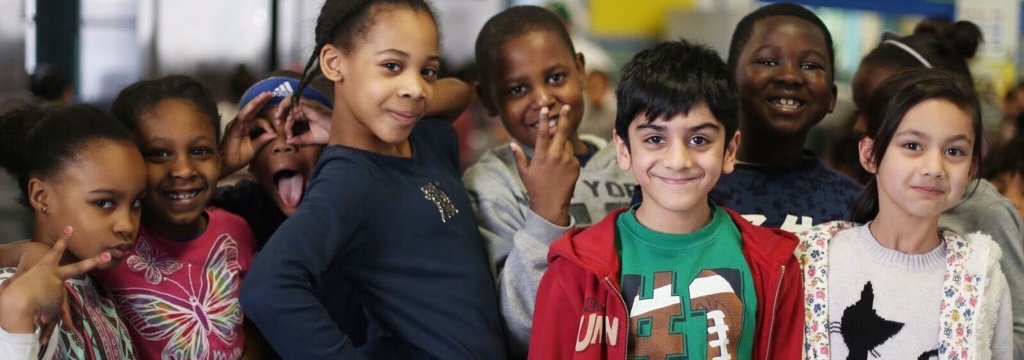
Our Insights
What’s Special
School promotes love of learning—not test prep
The Downside
Limited upper level course offerings, especially in high school
The Institute for Collaborative Education (ICE) is a small, progressive secondary school that strives to teach children to love learning, not just to take standardized tests. Children may act out scenes from Shakespeare's Julius Caesar as part of their study of Ancient Rome, use earthquake data to map fault lines on their computers, or play in the middle school's award winning jazz band.
ICE belongs to a consortium of 30 New York state high schools whose students are exempt from taking most state-mandated Regents exams. (Middle school students must take the state English and math tests, and high school student must take the English Regents.) Children are evaluated based on their written essays and oral presentations called portfolios.
The school is based on the philosophy of the education reformer Theodore Sizer, who believed that small schools that teach a few subjects well are more effective than large schools that attempt to teach many subjects.
The small size is both the school’s strength and its weakness. With just 60 or 70 students in each grade, ICE is an intimate place where teachers get to know students well. Parents say there is a “family feel to the school” and students get an unusual level of support from the college office. At the same time, course offerings are limited. Only two years of high school Spanish are offered. There are no Advanced Placement classes. (Students may arrange to take courses at nearby colleges.)
Seniors have internships, rather than regular academic coursework, for their entire second semester, working at architects' offices, law firms, art galleries and a science research labs at local universities.
It's an informal place. Students call teachers by their first names and sometimes use slang when speaking to adults. Blue jeans are the rule, on adults as well as kids. Kids can be boisterous during class changes. But there is real learning going on, and kids seem happy and engaged. There are some non-traditional activities (like testing the water quality of the Bronx River in a biology class) as well as tried-and-true reading assignments like Macbeth or The Great Gatsby.
Seventh-graders take an integrated math/science class called "smath," where they build models of roller coasters and catapults; 11th-graders may take statistics and an introduction to neuroscience course that's so popular that a few graduates have gone on to study neuroscience in college. Students have won awards from the NYC Science and Engineering Fair for projects such as one on the effect of transracial adoptions.
Peter Karp, a former science teacher, became principal in 2012, replacing founding principal John Pettinato who retired after 20 years at ICE.
The Institute for Collaborative Education occupies the 5th floor and part of the 4th floor of the former Stuyvesant High School, which it shares with Health Professions and Human Services High School and a District 75 program for autistic children.
College acceptances include Brown, Colby, Sarah Lawrence, Yale, the University of Chicago, Cornell, Penn State, Middlebury College, Hampshire College, Bard, Bucknell, and College of the Atlantic.
SPECIAL EDUCATION: The school offers both “push in” and “pull out” special education teacher support services (SETSS). There are a few team-teaching classes in the high school.(Clara Hemphill, September 2018; admissions update, 2022)
Get more from InsideSchools
School Stats
Is this school safe and well-run?
From the 2024-2025 NYC School Survey
From this school's most recent Quality Review Report
From the 2024-25 School Quality Report
How do students perform academically?
From the 2024-25 School Quality Guide
Who does this school serve?
From the 2024-25 Demographic Snapshot
From the 2024-25 School Quality Guide
How does this school serve special populations?
From the 2024-25 School Quality Report
From the New York State 2024-2025 Assessment Database
Programs & Admissions
From the 2024 High School DirectoryThe Institute For Collaborative Education
Offerings
From the 2024 High School Directory
Read about admissions, academics, and more at this school on NYCDOE’s MySchools

Contact & Location
Location
345 East 15Th Street
Manhattan
NY
10003
Trains:
 ,
,  ,
,  ,
,  ,
,  ,
,  to 14th St-Union Square;
  to 1st Av
Buses: BM1, BM2, BM3, BM4, M1, M101, M102, M103, M14A-SBS, M14D-SBS, M15, M15-SBS, M2, M23-SBS, M3, M34-SBS, M34A-SBS, M8, M9, QM63, QM64, QM68, SIM10, SIM11, SIM1C, SIM3, SIM31, SIM33, SIM33C, SIM3C, SIM4C, SIM6, SIM7, SIM9, X27, X28, X37, X38
Contact
Other Details
This school shares the former Stuyvesant Campus with two other schools
Was this information helpful?
Get more from InsideSchools
You may also like …
The Clinton School
Manhattan, NY 10003

Comments