Recent comments
Search News & Views
Donate
Support Insideschools NowOur columnists
Blogger alums
Take our poll
News and views
Physical education programs in New York City public schools are woefully inadequate. An October audit by the City Comptroller's office showed that few schools meet the state standards, which call for daily PE for grades K-3; three times a week for grades 4-6, and 90 minutes a week for older students.
The comptroller's audit was prompted by the Women's City Club of New York (WCC) a non-profit civic organization, whose members advocate for more physical education in all schools. They point to studies showing the correlation between academic success in school and physical fitness. (Alec Appelbaum blogged about this topic for Insideschools last year.)
Now, WCC members are speaking out again about the importance of phys ed in schools. In a taped interview which will air on Sunday morning, Dr. Katherine S. Lobach, a member of the WCC Task Force on Physical Education in City Schools, says, "We need more school administrators to recognized the academic value of physical education and more parents to insiste that their children get it."
Watch the interview and learn how you can help get your child's school to offer more phys ed and exercise.
Small high schools are better, study claims
Written by Insideschools staff Thursday, 26 January 2012 13:41Teens who attend a new small high school have a better chance of graduating than their peers at larger, established schools, according to a study released yesterday by the research firm MDRC.
The study compares students who were accepted by lottery to one of 105 new schools to those who applied to the same school but did not get in. Fnded by the Gates Foundation, the study looked at students who entered a new small school -- mostly in Brooklyn and the Bronx -- between 2005 and 2008. It found that "67.9 percent of the students who entered small high schools in 2005 and 2006 graduated four years later, compared with 59.3 percent of the students who were not admitted and instead went to larger schools," the New York Times reports.
Education advocates say that while many of the new small schools opened by the Bloomberg administration post better results than the large, failing schools they replaced, not all of them are successful. In fact, the city is moving to close some of them.
"We do know that overall the small schools are successful. We also know that some of them are terrible failures. What we don't know is what makes some of them successful and some of them failures," Insideschools' Clara Hemphill told NY1 reporter Lindsey Christ. "The small schools did start out with a lot of energy. The question is whether that can be sustained."
Read more on NY1, GothamSchools, and SchoolBook.
I have a modest proposal for the state and city officials responsible for placing Regents exams a week after finals: Could you please flip the schedule and schedule Regents before finals?
While not all city high school students take Regents exams in January, there are no classes at all in most New York City high schools during the state exams week. Yet nearly all take finals, or midterms in many of their classes a week before.
That means that last week, my two high schoolers had multiple midterm or final exams on the same day, nearly every day. They stayed up way too late studying – or, at least I think that's what they were doing. Their bedroom became a landfill of crumpled paper, flashcards, calculators and notebooks. Tired and cranky, they complained they didn't have adequate time to prepare.
There is an inherent irony in this artistic mecca we call New York City when it comes to the Education Department's arts education policies. Insideschool's own Judy Baum reported that although there is no lack of good arts education programs, "46% of elementary schools do not meet the state standards in the arts." Insideschools alum and Gotham Schools writer Philissa Cramer highlighted that "about 20 percent of schools do not employ a single arts teacher, even for a part-time position."
Not surprisingly, the arts become the first casualties as both local and national educational trends focus more and more on standardized testing. And when you factor in shrinking budgets and classroom space, the situation gets even worse.
I find these developements especially disturbing since I was brought up in a household that viewed the arts as a basic human need, right up there with food, shelter, and clothing.
Parents of kids with lopsided abilities despair of finding the right educational fit: for the math whiz who has dyslexia; the child with a photographic memory who can’t sit still; the ace test-taker who struggles to get along with her peers.
These kids are Twice Exceptional, often abbreviated as 2e. They’re super smart, but profoundly challenged. Most have Individualed Education Programs (IEP), specifying special education services. They just don’t fit into the public school system.
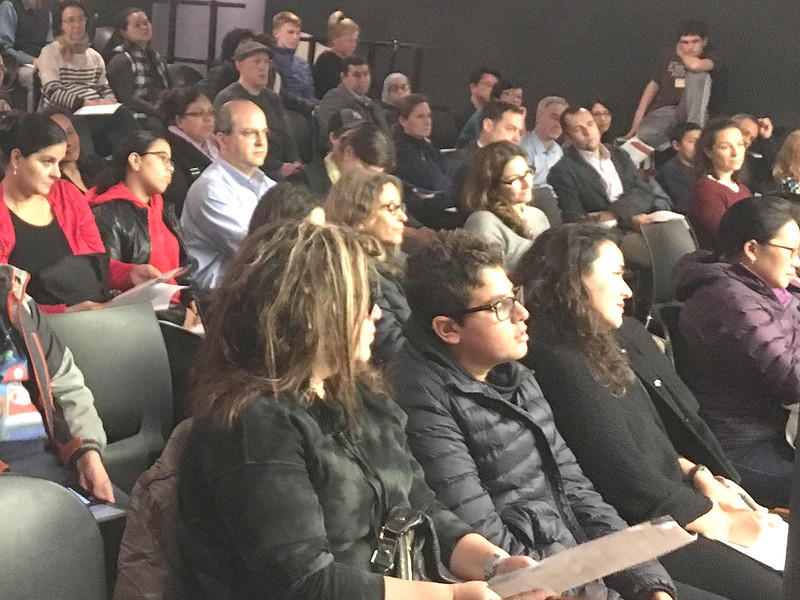
On January 19, dozens of parents turned out for a meeting hosted by the Citywide Council on Special Education (CCSE) featuring a panel of educators and Education Department officials. They were not surprised to learn that there are no programs designed specifically for 2e kids, moreover the Department of Education does not have “clean data” showing how many 2e’s there are in the system: “Gifted and Talented is not tracked by disability yet but the number is extremely low,” said Lauren Katzman, director of special education.
College Counselor: Playing the waiting game
Written by Dr. Jane S. Gabin Tuesday, 24 January 2012 11:31Q: I applied to seven colleges, regular decision. There are three that I really hope I get into. The others are fine, but I’m not that excited about them. My counselor thinks I have a pretty good chance at most of them – but not the top three. And those are the ones where I most want to get accepted. I’m not going to hear anything for two months – and I worry that my applications will just get overlooked in the piles of folders. Now that everything is turned in, what else can I do to make the admissions people notice me? I’m an excellent baker – what if I sent boxes of my brownies to the admissions offices at my top choice schools? Or should I write an additional personal letter telling them how much I want to attend? Would handwritten letters make a better impression than e-mail notes? How many times do you think I ought to contact them?
A: Simply waiting is very difficult. I understand your desire to be active rather than passive at this point. You want to do something. But please resist the urge to communicate unless completely necessary. The main thing admissions readers want to receive, after an application is originally submitted, is an updated transcript. Right about now, high schools ought to be sending these to the colleges where students have applied. This is the major piece of information that will help determine the admissions decision.
Parents who unwittingly lead young children into addiction often can pinpoint that horrible moment when they’ve hit rock bottom. My moment came Thursday when my 6-year-old daughter, home from 1st grade with a cold, sat on the sofa watching a DVD of the idiotic musical “Carousel.”
Sometime after the number “This Was a Real Nice Clambake,” my blank-faced child mumbled, “This is my favorite movie.” I froze and wondered aloud, “Oh God, what have I done?”
After decades of focusing on Regents exams and graduation rates, in 2011 for the first time the Education Department evaluated each high school on "college readiness" - that is, how many of its graduates were actually prepared to do college work. The score on each school's Progress Report didn't carry any weight this year but the numbers are depressing: fewer than half of the 2011 public high school graduates reported that they planned to enter college in the fall. And only one in four 2011 grads were deemed "college ready" — not in need of remedial college courses after four years of high school. The numbers are even lower for black and Latino students.
The City Council is pressing DOE officials to explain what they are doing to improve college-readiness. In turn, the DOE will hold school's accountable: high schools will be docked points for poor college readiness scores on the 2012 Progress Reports.
High schools already struggle to meet other accountability requirements. Some schools, like It Takes A Village Academy in East Flatbush, have a high Regents pass rate (90% graduate in 4 years) and an abysmal college readiness rate (9%).
Should high schools take more initiative to guide students through test prep, college vists and the application process? Whose responsibility is it to prepare kids for college? Take our poll and share your ideas!
Warning to anyone who is awaiting results of the latest round of high school admissions: It's not going to be over soon.
You may wonder what that means. After all, if you've done the required homework, you've probably taken numerous tours of New York City High schools, endured tryout anxiety with your child, and possibly used vacation time for tours. Perhaps you've even shelled out hundreds of dollars on specialized test tutoring for the specialized high schools and discussed how to rank certain schools.
You've already calculated commute times and weighed the odds of admission in seemingly endless discussions with other parents, teachers and students.
Do "screened" schools screen out poor kids?
Written by Meredith Kolodner Wednesday, 18 January 2012 19:47New York City public high schools with academic requirements for entry offer a rigorous education, but admission is supposed to be based on performance, not on income. So why do so few low-income students manage to get in?
A look at two dozen of the city's most elite high schools -- those that require a score of proficient or higher (a 3 or 4) on both the state math and reading exams and those that require a spectacular score on the "specialized test" -- shows a huge discrepancy in who's enrolled, based on income.
About 74% of high school students citywide qualify for free or reduced lunch ($41,348 or less for a family of four) compared with 41% of students at the exam and selective schools.