Under the plan, Tribeca students living west of Church Street. will be zoned for the highly-regarded, but becoming-over-crowded, PS 234. PS 89, originally the zoned school for Battery Park City students, will now be zoned for students living north of Battery Park City and Gateway Plaza.
“Closing a school is worse than a root canal,” Chancellor Klein recently told the New Yorker. “You’re disrupting people’s lives.” Nevertheless, the Panel for Educational Policy voted Tuesday to close 19 ” failing” schools. This, despite major outcry from parents, students, and teachers.
Advocates for Children — the parent of Insideschools.org — issued a statement prior to the vote warning that many of the closing schools served large numbers of high-needs students, and that while closing failing schools is sometimes necessary, the city ought to consider the effect these closures will have on our most at-risk youth.
What do you think about this latest round of school closings? Please take our poll at left and share your comments below.
In our most recent poll, we asked how you felt about your school security officers. “Great!” said 35% of respondents. But 63% had concerns, and of those, 18% felt police officers don’t belong inside our schools.
If you or your child have experienced problems with school safety officers, and would like to communicate with a member of the NYCLU, ACLU, and Dorsey Whitney legal team about the recently filed class-action lawsuit — which alleges that NYPD personnel assigned to New York City’s public schools have repeatedly violated students’ civil rights through wrongful arrests and the excessive use of force — or share a story about policing in our schools, please click here. You can also contact the NYCLU’s Johanna Miller at jmiller@nyclu.org.
A recent poll by Insideschools.org found parents overwhelmingly against the bake sale restrictions imposed by the chancellor. Insideschools’ readers were not alone in their disapproval.
The outcry by parents and kids against the Department of Education’s ban on bake sales seems to have convinced the DOE to amend Chancellor’s Regulation A-812. Under proposed changes, parent organizations would be able to hold one bake sale per month at any time of day, and sell “non-approved” food during that sale. To many, that means cupcakes. Sales are not allowed in the cafeteria.
For students, looking for revenue to support their clubs and teams, the regulation relaxes the time constraints. Kids could sell approved foods outside the cafeteria at any time of day and for as many days as they wish. Still no cupcakes there, in fact no homemade goodies at all. Students would be limited to selling only those serving-size, packaged snacks that are on an approved list. (more…)
Yesterday I had the privilege of serving on a panel at the new Urban Assembly School for Green Careers, listening to 9th graders hold a debate. The topic was “Proposed: a new waste transfer station should be built in the South Bronx.”
The two teams represented the South Bronx and the Upper East Side.The students had visited a park right next door to a South Bronx waste transfer station that was very stinky, they said. The field trip had been hosted by Sustainable South Bronx.
The “Upper East Side” team argued against building the site in that neighborhood, noting that many minority and disadvantaged children live in the neighborhood, and 600 of them go to summer camp at Asphalt Green, where health would be threatened if garbage trucks were rumbling in and out all day. (more…)
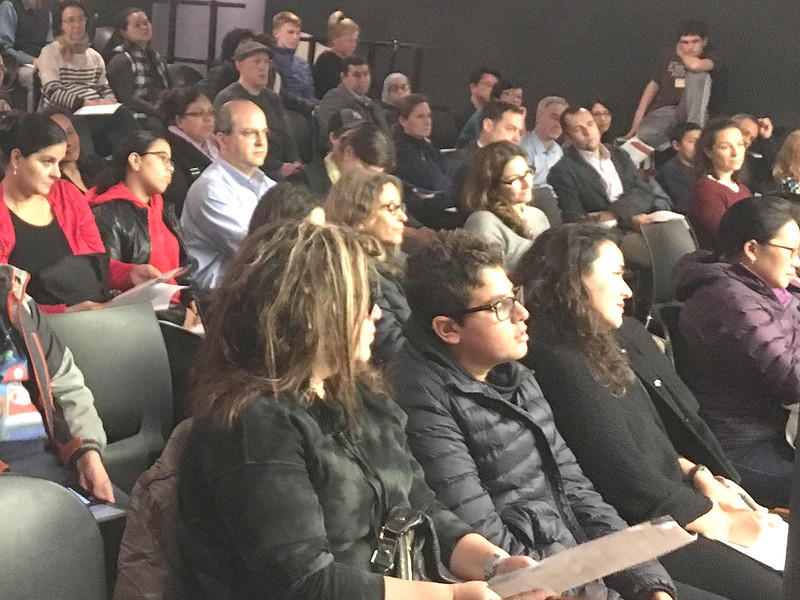
Chants of protest rang through the streets of Fort Greene yesterday afternoon, as thousands of New Yorkers gathered to urge local officials to vote against closing 20 public schools. After two hours of protest and nearly nine hours of public comment, the Panel for Educational Policy approved the phasing-out of 19 of the schools. It will vote on closing the 20th school, Alfred E. Smith Careers and Technical Education High School in Bronx, next month.
“Keep schools open,” the crowd chanted as United Federation of Teachers President Michael Mulgrew took the stage at the 4 p.m. rally, his image broadcast on a jumbo screen stretching down Dekalb Avenue along Fort Greene Park for protesters to see. “We cannot continue with an educational policy that says, ‘we will no longer fix schools, we will close schools,’” he said before leading the crowd in a chant of “help not harm.”
When the rally came to a close, community members lined up along South Elliot Place to enter Brooklyn Tech High School’s auditorium for the 6 p.m. meeting of the PEP. The line buzzed with discussion.”Statistically we were just one year on the Schools in need of Improvement list and this is only the second year with our new principal,” said a teacher from Global Enterprise Academy, a school slated for closure. “We didn’t see it coming, we were punched in the head.”A student marching band made its way down the line, drowning out conversation.
The school’s two-story auditorium quickly filled to capacity. As PEP members took their seats on stage, community members remained on their feet, waving banners with slogans such as “keep the public in public education,” while chanting “save our schools.”
The crowd quieted as the panel approved minutes from its previous meeting. The panel chairman then asked Chancellor Joel Klein to provide an update. Boos filled the auditorium. “As I’ve said many times, our first obligation is to our children. The sad reality is that the schools that we present tonight are schools that are not meeting the standards that we need to meet for our children,” said Klein. “It saddens me that there are people here who are unprepared to listen and people who do not listen are typically people who are not concerned about the guideline and only about shouting people down.”
Hundreds of community members were allotted two minutes to speak. Manhattan Borough President Scott Stringer was one of the first to approach the microphone. “The people who build our schools over generations have been the communities, neighborhoods, parents, students,” he said. “If we agree that [the community] are the stakeholders, how could you possibly be the only ones to decide what schools remain and what schools close?” The panel chairman shut off the microphone at the two-minute limit, launching the crowd into a chant of “let him speak” — a chant that would be repeated throughout the evening.
An hour later, Dr Annie B. Martin, president of the New York branch of the NAACP, stepped to the mic. “To close these 20 schools, the DOE will disrupt the lives of the students, parents, and the very fiber of their communities,” she stated, “These are our public schools. They are a part of our communities.” Dr. Martin’s microphone was also shut off at two minutes. The crowd once again broke into a chant of “let her speak.” A community member later allowed Dr. Martin to finish her statement during his comment period.
Community members expressed concerns regarding the impact of school closure on students, the metrics by which the DOE judges whether a schools is “failing,” the PEP’s lack of teaching experience, and the influence of economic concerns on education policy, among other issues. Community members spoke until 2:45 a.m., when the panel began its vote. The closure of 19 schools was approved.
Impassioned pleas to save neighborhood’s schools came from the far-reaches of all boroughs — Far Rockaway, Queens, the Northeast Bronx, Bed Stuy, Brooklyn and midtown Manhattan. Parents from PS 16 on Staten Island were there to protest the plan to split their school in half.
For the first time since Mayor Bloomberg took control of the city’s schools, parents — some 2000 strong — came together in a bid to keep their schools open. However, given that the PEP has previously approved all school closings, the schools’ fate appeared to be decided even before the meeting began.
The minimal checks and balances on mayoral control that were put into place by the state legislature last summer, were not enough to offset the mayor’s ironclad grip of the schools. Of the 13 members on the oversight board — the PEP — eight are appointed by the mayor and serve at his pleasure. (more…)
Our house, like any other with a 6-year-old, has its share of “No’s.” “No shoes on the couch.” “No getting wild in the house.” “No using the word ‘stupid.’” But there is also one that is autism-household-specific: “No talking about that anymore.”
For example, Brooks will ask: “Is MOMA like the Guggenheim? It’s similar, right? Is it similar? Not the same but similar.” And when we say “Yes, it’s similar. They are both museums,” he can easily go on for an unthinkably long period of time discussing the definition of similar and all the things he knows about that are similar, and he constantly wants us to chime in to validate his understanding of the concept.
We know that this is a combination of comforting himself with predictable facts, streamlining his sometimes disorganized thoughts, and simply his age-old habit of getting stuck in repetitive patterns. So we try to thin out our diminishing patience, and we remind ourselves that even though he still does this, he does it less and less, and that eventually, he will learn to stop talking in circles. (more…)
Q: How difficult is it to transfer to another college? Is it easier or harder than getting admitted as a freshman? Also, does the college you are applying to look at your high school record or just your college record?
A: The basic answer to all your questions above is: It depends.
Openings for transfer students are made possible by other students leaving the college. A school with a high retention rate will have fewer openings. In general, the more selective a college, the fewer places it will have. On the other hand, a less selective school which is also more affordable, may be experiencing a higher demand for places — so it may be harder to be admitted as a transfer student there this year than it was last year. (more…)
Parents packed into the District 3 CEC meeting on Jan. 20 to hear Department of Education officials address the impact of charter schools moving into public schools in Harlem, and overcrowding in Upper West Side schools.
Rose said that there are no new charter schools planned for District 3 next year. She reported that parents are joining school and public officials in walk-throughs of buildings where the amount of space allocated to a particular school– its “Instructional Footprint” — is under question due to space utilization or overcrowding. Presumably, the addition of parents could lend credibility to the process of siting charter schools or deciding how many children can successfully be educated in a given building. (more…)
I looked at the scattered notes and index cards covering my dining room table last week, struck by a distant but very real memory of my college freshman self during finals: Sprawled out at 6 a.m. in a study room in my freshman dorm, surrounded by textbooks and index cards after pulling an all-nighter.
Trying to absorb every significant event in the history of Western Civilization in one sitting, I learned, was not such a good idea.
Last week many New York City public high school students faced their first round of high school finals, in some cases digesting large quantities of information at the last minute. This week, many of those same students will also take New York State Regents exams they must pass in order to graduate.
Those who know how to keep up with assigned reading and to carefully organize, outline, and study their notes well in advance probably sailed through their finals. Others found the experience daunting, judging from frantic text messaging and Facebook posts proclaiming imminent failure and pleas for help finding the right notes. (more…)
Parents and teachers from around the city gathered across the street from Mayor Bloomberg’s home to protest proposed school closures and charter school expansions on Thursday evening. Today Advocates for Children, a group that works with the city’s most disadvantaged youth, issued a statement urging the Department of Education to consider the effect of closures on homeless students and those with special needs. Closing failing schools is sometimes necessary, the statement says, but the impact of closures on the city’s most at-risk youth must be addressed.
The statement notes that many of the schools facing closure serve extremely disadvantaged student populations. “The number of students who are homeless rose by 21% citywide from 2007-08 to 2008-09, it went up by a remarkable 580% on average at the schools slated to be closed,” it reports. These schools also serve higher populations of English Language Learners and students with special education needs.
AFC urges the Department of Education to answer a number of questions: What happens to students with special education needs when their schools close? What is the DOE doing to increase the supply of attractive high school options for English Language Learners and student with other special education needs? And, does a school’s willingness to serve a diverse population with multiple challenges make it a target for closure?
Read about other developments in the school closure debate and view AFC’s statement below: (more…)
Five students and their parents sued the city this week, claiming that kids have been wrongly handcuffed, assaulted, and arrested by school safety officers employed by the New York City Police Department.
In addition to damages, the class action lawsuit asks the court to order that schools, rather than safety officers, deal with disciplinary issues, and calls for the city to set up a complaint process and impose new disciplinary measures for officers found guilty of misconduct.
Have you experienced incidents where you felt school safety agents acted inappropriately? Or do the officers at your school behave professionally, keeping kids safe? What kinds of disciplinary issues are cropping up in your school, and how are they handled? Are kids cuffed, “perp-walked,” and packed off to the precinct, or are they simply sent to the principal’s office?
Kids, parents, teachers, and administrators: how do you feel about your school’s safety officers? Take our poll at left and share your experiences below.
(If you would like to communicate with a member of the NYCLU, ACLU and Dorsey Whitney legal team about this lawsuit, or share a story about policing in New York City public schools, please click here. You can also contact the NYCLU’s Johanna Miller at jmiller@nyclu.org)
In our most recent poll, we asked if your school is doing something to help Haiti. Nearly 60% of you said “yes,” and 22% said “I don’t know but I think it’s a great idea.” Just 12% said “no” and a mere 5% said, “I don’t know but I think our school should stay focused on educating our kids.”
Collection jugs and posters are popping up at schools throughout the five boroughs, and some schools have taken advantage of Chancellor Klein’s temporary lifting of the bake sale ban to raise funds for relief efforts. The guidelines issued also encourage schools to send collected donations to the Mayor’s Fund to Advance New York City, which it said would distribute them to “reputable relief organizations, including the Red Cross.”
How is your school addressing the situation, either through fundraising or learning opportunities?
“Don’t think. If you think, you will fail.” That’s not a Zen master speaking, but my government teacher. “I’ve seen plenty of students go wrong because they were creative, intelligent people and they thought about the questions. Don’t do it. Copy exactly what’s in the box. Word for word.”
Her lips twitched into a smile, but she wasn’t joking. She was referring to the Document Based Questions section of the U.S. History and Government Regents exam, a test that will be the culmination of my last three semesters and has turned my government class into test prep for the past three weeks.
The sad part? She’s right. And the really sad part? Because she’s right, instead of teaching us how to analyze and understand government, our last 15-plus classes have been spent learning to copy from the box. I don’t blame my teacher at all, her job is to help us do well on the Regents exams and she’s giving us the best advice she can.
Still, isn’t it weird that after more than 12 years of school, the big expectation is that I can copy words of text onto an answer sheet?
Well, I’ll do it. I want a good grade like the next guy, so I’ll turn my brain off when I sit for the Regents next week. I hope that after graduating high school I’ll be able to think again.
NY1 education reporter Lindsey Christ this week is chronicling the sad story of Paul Robeson High School, one of 20 schools slated for closure by the Department of Education. The reporter first visited Paul Robeson for Insideschools.org last year. At that time she found that “high absenteeism, occasional violence, low graduation rates, and poor test scores” were plaguing the school, one of a dwindling number of large comprehensive high schools left in Brooklyn.
In Tuesday’s report for NY1, Christ visited empty classrooms and talked to teachers about the attendance problem at Robeson — only 69% of students show up for school on a given day, sometimes as few as five are in a classroom. In Monday’s story, students blamed themselves, as well as the school, for their lackluster performance.
Check out the coverage on NY1 for a look at what’s happening inside one large high school. Meanwhile, the debate continues about how well small schools, which are increasingly replacing neighborhood high schools, serve the most troubled students, such as those skipping classes at Paul Robeson.
Almost every year, we are faced with the task of finding — and hiring –new teachers. What makes a great teacher? A school’s success depends on the quality of the faculty, and any school leader’s answer to that question will tell you much about the school.
For us, great teachers have three essential qualities. They must be 1) constant, and hungry, learners, 2) committed to knowing young people and their families well, and 3) supportive and collegial members of a professional community.
January 21 Update: Red Hook community members gathered before last night’s public hearing at PS 15 to voice their discontent with the extension of PAVE Academy’s co-location within PS 15. They dispute the accuracy of PAVE’s Educational Impact Statement – a document outlining the charter school’s plans for development.
“Expanding PAVE within our school is unfair and detrimental. It does not promote “choice” or “reform,” stated John Battis, a PS 15 parent, at the hearing. “The EIS is a “cut and paste” job void of any meaningful information about the real impact on our community.”
A group of PS 15 parents released an open letter to Chancellor Klein, Mayor Bloomberg, and members of the PEP yesterday arguing that the EIS does not accurately reflect the school’s capacity. “This document simply does not represent the true educational impact of the change in utilization the document supports,” it stated. “Cutting our building in half will set back all of our efforts which have resulted in the only successful public school serving Red Hook.”
PAVE plans to move into a $26 million facility which is not slated for completion until 2015. PS 15 originally agreed to a two-year, co-location agreement with PAVE to end in 2010. The Panel for Educational Policy will vote on an extension of PAVE’s co-location on Jan. 26 at Brooklyn Tech High School at 6 p.m. A second rally is scheduled to begin at 4 p.m., across the street from Brooklyn Tech.
Norm Scott of Education Notes Online captured the views of PS 15 parents and PAVE faculty at the January 19th hearing. (Correction: The video of Spencer Robertson speaking on behalf of PAVE Academy was captured at a September 2009 meeting at PS 15. Thank you to Jim Devor for setting us straight!) :
January 20: As the debate over increasing New York’s charter school cap enters its final hours in Albany, Brooklyn parents are protesting the sharing of public school space with charter schools in Red Hook.
My mother told me that I should write to you about the fact that that I forgot all my math facts when the teacher gave us two minutes to solve 32 multiplication problems. Do you think two minute tests should be allowed?
Jake (4th grader)
Dear Jake,
Short, timed tests are tough, but they do have a purpose. Before we discuss that, I want to assure you that you are not alone — many kids lose it when they first meet a timed test, even in places where test prep pressure is not as strong as it is in NYC schools.
Fortunately, what you describe is not the situation you will face when you take the New York State math test in May. Then you will have an hour and a half — plenty of time to pace yourself. You can tackle the easy problems first, and then go back to those you have trouble with.
Nevertheless, you will be given short two-minute test prep exercises all along the way to graduation and to do well on them, you have to keep your cool and you have to practice. Just as you will before every test, tell yourself, this test will help me find out what I still have to work on. Then tell yourself, I am going to do the best I can. Then take a deep breath and start. (more…)
Someone asked me: do I worry my daughter will be “labeled” by getting an IEP (Individualized Education Plan) and switching to the CTT (Collaborative Team Teaching) classroom? That’s a good question, and if I had been asked years ago, hypothetically, I would have said yes. But right now, my answer is absolutely not.
I did most of my worrying in the days when everyone told us not to worry about Night Owl, yet we fretted because she struggled in the realms of word retrieval and spatial organization (puzzles, blocks, letters), among other little clues. It was my husband’s and my persistence that led us to more in-depth evaluations, and finally, the documentation we needed to get her services at school. Right now, if the label of a learning disability is what it takes to get the right kind of help for her, that’s a positive thing. (more…)
Many estimates indicate that there are more Haitians living in New York City than in earthquake-torn Port au Prince. Most live in Brooklyn and Queens where some schools offer programs for students who speak Haitian Creole. In schools, such as PS 269, there is a large population of students of Haitian descent who are eager to find ways to support Haiti in this disaster.
The New York Times has assembled lesson plans for educators, and five ways to teach about Haiti right now. These resources may also be helpful to parents. The Red Cross estimates that perhaps 50,000 people have already lost their lives, including thousands of children. As more details emerge, our kids will need help, both at school and at home, with handling this grim news.
In this week’s poll, we ask if your school is helping in the relief effort for Haiti. Please share ideas below.
Although a majority of our poll participants said “no” to holiday homework, the results of our follow-up poll indicate that most teachers assigned work over the break.
Forty-one percent of you said, “yes, and quite a lot,” while 38 percent reported, “yes, but not too much.” Just 17 percent of kids received no homework at all, and a mere two percent received homework that was optional.
Homework continues to be a hot topic and we’re wondering what you think about the quality of your child’s homework in general. Does it inspire your child to learn? Is it simply busy work? Post a comment to let us know!
The Department of Education awarded a $12 million grant to the non-profit group Out2Play Inc. to construct 70 new playgrounds across New York City’s five boroughs. The first 30 playgrounds are slated for completion by the end of 2010, according to Crain’s New York Business. No word yet where the new playgrounds will be located.
When Out2Play was established in 2005, founder Andrea Wenner set a goal to transform 150 empty schoolyards into playgrounds. Five years later, 80 playgrounds span nearly one million square feet of previously-vacant space in each borough. The city’s grant will be added to $6 million raised by Out2Play to accomplish Wenner’s goal.
In a recent interview with Crain’s New York Business, Wenner explained that the funding “is going to go a long way in ensuring that the children who come through these schools every year will have a place to be active, to play and to have fun.”
The work of Out2Play will also help fulfill the goals of the city’s PlaNYC initiative — a ten-point program aimed at improving living conditions in the city while protecting the environment. The initiative’s goals include creating new homes for nearly one million residents and reducing carbon emissions by 30 percent.
Actor Matthew Modine started a chat with middle school students at Brooklyn’s New Horizons School, MS 442 on Wednesday by turning off the overhead fluorescent lights to reduce energy. “I feel very strongly about empowering individuals to make a measurable, tangible difference to our community,” he said.
Modine was accompanied by several of the city’s sustainability bigwigs, there to demonstrate the city’s support for the students who will help schools save energy by participating in this year’s Green Cup Challenge, an annual, student-led challenge to measure and reduce schools’ energy use. Coordinated by the national non-profit Green Schools Alliance, the GCC’s first electric meter reading is this Friday, Jan.15, after which students will have a month to cut energy use.
At PS 166 in District 3, children are preparing for the Green Cup Challenge by making signs reminding everyone to “turn off the lights” and “power down computers.” A school-wide assembly made the whole school aware of the Challenge. Each classroom has designated two “climate captains” who will ensure that lights are turned off at lunch and recess, windows are closed, and unused appliances unplugged. School custodial staff have also been brought into the loop. (more…)
I have written many posts about how much I love PS 178, Brooks’s school. It is extraordinary. Period. This is not news.
But I thought it might be an interesting exercise to try to articulate what makes it so good, and for that matter what makes any school good. Especially at this juncture in New York City public education where 20 schools have proposed closing dates, based in large part on consistently low standardized test scores. Since I am skeptical about this kind of data being a reliable indicator of a good education, I wonder about alternative measurements. Is it possible to boil the essence of a good school down to a few bullet points? (more…)
Q: My stepson is a high school junior and lives in Puerto Rico. He really wants to go to college in New York City. Can you recommend a good website or resource for us to help him prepare for the application process?
A: New York City is one of the world’s best college towns! There are colleges and universities in every borough, for every field of study, and in a wide range of price and accessibility. The list is too long to give here, but it includes Columbia University, Barnard College, New York University, Marymount Manhattan, Cooper Union, Pratt Institute, St. John’s University, Wagner College, and the 16 campuses of the City University of New York. (Never heard of Wagner College? Check it out. It’s a “hidden gem” on Staten Island!)
Students in New York City can get a two-year Associate’s degree at a community college, a four-year bachelor’s — even go on to graduate school, law school, nursing or medical school, or business school. There are specialized schools for studying art, computers, medical technology, fashion, music, music production, aviation, merchandising, and education. The most expensive colleges can cost over $50,000 a year while others charge less than a fifth of that amount.
Your stepson might be a bit overwhelmed at first by the sheer amount of information available, but if he starts methodically he will be able to come up with a manageable shopping list. An excellent place to start is the College Board which gives basic facts about the 3500+ colleges and universities in the U.S. (more…)
A host of parental postings on this blog in recent weeks have included the following concern: “My child has so much homework and gets so little sleep that I feel really sorry for him/her.”
Often, this has come from the parents of freshmen at schools like Brooklyn Tech, Bronx Science and Stuyvesant, large, highly sought after and filled with high expectations and high achievers.
High expectations mean that students will be expected to keep up with what in some cases might feel like a daunting work load, while adjusting to huge schools filled with ambitious classmates and teachers who may not have time to get to know them. (more…)
Gov. David Paterson unveiled a bill Thursday that aims to improve New York’s chances of receiving $700 million in Race to the Top funds.
Since the introduction of the Race to the Top in 2009, states have worked feverishly to conform with its eligibility standards — each hoping to reap a portion of the fund’s $4 billion in competitive grants.
To improve New York’s chances, Paterson’s bill would eliminate the cap on charter schools, allow the State to fund charter development, take student performance into consideration in teacher tenure decisions, and empower the Board of Regents to take control of low-performing schools. (more…)
At 7 a.m.on Tuesday, I and 15 of my fellow students, stood on the steps of Martin Luther King Educational Campus shaking with cold and clutching signs that protested the proposed student MetroCard cuts. All of us have been to several student protests this year, and we know what to expect. They’re always smaller than we want them to be, always loud and impassioned, always inspiring, and rarely well covered by the press.
This one was different: we were standing quietly on the steps behind NYC Council Speaker Christine Quinn, who was holding an outdoor press conference to speak out against the MTA cuts (particularly to student and senior citizen fares). She criticized the MTA for not discussing this proposal with the City Council, and said that she was open to meeting and collaborating with them to find solutions to the budgetary problems.
A few weeks ago the Student Union received an email from Nick Rolf, the community outreach organizer for Christine Quinn’s office asking us to get 15 students to attend the press conference and stand behind Speaker Quinn. This was a rare and much appreciated attempt by the City Council to involve students in their actions. One facebook page later, we were there. (more…)
Recently, a friend and public school parent said to me that they were not sure they could expect their child to be known well in school, implying that such things cannot happen “in public school.” It reminded me of many conversations I have had with people—personal and professional—that assume that you can’t and shouldn’t expect too much.
I couldn’t disagree more. While NYC public schools have significant limitations in terms of money and space, we are increasingly able to hire the teachers we want (those who are hungry, constant learners—more on that in a future entry), to spend our funds in the way that we want, and to use our spaces to reflect our values about learning.
At Arts & Letters, we spend 92% of our budget on our faculty, so that we ensure that each child is known well. Every student has an advisor, who is a faculty member, charged with knowing their 15 (or fewer) students, and their families. They meet with them one on one, meet with their families, and as a group, they process social emotional issues they face.
The United Federation of Teachers, alongside a coalition of parents and community groups, filed a lawsuit today against the New York City Department of Education, claiming that it failed to properly allocate more than $750 million in state funding to improve educational conditions and reduce class sizes.
In 2007, the city accepted $258 million in Contracts for Excellence funds from the state — $158 million of which was allotted specifically to support a five-year class size reduction plan. In April 2008, a report commissioned by the UFT showed that nearly half of the schools that received this funding did not see such reductions, while 34 percent saw class sizes increase.
These findings were supported by a September 2008 report from the New York State Education Department revealing that class size and/or pupil-to-teacher ratio had increased in 54 percent of schools receiving funding, and in 70 schools that received over $20 million in funds.(more…)
Dear Judy,
What can I do if a teacher intentionally lowers my son’s grades? He is in the 2nd grade of the gifted and talented class. At the parent teacher conference the teacher said that my son was doing very well - reading on a 3rd grade level, But she did mention some issues with his behavior. When we got the report card, it had only 1’s and 2’s! We think she intentionally lowered his grades because of his behavior. What should we do? Please advise.
Elena
Dear Elena,
The simplest solution is to make an appointment to discuss the report card with the teacher. Most schools use a uniform report card and use specific standards to decide on grades. That is hard in 2nd grade because there are no state standardized tests on which to base a grade. In 2nd grade, however, there are progress assessments to help the teacher form a judgment.
Some teachers and some schools give low grades in the first marking period to give the kids an incentive to work harder. You should find out if that is the policy in your school, or if that was the teacher’s intention. And, ask more specifically about what progress measures the teacher used to give him his grades. Bring the issue to the principal if you get no satisfaction. (more…)
It’s Sunday, the last day of holiday break, and at 4:30 my daughter proclaims she’s ready for a bath.
“But what about dinner?” I ask. “You haven’t even eaten yet.”
“No dinner!” she insists, hopping up and down for emphasis. “I’m ready for bed. I want tomorrow to be here.”
This, from a child who normally uses superhero powers to stave off bedtime, is remarkable, to say the least. But she has a reason for wanting to fast-forward the night: in the morning, she’ll be switching to a new kindergarten class, and one of her best buddies is in it. (more…)
After a majority of parents and students said “no” to holiday homework, we’d like to know whether your child was actually assigned homework. And, if homework was assigned, did it get done?
Take our follow-up poll in the upper left hand corner of the screen, and share your comments below. We welcome comments from students, but please observe our posted policy (you know, be nice, no cursing, no calling your teacher names… or claiming the dog ate your homework).
Our most recent poll — asking whether or not teachers should assign homework over the holiday break — certainly struck a nerve with parents and kids alike!
Of the more than almost 1,900 Insideschools.org visitors who voted, more than half said, “no, kids deserve a break!” About a quarter said “yes, but not too much,” and 15% said, “yes, kids should have homework to keep up the momentum. Just five percent said, “Yes, but only if it’s optional.”
Insideschools.org is an independent, non-profit website devoted to informing parents, teachers, and students about NYC public schools. The InsideSCOOP is a venue for Insideschools staffers and guest contributors to provide news, analysis, and their own opinions about public schools. Please note that views by our columnists are not necessarily those of Insideschools.org or Advocates for Children. For general comments or questions about education and schools in NYC, visit the Insideschools forum.
Our columnists
Claiborne Willams Milde has two daughters in public school and writes our "Kindergarten Corner."
Claiborne's posts »
Donya Rhett, PhD, is a public school parent and a clinical psychologist in a school-based health center.
Donya's posts »
Jennifer Freeman is a long-time contributor to Insideschools who now writes about the movement in schools to be "Going Green."
Jennifer's posts »
Liz Willen is the assistant director of the Hechinger Institute on Education and the Media at Columbia University. She has two sons in public schools and writes both "Middle School Muddle" and "High School Hustle." Liz's posts »
Marni Goltsman is the parent of a 7-year-old in PS 178's ASD Nest program. She was a Web Developer here at Insideschools until February 2010 and now handles web development and social media at the Paley Center for Media. Marni's posts »
Toni Bruno is a senior at LaGuardia High School and member of the NYC Student Union Toni's posts »
Allison Gaines Pell is the founding principal of the Urban Assembly Academy of Arts & Letters and a public school parent. Read Allison’s posts in Principal’s Perspective.
Allison's posts »
Judy Baum("Ask Judy") was a Public Education Association information specialist before joining Advocates for Children. Judy has visited many schools and observes the current scene both as an Insideschools volunteer and as the grandmother of a public school student. Judy's posts »
Dr. Jane S. Gabin ("Ask the College Counselor") is director of college guidance at The Frisch School in Paramus, NJ. Before that, she was a college counselor at LREI: Little Red School House & Elisabeth Irwin and the United Nations International School in Manhattan. She was an admissions officer for 10 years at The University of North Carolina at Chapel Hill. Jane's posts »