Recent comments
Search News & Views
Our columnists
Blogger alums
Take our poll
Catherine Man
The games students play...and how they help them learn
Catherine Man, formerly a school reporter at Insideschools.org, is a graduate student at Teachers College, studying instructional technology and games in education.
Ever watch a kid at a video game, playing a level for hundredth time until they finally beat it? In that child, there's a belief that the game can be won and the challenges, no matter how difficult, can be overcome.
Educators and researchers are looking into why games and other technology can motivate children —and adults— to persevere with difficult tasks. A good game motivates players to take on challenges, to learn, to evaluate and explore different strategies to achieve a goal. Children come to know that when they master the skills required to beat the boss (the challenge that poses the final obstacle to winning), they can win the game. In contrast, students often accept defeat when facing other challenges in their lives by saying "I will never pass this test!" or "I can get by in life without learning algebra."
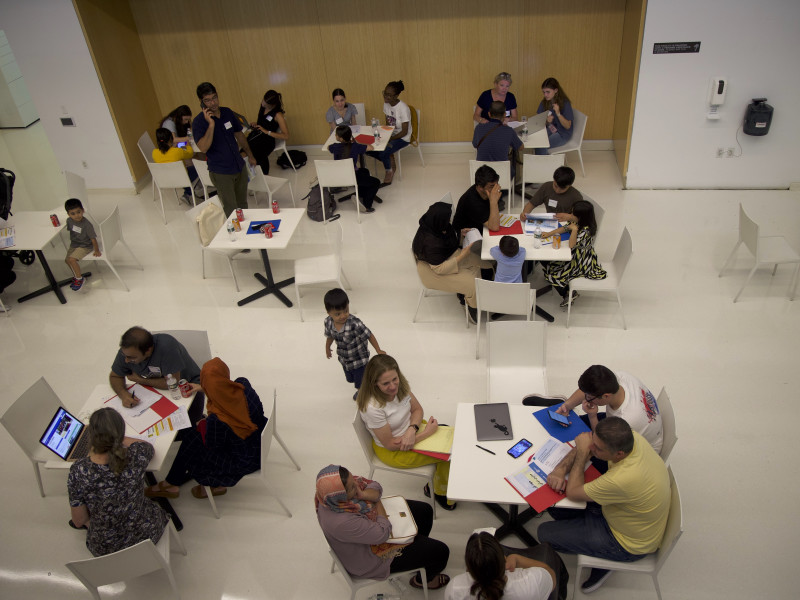
I tested a game aimed at getting kids to process more information —aka read the lengthy text— in an exhibit at the New York Hall of Science. The game used a narrative to motivate the players to collaboratively solve a problem, and let them know they could do this by utilizing the resources on hand.
This was a small project compared to those taken on by my colleagues and mentors at Teachers College who are developing digital games and studying their effectiveness by working with children in local schools. But it was eye-opening to see children, who felt that reading was too much work in other situations, run around the exhibit searching for answers to the problems we posed for them, and egging each other on.
Games naturally appeal to children but have been mostly relegated to spaces outside of school. Likewise, children have been teaching themselves to use digital tools because they are often forbidden to do so inside the classroom. They willingly devote their time to lengthy creative processes, such as the Quest to Learn student profiled in a September 15 New York Times Magazine article who makes YouTube videos when he is sick at home.
Quest to Learn opened a year ago with the goal of radically changing how we think about school as a learning space. Its curriculum is styled with game design principles—and students learn by playing and designing games— but teachers also rely heavily on familiar pedagogy such as project-based learning, problem-solving, and constant assessment.
It was founded on many of the principles advocated by researchers like Professor James Paul Gee, who has spent years studying the use of digital and media tools in the classroom. He writes: “As an educator, I realized that this was just the problem our schools face-- how do you get someone to learn something long, hard, and complex, and enjoy it?”
Gotham Gazette this week takes an in-depth look at one of the Chancellor Klein's newest initiatives, the Innovation Zone (iZone), a growing group of schools piloting technology-intensive instruction such as online classes and adaptive software. In launching the iZone, the chancellor recognized a pressing need to update the slow-changing American school system to reconnect with today’s students.
The U.S. Department of Education released a National Education Technology Plan earlier this year that suggests a need to explore new instructional methods. Several days ago, President Obama announced the launch of the National STEM Video Game Challenge to get game developers, both adults and children, to motivate interest in science, technology, engineering and math among young people.
As the Gotham Gazette article points out, iZone schools need to carefully evaluate how best to use technology to bring lessons to life. For example, plugging a traditional lecture into an online class can backfire; it can lose that element of engagement that exists in an offline exchange between teacher and student. Adaptive software that records an individual student’s progress on math problems and then reports back to the user appears to deliver differentiated instruction, but the activity might not be all that different from using a math workbook.
Consider, in contrast, software that requires students to learn and then teach material to a digital “agent,” who offers feedback on their teaching. This software was developed at Vanderbilt University, where research has shown that when students have to be more aware of their own understanding of the material in order to teach it, they master it better.
Researchers are examining the digital tools and toys kids love as a starting point. In the end, it's not about the technology. The tools and toys are not stand-ins for teachers, who are needed to help students process their experiences. The technology is, however, helping us to rethink education, and explore ways to encourage learning that we weren’t able to imagine before. The question we must come back to again and again is, what else can technology help us accomplish?
Is your child's school in the iZone? Are teachers effectively integrating technology into the classroom? What works well and what doesn't?
Share your thoughts below.
Long lines at supplementary round high school fair
While thousands of parents and students showed up at the supplementary round high school fair on Tuesday, many of the schools on the Department of Education list of available seats were not represented. We asked a few schools how many seats they actually have available. This is what they reported:
-The new, long-awaited Sunset Park High School has 25 seats left.
- The new, selective Cinema High School has only filled 15 out of their 80 seats. They will not hold another audition for applicants but will instead consider grades and test scores. The principal said they would look at applications with fresh eyes, so students who applied in the first round and didn't get a seat at Cinema can apply again.
- The acclaimed Dual Language and Asian Studies High School has only 10 unfilled seats.
- Manhattan Business Academy has 58 seats left.

Some families at the fair were hopeful that they would get a good match in the second round, others remained very angry. Several families protested the process outside, refusing to enter the building.
A family from the Bronx said their son has good grades, but his middle school counselor "isn't competent at all." They described the process as "disappointing. It's a public education- why all the rejection?"
Families have until Friday, April 3 to hand in new applications to their school's guidance counselor. Those unhappy with the match they get in this round may appeal.