Recent comments
Search News & Views
Our columnists
Blogger alums
Donate
Gail Robinson
Gail Robinson was editor in chief of Gotham Gazette for four years and covered education for the Gazette before that. A Brooklyn resident, she began her career as an education reporter in Westchester and has been executive editor of a foreign affairs magazine and political editor for a news feature service. Her two children graduated from New York City public schools.
Passions run high over charter school sitings
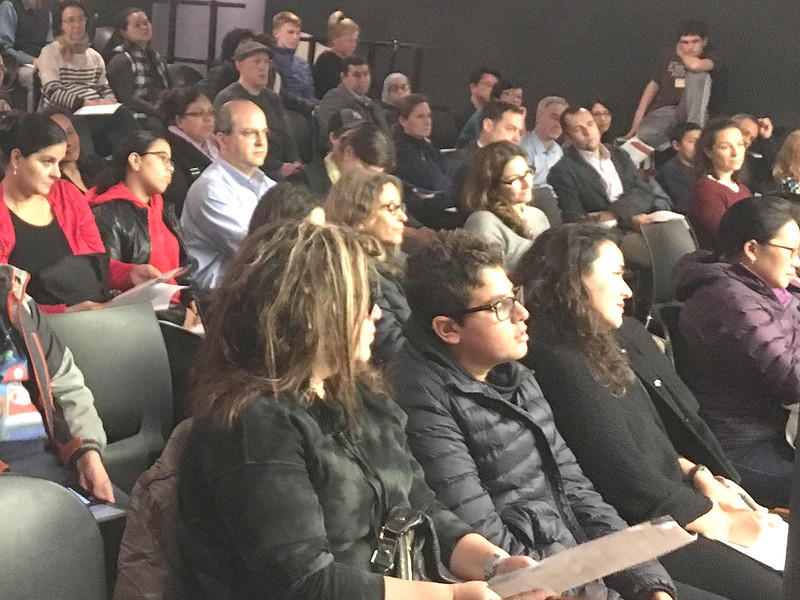
Barring any astounding development, on Dec. 20, the Panel on Educational Policy will vote to allow 13 new charter schools to open next fall in Department of Education buildings currently used by at least one other public school. While parents, students, educators and others sharply disagree on the merits of the individual schools, many concur that the process for deciding which charters go where is deeply flawed.
Already some mayoral candidates have opposed the procedure. And speakers at two hearings in north Brooklyn last week offered scathing attacks on how the DOE sites charter schools.
Under New York state law, charter schools do not get money for facilities, a major obstacle where space is scarce and expensive. The DOE has come to the rescue by providing charters with free space. In 2011-12, according to New York City Charter School Center, 58 percent of the city's charter schools were in DOE buildings. While the Education Department no longer has the power to authorize charters -- that responsibility lies with the state Board of Regents and SUNY – its Office of Portfolio Planning places the schools.
The hearing process is "a piece of theater that leaves us disappointed and even dehydrated," said District 14 parent Kate Yourke, "I don't know how we stop this because we have no power. The law in this state gives us no say."
New charters target wealthier areas
The fifth graders, dressed in white shirts and navy slacks or shirts, sit in neat rows as the teacher offers up some basic principles of division. "How can you divide 0 into 64 pieces?" she asks, before telling them to write a definition in their notebook–taking care to write neatly and use complete sentences.
Down the hall, an English teacher offers explicit directions to another group of children. "If you do not have your written material, wait and put your hand in the air," she says. "Every binder should be zipped and standing next to your desk."
This middle school, Brooklyn Ascend in Brownsville, goes beyond academic basics–students read Shakespeare and study art, Spanish and music. But it smacks of discipline and tradition. The school's founder, Steven Wilson, says such routines avoid wasted time.
"We have a tremendous amount of work to do here to overcome deficiencies" that the school's largely low-income, black students arrive at the school with, Wilson says. "Teachers leading very purposeful activities are the way to allow our students to catch up and make a middle-class life."
For almost a decade, schools such as Brooklyn Ascend have represented the face of charter schools in New York City. Overwhelmingly black and Hispanic, they stress academics and discipline in their efforts to push children in the city's most blighted neighborhoods to excel academically.
Now, though, charter schools in Brooklyn have entered a new phase. Led by Eva Moskowitz, whose Success Academy network is the city's largest and most controversial group of charters, operators have started to open charter schools in more diverse and affluent parts of the city, including Williamsburg, Cobble Hill and Fort Greene. To attract parents in these areas, some schools now stress diversity and a more progressive curriculum...

(Read the rest of this story, "Charters Target Middle Class Brooklyn" on City Limits.)
Vanishing students at Harlem Success?
Many uptown Manhattan parents hope that winning the lottery for a seat at Harlem Success Academy I will put their child on the path to academic achievement. But just because a child gets into Harlem Success does not mean he or she will complete 5th grade there. The school -- part of Eva Moskowitz's Success Academy network -- has a high attrition rate, leading critics to charge that the school may push out low achieving or difficult students.
Harlem Success denies that's the case, and says the attrition can be explained by children moving away--or even skipping a grade. Without better data from the state, it's impossible to say who is right. But one thing is certain: Harlem Success loses a lot of kids between kindergarten and 5th grade.
According to figures on the school's New York State Report Card, 83 students entered kindergarten in 2006-07, the school's first year of operation. When that class reached 4th grade in 2010-11, it had only 53 students -- a drop of 36 percent. Harlem Success also took in a 1st grade class with 73 students in 2006. When that group reached 5th grade, it too had shrunk appreciably -- by 36 percent.
The attrition accelerated as the classes advanced. The 2006-07 1st grade class, for example, did not shrink at all as it entered 2nd grade, but saw one sharp falloff between 2nd and 3rd and another between 4th and 5th.
So far, following classes have not shown a similar decline. The 2007-08 kindergarten started out with 123 students, increased to 127 the following year and then fell back to 117 by the time it reached 3rd grade in 2010-11.
The United Federation of Teachers charges that the school may weed out students before they take standardized tests at the end of 3rd grade. Citing Harlem Success's attrition during a panel discussion on charter schools sponsored by the New York City Bar Association, UFT vice president Leo Casey said, "All of the students who would have brought down the statistics are gone."
In a subsequent email, Casey wrote, "It may be significant that the bulk of the attrition at Harlem Success Academy 1 seems to have come in the tested grades."
Harlem Success boasts extremely high test scores and the network has made them a major selling point.
Asked about the attrition at Harlem Success, a spokeswoman denied the school pushes out students. "Success Academy Charter Schools does not counsel out students or encourage them to leave," she said in an email. Shifts in size, according to the school, come from students moving, skipping a grade or having to leave for other reasons, such as illness.
Not all charters see their classes shrink. Overall, the attrition rate at elementary charter schools is roughly equivalent to those at district schools, according to a recent report by the New York City Charter School Center. At Harlem Children's Zone Promise Academy, the attrition was virtually non-existent; in fact, some classes grew.
The three other Harlem Success schools also show little to no attrition so far. The state data, though, only goes through the 2010-2011 school year when none of those schools went beyond 3rd grade.
James Merriman, chief executive officer of the Charter School Center, said the data does not provide an adequate picture of what occurs at schools -- district or charter. The numbers simply compare the size of two classes; they do not indicate how many children in a school's 5th grade started there as kindergartners and how many enrolled somewhere along the way.
Merriman said he does not think many schools push out difficult students. "I'm not saying that pattern doesn't exist for a particular individual school. I'm not saying that it does," Merriman said. He added the state and city need to collect more data "so that if it does exist we can find it."
Rather than looking at the shrinking class size, Harlem Success points to the school stability rate. This measure, also on state report cards, is the percentage of students in a school's highest grade who were enrolled in the school during the previous year. Harlem Success has a 100 percent stability score, according to the state report card. Harlem Success officials say District 3, where the school is located, has an overall stability score of 87 percent.
While the number has some significance, a school could, in theory, guarantee itself a perfect score by not admitting any new students to its highest grade. The union says that is, in fact, what happens: Unlike conventional public schools, charters do not admit students to fill vacancies in higher grades.
Harlem Success also has a high suspension rate -- 15 percent in the 2009-10 school year. (The state report cards do not list expulsions.) Charter schools do not have to adhere to the city's discipline code, according to Merriman, as long as they have an approved code and provide due process to students accused of infractions.
At a City Council hearing earlier this spring, Councilmember Robert Jackson, chair of the education committee, and Councilmember Gale Brewer asked Deputy Chancellor Marc Sternberg about charters removing difficult students. "Charter schools have an obligation to serve all comers," Sternberg said. Those that failed to do so, he added, could see their charters revoked.