Recent comments
Search News & Views
Our columnists
Blogger alums
Donate
Clara Hemphill
Immigrants learn English by storytelling
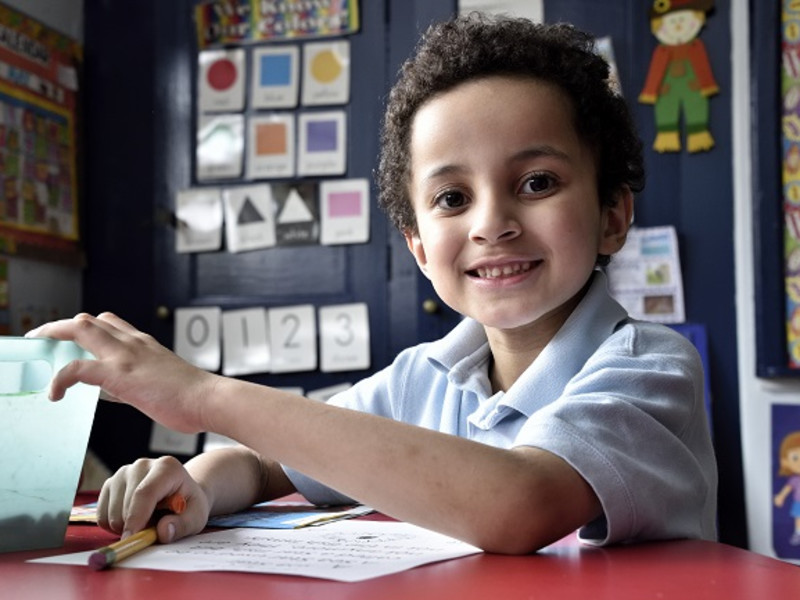
Half a dozen middle schools are experimenting with an unusual approach to teaching new immigrants English: Children write stories about their own lives and read them out loud in front of an audience. The exercises builds confidence and, in some cases, serves as a catharsis for children dealing with trauma, as an article by Peter McDermott in Feet in Two Worlds shows.
One boy described what it was like to walk across the border from Mexico. He shook as he told the story, but was greeted with thunderous applause when he finished. A girl described the sorrow of losing her mother. A girl wrote a poem about a troubled man in Pakistan.
The program is part of a federally-funded Story Studio for the Urban Arts Project. Some 365 students took part in the 2010-2011 school year at MS 131 in Manhattan; IS 62, IS 281 and IS 223 in Brooklyn; and IS 145 in Queens, and the program will continue this year.
Tell us what your school is really like
As the new school year begins, we are launching an all-new Insideschools website with dozens of new school reviews, slideshows and videos to help New York City parents navigate a complex school system.
Help us flesh out our school portraits by sending photos (as JPEG attachments) and videos (with links to YouTube) to This email address is being protected from spambots. You need JavaScript enabled to view it. , or post your comments directly on the school profile page. We need your help to continue to provide our multi-dimensional portraits of the city’s schools.
We believe that you can’t judge a school by its standardized test scores alone. We believe education should develop character, citizenship, good work habits and self-control—qualities that the tests don’t measure. A recent New York Times column suggests life skills like motivation, focus and resilience are far better predictors of long-term success than high grades.
To see whether schools are trying to build these skills, we sit in on classes, visit the lunchroom and playground, and interview teachers and parents. We snap photos to capture the culture and atmosphere of a school. We ask parents to share their experiences by posting their comments about schools. We care about test scores, but we also care about the heart and soul of a school.
Getting started
New York City has a complicated public school system that's not easy to navigate. It has some of the best schools in the country as well as some that struggle to provide even a basic education.
Some neighborhoods have excellent zoned schools, and all you need to do to enroll your child is to show up with proper documents. But if you are not satisfied with your neighborhood school, you may want to explore other options.
The city has an extensive system of school choice, and, depending on the age of your child and where you live, you may have have a number of alternatives. Insideschools is an independent website designed to help you get the best education for your child. See our pages on elementary schools, middle schools and high schools to explore the possibilities.
Getting started
Your child is entitled to attend kindergarten the year he or she turns five. (If your child has his birthday in late September, October, November or December, he may begin school in September when he is still four.) For information on how to enroll, see our page on New to NYC Schools or call the Department of Education at (718) 935-2009.
Your child will usually be assigned to a school according to your address. If your zoned neighborhood school is overcrowded, your child may be assigned to a school with more space. Call the parent coordinator at your neighborhood school to see if there is typically a waiting list for kindergarten.
Special education services and English as a Second Language are available in your neighborhood school. If you are unsatisfied with the school to which your child is assigned, you may want to consider other options.
Some public schools have pre-kindergarten classes for 4-year-olds. Pre-kindergarten classes tend to be concentrated in high-poverty areas.
New guide to special education
Does your child need special education services? A new, free 26-page step-by guide will help you get the help he or she needs to be successful in school. The guide, prepared for the advocacy group Autism Speaks, offers an overview of legal rights, gives tips on how to get an evaluation, and outlines what you need to know to put together an individualized education program or IEP for your child.
“The IEP process can be daunting, overwhelming and highly frustrating for parents," said Lisa Goring, vice president of family services at Autism Speaks. “We hope this guide will give families an
effective road map that prepares them to make informed decisions and advocate for their child as effectively as possible.”
Although the guide is produced by Autism Speaks, most of the information applies to all students that qualify for special education. respective of their diagnosis.The guide was prepared by attorneys at Goodwin Procter for the autism advocacy group.
Public and charter school options
Our Children, Our Choices: An Informative Discussion on Public and Charter School Options
This past weekend a panel of educators, administrators, education advocates and activists -- from both sides of the public versus charter school debate -- convened for a lively, engaging and informative discussion around public and charter school options for NYC students.
The panel, painstakingly assembled over the past six months by Community Board 12 in Manhattan, included Pedro Noguera, Ph.D. , Executive Director of New York University's Metropolitan Center for Urban Education; James Merriman, Esq. , CEO, New York City Charter Schools Center; Susan Miller Barker, Interim Executive Director, SUNY Charter Schools Institute; Julie Cavanaugh, Director, "The Inconvenient Truth about Waiting for Superman"; and Mona Davids, Executive Director, New York Charter Parents Association. (NYC Department of Education Chancellor Dennis Walcott had also been invited but was unable to attend.)
Mona Davids, a parent who initially embraced the idea of charters but later found herself disappointed by the poor performance of her child's school, provided some basic definitions: "Charter" is the name of the contract that spells out the terms of what the education organization will provide. If a parent wants to know the school's rules and regulations, these are spelled out in the by-laws of the organization. She urged charter school parents to become familiar with both documents. But then she asked, "How many parents have the time?"
Ms. Davids explained that the NYS Legislature passed a 2010 bill introducing some reforms to the original 1998 charter school law, but because of a procedural oversight the proposed reforms are not enforceable; a new amendment is needed to make the reforms real. At this point the one politician in attendance, NYS Assemblyman Guillermo Linares, stood and said - to applause from the audience of approximately sixty parents, teachers and advocates - "I promise to work with you to introduce that amendment."
Pedro Noguera reminded the audience that the original purpose of charter schools was "to promote change and innovation." He went on to cite what he sees as the three main obstacles to achieving this original vision:
First, there is no clear way to ensure that access to charter schools is equitable, and not limited to the families that are "the best organized, the most prepared." He noted that the charter school lottery was introduced to ensure broad access, but said that this approach is not sufficient because many of the neediest families are not even aware that the lottery exists, and because there is evidence that some charters have found ways to circumvent the system and are screening applicants.
Second, parent rights are unclear. As a result, parents who are unhappy with a school often simply leave.
Third, co-location of charters within district schools is controversial; there is often no agreement about how to share space, to ensure that resources are shared equitably.
In closing, Dr. Noguera said, "a market model where some win and some lose is not acceptable."
James Merriman, now CEO of the NYC Charter Schools Center but formerly executive director of the SUNY Charter Schools Institute, an authorizer of charter schools in NYS, said that "the charters are not interested in competing with the public schools. " He noted that many district schools have excellent relationships with their co-located charter schools, but said that we don't hear from these principals because they're afraid of angering the UFT.
Susan Miller Barker, currently interim executive director of SUNY's Charter Schools Institute, pointed out that if charter schools do not fulfill their contracts they can -- and will -- be closed. She spoke directly to NYC public school parents when she said, "I feel your frustration, it has been conveyed."
Julie Cavanaugh, a Brooklyn school teacher who directed a recently-released rebuttal to last year's popular "Waiting for Superman" film, provided some surprising statistics explaining how charters are able to demonstrate superior outcomes by -- among other tactics -- enrolling far fewer special needs students and far fewer English language learners than NYC public schools.
In the end she noted that charters are supposed to provide choice, and asked, "but choice for whom?"
Introducing: Insideschools reviews with slideshows
We’ve been taking a camera on our school visits. Take a look at our latest reviews, and tell us what you think of our new slideshows.
In Manhattan, see PS 183, PS 19, PS 33, Manhattan New School, PS 267, PS 158, PS 198, Midtown West, Harlem Success Academy 3, PS 375, The Equity Project Charter School, University Neighborhood Middle School, and DREAM Charter.
(We also have posted new reviews of PS 116, Future Leaders Institute, and PS 242--with pictures still to come.)
In the Bronx, see Girls Prep, Soundview Academy for Culture & Scholarship, Equality Charter
In Brooklyn, see MS 381, Ethical Community Charter School, Fahari Charter, and Coney Island Charter.
In Queens, posted reviews of East-West School of International Studies and VOICE Charter School (pictures still to come.)
In Staten Island, see Lavelle Charter.
We'd like your opinion: Do the photos add to your understanding of the school? If we have a limited budget, should we concentrate more on the written school reviews, or the pictures?
Report: City forced out thousands of students at closing schools
When the city decides to close a low-performing high school, it is usually phased out over a period of four years. That mean no new students are admitted, but the students who are there are supposed to be able to stay until they graduate. Now, a student advocacy group charges that the city has forced out thousands of students who were left at closing schools.
“The problems that produce poor performance are often exacerbated when closure is announced,” according to the report, No Closer to College, published by the Urban Youth Collaborative. “School spirit and morale plummet, staff scramble for jobs at other schools, enrichment and afterschool programs move elsewhere, and schools become physically marginalized in their own buildings.”
According to the report, of the 33,000 students in the 21 New York City high schools that have been closed since since 2000:
- 5,612 dropped out
- 9,668 were discharged from the school system
- 8,089 were still enrolled when their schools closed, and there is no data showing what happened to them
- Only 9,592 actually graduated.
The report quotes Shael Polakow-Suransky, the chief academic officer of the Department of Education, as saying “there’s not been a consistent set of supports for the schools that are phasing out,” adding that the city has an obligation to “create opportunities” students who want to stay and graduate.
The report calls on the city to invest in struggling schools rather than closing them.
Dennis Walcott: A City Hall insider who has credibility with parents
There aren’t a lot of people who can step into the job of running the country’s largest school system on a moment’s notice and, under the circumstances, Dennis Walcott is probably the best we can hope for. Deputy mayor for education for nine years, Walcott is knowledgeable about budgets, union contracts, and the major reforms to the school system over the past decade. As a public school graduate, parent, and now grandparent he has far more credibility than Cathie Black, who stepped down as schools chancellor Thursday after a disastrous 3-1/2-month tenure. Although Walcott lacks the supervisory license needed to become chancellor, its seems likely that State Education Commissioner David Stein will grant him the necessary waiver.
It was clear from the start that Mayor Michael Bloomberg made a misstep when he appointed Black—a publishing executive with no experience in education who quickly became an embarrassment to his administration. Black offended parents by joking that overcrowding in schools could be relieved if they only practiced birth control. She bewildered one principal when she suggested children bring their pets to school. She was so out of touch with the geography of the city that she confused Bayside, Queens, with Bay Ridge, Brooklyn. As senior administrators at the Department of Education headquarters at the former Tweed headed for the exits, a Marist-NY 1 opinion poll placed her approval ratings at just 17 percent. At a news conference announcing her departure, Bloomberg said “The story had become her and it should be about the students.”
Walcott is expected to continue Bloomberg’s agenda—closing schools for poor performance, forcing ordinary public schools to share space with charter schools and judging schools, teachers and students almost exclusively by standardized test results. That agenda has alienated many parents. At the same time, Walcott has visited hundreds of schools and attended countless community meetings, giving him a reputation as a senior official who will at least listen to parents—even if he doesn’t always follow up with actions.
Most important, Walcott may be able to stem the hemorrhaging of senior staff at Tweed and focus on the important work of negotiating with Albany over the shrinking education budget and with the teachers’ union over threatened layoffs.
“The wheels have fallen off over there,” one United Federation of Teachers insider said of the DOE. “Walcott will at least get the wheels back on.”
Charter school applications due April 1; see our new reviews
We have been visiting charter schools this spring and have posted 20 new profiles, just in time for the April 1 application deadline. In addition, we have posted nine previews of charter schools that are scheduled to open in the fall. You may apply directly to each school; some schools also accept a common application on The New York Charter School Center website. Children are admitted by lotteries held in April, if there are more applicants than spaces available.
Charter schools are a mixed bag: some are orderly, cheerful places that offer children exciting new opportunities, while others struggle with basics like discipline. Some are better than ordinary neighborhood public schools, while others are no better -- or even worse. Many have a longer-than-average school day and have classes over the summer.
See links to our latest profiles and previews.
MANHATTAN
The Equity Charter Project School, a middle school in Washington Heights, has attracted a lot of press because it pays teachers $125,000 a year.
Harlem Success Academy 3, an East Harlem elementary school, is part of former City Councilwoman Eva Moskowitz's network of charter schools--and the one where she sends her own children. (We have a brief preview of plans for Upper West Success, in the same network, to open on the Upper West Side, and Brooklyn Success, to open in Williamsburg.)
DREAM Charter School, an East Harlem elementary school, combines a family-friendly atmosphere with firm discipline and challenging academics. St. HOPE Leadership Academy Charter School is a middle school in central Harlem that focuses on personal attention and tough love.
We also have previews of two other charter schools scheduled to open in the fall:
The former principal of Hunter College High School is opening a middle school called Innovate Manhattan in the Department of Education Headquarters downtown.
Broome Street Academy, a high school affiliated with The Door, will target homeless and disadvantaged teens.
BRONX
Bronx Success 1 and Bronx Success 2 are part of Eva Moskowitz' growing network of elementary schools.
Girls Preparatory Charter School Bronx, modeled after a school of the same name on the Lower East Side, is an all-girls school offering music, dance, arts, and yoga.
Many charter schools operate under the premise that teachers’ unions are a barrier to good education. But Green Dot New York Charter High School is out to prove that well-paid, unionized teachers, when treated like professionals and protected from capricious firings, are fundamental to students’ success.
Equality Charter School in Co-Op city had uneven discipline the day we visited; the principal was fired a few weeks after our visit.
We also have preview of schools scheduled to open in the fall.
A Montessori School will serve kids learning to speak English (but no site has been found for it yet.) No site has been found for Heketi, another school that's due to open in District 9 and that is targeting children who don't speak English at home.
Icahn 5 will join other schools in the network in a renovated building in District 11.
New Visions for Public Schools, a nonprofit which has long worked with public schools, is opening two charter high schools in the JFK building, each with a different focus: New Visions Charter School for Advanced Math and Science and New Vision Charter School for Humanities. Note that application deadline for these schools is April 8. (Eighth-graders may apply online).
BROOKLYN
Achievement First Brownville is a highly structured school with strict discipline. Explore Charter School and Explore Empower Charter School are part of a growing network of back-to basics schools.
At PAVE Academy School, an elementary school in Red Hook, a highly structured day keeps the kids busy and engaged. Children learn Spanish as well as English at La Cima Charter School, an elementary school in Bedford Stuyvesant. It has a no-nonsense atmosphere but also some time for play.
Ethical Community Charter School in Bedford Stuyvesant draws on the philosophy of the private Ethical Culture Fieldston School. It uses progressive teaching techniques and focuses on building character while encouraging children to ask questions and become thoughtful citizens.
Children are respectful and engaged at Coney Island Preparatory Charter School, an elementary school where students move through the halls in silent, single-file lines.
Teachers at Fahari Charter, a middle school in Flatbush, are still working on developing techniques to control their classes.
Brooklyn Ascend Charter and Brownsville Ascend Charter are nearly identical elementary schools that share a new building in Brownsville. They are highly structured no-excuses schools with a long school day.
A Brooklyn native will open Invictus Preparatory Charter School, (no address yet), a 6-12 school which promises to offer a strict code of conduct, a longer school day and year, and an unflinching commitment to turning out college-bound students.
QUEENS
Growing up Green, an elementary school in Long Island City, welcomes parent involvement and lets children be children.
STATEN ISLAND
Some charter schools have been criticized for failing to serve children with special needs. But Lavelle Charter School, a middle school which will grow to include high school grades, has worked hard to integrate children with a range of disabilities into regular classes.