Recent comments

Search News & Views

Take our poll

Should teachers make more money?

Allison Gaines Pell

Allison Gaines Pell

is the founding principal of the Urban Assembly Academy of Arts & Letters and a public school parent. Read Allison's posts in Principal's Perspective.

Every year,  our 8th graders take a two-part science test that may soon become high-stakes, can you explain or link here? and we are charged with grading it. This year, as our science team endeavored to grade the test, we began to talk about what the test itself was measuring.

In one part of the “performance” part of the test, students are ask to write observable questions about five plastic insects. One student wrote “Which insects live in the dirt and why?” and another wrote “Which insects have wings?” For the sake of the test, the latter was correct; the test was asking for observable questions. But in the end, shouldn’t we be more interested in teaching students to identify and ask high level thinking questions, such as the first? (The answer was incorrect because the answer is not observable.)

At Arts & Letters, we try to teach our young scientists-in-training to come up with “researchable questions” all the time, and celebrate them for their curiosity. The field of science, after all, is a pursuit of big questions about our world. How do we prepare them to be scientists if we are asking simply for compliance?

As our city shifts towards a college-readiness is there a news link here? approach to teaching and learning, I hope that our assessments will bring us closer to measuring how much our children are asked to THINK, rather than how they are able to comply, which has been too much of the focus of the standardized tests we have in place now. While we can teach our students to comply, our job at school should be to teach them to prepare for the unknown, to give them, as Howard Gardner says, a long “rehearsal for the kind of person, worker, and citizen they are going to be.” All students have this natural curiosity and ability to think at high levels —we need assessments that will affirm our teaching in this way.

Can you make any comparisons or references to the "high stakes" standardized math and ELA tests, given the fact that so many students are being recommended for summer school and it is timely? Any way that this kind of "thinking" could make its way into the standardized tests? (Isn't the state looking at how to redo them or make them more relevant ?)


At around 11 am on the day of the BIG ANNOUNCEMENT, I was sitting in my office writing feedback about a lesson I had just observed when my husband (an architect, not even an educator!) called and told me that Chancellor Black had resigned. Moments later, a teacher texted me asking if it was true. I confirmed the news online, walked to our main office where a few people were talking about it, and then returned to the work at hand. And it was 11:05. This story is thoroughly unremarkable except for what it reveals, which is that the high-drama upheavals and changes at Tweed have very little impact on the daily life of a school.

Over the Klein years, principals were given an incredible amount of autonomy in exchange for accountability. My faculty and I have grown a school in that context and, overall, meet the demands of the DOE in such as way that we are allowed to continue to do the work we care most about. As Howard Gardner said at a Project Zero conference I attended last weekend, "school is a rehearsal for the kind of person, worker, or citizen you are going to be." This work is much more difficult, and more interesting,  than navigating the new initiatives of the Department of Education, despite the sometimes major (and even positive) impact that those policies have on our practices.

I do relate, however, to the principal quoted in the New York Times, who spoke about the isolation of individual schools in our system. Wouldn't it be wonderful if we could have a Chancellor or a national education administration who initiated a steady but rigorous focus on school as a rehearsal for citizenship, and good personhood, in addition to well-rounded pursuits of knowledge? I fear we are all too far gone from this focus to see this as anything but idealism, and I fear too that our concentration on churning out "21st century workers" is a response based on fear rather than an appeal to the "higher selves" we aspire to be as part of our nation's stated goals.

In late January, our teachers were required to verify the data WHAT KIND OF DATA -TEST SCORES ONLY OR SOMETHING ELSE? for their students in preparation to receive their Teacher Data Reports. They had to review four years of student data from our school and wherever else they taught, and ensure that every student was properly entered into the DOE's systems. They did this so that when theirSTUDENTS? testing data is analyzed, it is analyzed with the right set of data; this is important because these reports reduce teachers to "below average," average," and "above average." In the midst of a national conversation about how to determine whether teachers keep their jobs, this data verification has become extremely important. The testing data could make the difference between having a job and... not.
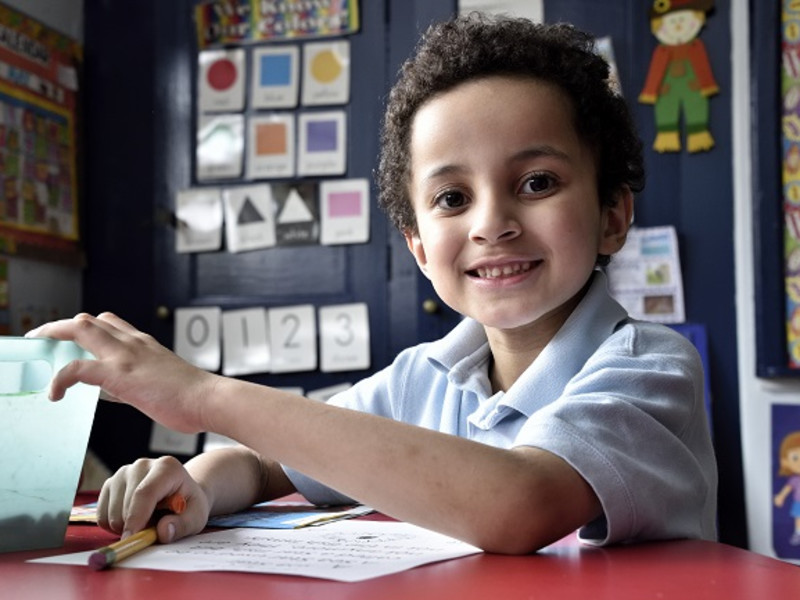
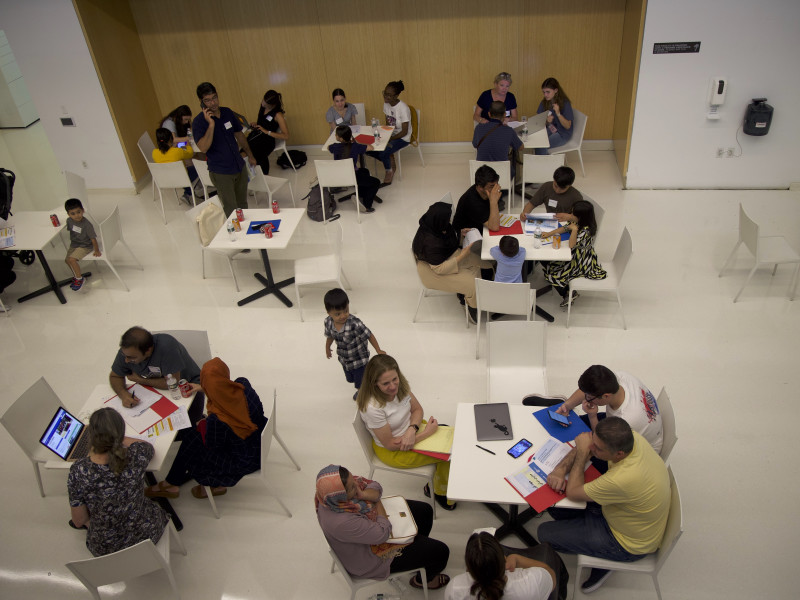
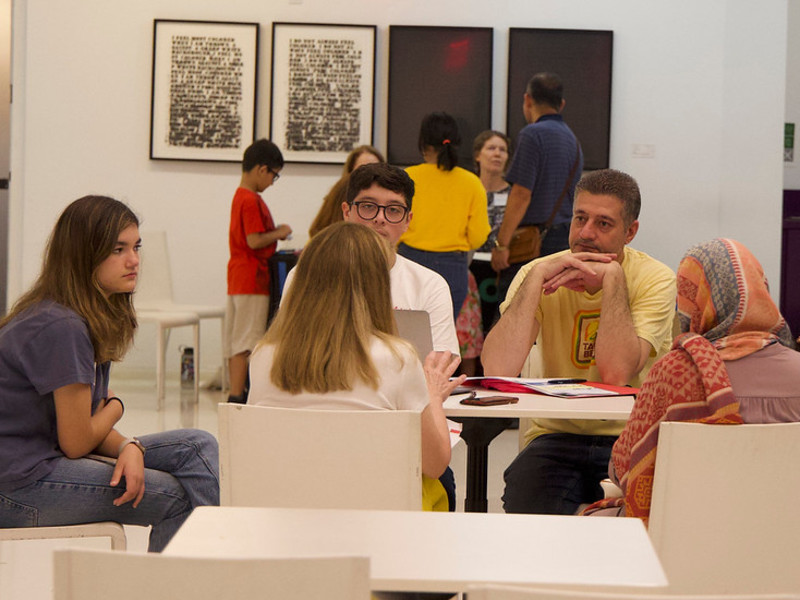
Just one week after this "verification window," at our biannual Roundtables, our students sat (three to a table) with an educator and other community members, including parents, to describe and answer questions about the work they completed over the semester. In some cases, students reenacted dissections or labs, solved multi-step equations, or described a particular academic challenge they faced.

At Roundtables, teachers were looking not only at the students, but also their colleagues' work. They considered questions such as: What techniques did this teacher use to get such high quality writing from this child? Where did this student lose his or her way? Where did the teacher step in (or not)? How do I help this struggling learner get through the presentation? How can I use the scientific method to the support of claims in a thesis-driven essay for my own students?

As conversations rage on about whether teachers ratings should be made public, and whether teachers should be granted tenure based on student test scores, I wonder how many people are getting glimpses of teachers having these conversations about their work with one another? These conversations take place in structured public ways such as our Roundtables, and in more informal planning meetings, and in other professional learning groups. I wonder if they have considered how much more helpful it is to watch oneself on a video teaching a new concept (to see where there is a gap, or where there should have been a question, for example) than it is to see a graph and a summation like "average" or "above average" on a piece of paper. I know that for us, the most powerful form of teacher accountability is looking at the work students are doing, or not doing.

I know the people working centrally on the Teacher Data Reports want to increase the effectiveness and professionalism of teachers, and want to learn how to pair a standard measure with more qualitative measures. They are charged with the difficult task of measuring and moving a system. There is great urgency to figure out how we can pair these measures, because these harder-to-measure attributes constitute the difference between an excellent, professional, curious, life-changing teacher, and a mediocre one.

At Arts & Letters, we've been asking a lot of questions about bullying. The subject came up last winter when we launched our first "Say the Right Thing" campaign to combat name-calling. We created credos and posters for our classroom doors,  spoke about how language can be hurtful, and about how students can support one another, as well as build each other up,  in our advisory classes. We spent a day outside doing "guerrilla" sidewalk chalk projects to send positive messages into our community.

This year, we are delving deeper into the subject. Our School Leadership Team read a book called Bully, Bullied and Bystander by Barbara Coloroso. Her argument is that students -- and all of us -- take a turn at all of these roles at some time or another. Take a moment to consider: When were you bullied? When were you a bully? And when did you just stand by and let something happen? This is primarily considered adolescent behavior, but it happens among adults all the time.

To help build self-awareness and compassion for others, we've begun a schoolwide conversation about how we all play these roles at different times. Now we are working on documenting our parents and community members' experiences with having been bullied or with being a bully, and we will be putting them together in a short video to show our students that being a bully or a bystander is a choice we all have to confront. These clips will go alongside our experiences becoming "upstanders" as well.

It is scary to truly talk about bullying for a school, since it is akin to fastening a scarlet letter to your sweater: "oh, there is bullying at that school." But any school teacher, parent, or principal who tells you that it doesn't happen at their school is either hiding something or is not close enough to the students to see their interactions. Or maybe the students don't trust the adults enough to share.

Considering and even trying out all four roles (bully, bystander, bullied, and upstander) is part of growing up. We believe that it is one of our responsibilities to help our students reflect on which roles they choose to play. Whether it is Respect for All week or any other week of the year, being public about these difficult conversations is hard, but like anything else, awareness and openness is the first step.

We are in an historic moment in New York City public education. The state budget looks to be taking a 9% bit out of state aid, and we are now looking at lay offs, and historic cuts. State education officials say that we should not simply "throw money" at schools "that don't work."

This is indeed a big dilemma and I am humbled by the dilemmas facing those charged with keeping our state running. It would. But, I do want to question this notion that more money wouldn't help. For a long time, I have taken the stance that we have a certain pot of money, and the parameters for that money are set. But, more recently, I've been learning more about the per pupil expenditures in neighboring towns and cities, and I have to say that it doesn't at all seem fair. If I had more money, I could hire two extra learning specialists (in ELA and math) who could further address the difficulties of those students with special needs or other lagging skills; more math teachers so that our math classes could be even smaller to attend to the variety of challenges that math learning presents in middle schools. I could spend money ensuring that we have enough computers for every child to use at any time. These are not extras.

In essence, we public educators have become accustomed to a state of never-enough in our schools, and so everyone else has decided that somehow we should make more with less. But sometimes less is just less. Consider what you want for your child; consider the services and learning experiences your child should have to become a well-rounded, flexible learner and community member.

Don't get me wrong. We have wrestled the value from every single dollar we have. And our school has been and will continue to be great. But the one-two punch of a 9% cut and the possibility of laying off some of the most talented, open, and hungry young teachers, is simply unacceptable.

Tuesday, 11 January 2011 01:13

I am pleased to announce that we have been approved to expand into a K-8 school.

In an era of accountability,  where the news is about testing, budgets, and the very concrete aspects of public education, it is easy to forget that schools are supposed to be places that fulfill the hopes and dreams of a community for its children, that foster rigorous intellectual growth for educators and children alike, and that build compassionate communities through which children learn to interact with and learn from all different types of people. In this context, and with even more budget cuts coming, and even more demands placed on the role of public schools in our society, we are beginning the long and thrilling process of building a nine year sequence for the vibrant and diverse neighborhood of Brooklyn that we serve.

In my last post about diversity, many people asked about admissions, and how to cultivate diversity. I have just finished reading Jonathan Kozol’s Shame of the Nation (given to me by our PA president!), and in it, he describes beautifully the reason for an integrated school: "when [children from different backgrounds] go to school together [as children], [they] play games with one another and share secrets with each other and grow bonded to each other by those thousands of small pieces of perplexity and fantasy and sorrow and frivolity of which a child's daily life is actually made."

This is what we want to create, and without concrete admissions policies from the DOE to help us ensure diversity, we will do this through extensive recruiting throughout District 13. There are no two ways about it: seeking diversity in a new, unzoned, "lottery" school requires vastly more work. At the end of this week, we will have called and sent information to over 200 local preschools, day cares, Head Starts and community centers, and we are setting up information sessions at some of them, and at our school in the mornings and the evenings. We have emailed and faxed our application as widely as possible, and we will be asking each of our 300 middle school students to think about nephews and nieces, cousins and siblings who might be interested. We will post it on lamposts, list servs, in churches and in doorways. We hope that we have cast as wide a net as possible so that we can make sure that our children have the chance to learn from many. On this front, we are lucky to be an unzoned, district wide school, because this allows us to gather the diversity that a zoned school, which is dependent on neighborhood diversity, cannot.

With MLK Day looming this weekend, we have our annual reminder of how far we have to go and we see our recruitment efforts for diversity as one step towards realizing a "more perfect union" in District 13.

In December, Arts & Letters won approval to expand our middle school downward to include elementary grades, eventually becoming a K-8 school.  And now, happily, we are engaged in the important and exciting work of recruiting children, families, and teachers to build a vibrant, meaningful educational institution in Brooklyn. (See our website for information on upcoming information sessions and how to apply.)

In my last post, Getting diversity on the agenda, many commenters wrote about the controversy surrounding our proposal and their fear that creating a school of "choice" in the district could create separate and unequal systems. I want to address some of those concerns

We are committed to creating a diverse school in District 13 which is, according to this New York Times Interactive map of the census, one of the most diverse neighborhoods in the city. We have a recruiting plan in place that we believe will capture the district's diversity by casting a very wide net, even with the random selection process required by the Department of Education. We are making hundreds of phone calls, walking, emailing, and faxing flyers all around the district, and enlisting our middle school students to alert their cousins, nieces, and younger siblings about this new option.

Some  question whether "choice" schools are good for the school system, arguing that they can drain the neighborhood schools of the most active families.  As a parent, I believe choice is a good thing. For my own child, I considered distance from home, the social-emotional environment, the teaching philosophy, and size. I wanted to be able to see what types of educational experiences my children would have and to choose the one that best fits us.  For my family, some factors were more important than others. This is true for every family.

As an educator, I also believe choice is a good thing for New York City. Healthy competition can bring everyone along together (it has certainly pushed our middle school to be better as we've had to compete for students), and families should have the right to look around and decide what type of environment will best fit their child's personality, learning needs, and family.

There will always be dissenting opinions, and this is the great opportunity of diversity. The conversation about choice is important, and we are looking forward to continuing the dialogue as our school grows.

Thursday, 18 November 2010 06:43

Principal's Perspective: Dear Ms. Black

STILL WORKING ON THIS

Dear Ms. Black,

Let's assume that you are appointed as our next Chancellor. Here is my advice for you:

1) Spend your first few weeks in schools, talking with teachers, students, parents and school leaders. Ask them questions about their successes and their greatest challenges.  Ask them what gets in the way of having and implementing a vision of education (not just proficiency) for our young people. Education is complex, much more so than a business, because our core work is 1.1 million lives. Most of our rules have a myriad exceptions, there are few reliable measures for success that work every time.

2) Gather a group of teachers and principals to help guide your decision making. Not a fake advisory group, but people that you call, whose advice you trust, who will help you with the gut check you need on key issues. The educators in Tweed can help you identify those people, but pick a few outliers too, people you meet on your way. Surround yourself with educators who understand children and schools. Invite dissenting opinions. Choose 20 students who represent a cross section of the city, and run your thinking past them as well.

3) Figure out your passion in this work and win us over. Chancellor Klein came from outside education, but quickly won me over because he seemed to be passionate about this work in a very personal way. Your visits will help you find this voice if you haven't already.

We really need you to do a good job. We have too much at stake right now to flounder.

Every morning we have a moment of solitude and reflection in our school. We try to get so still and quiet that we can hear the hum of the lights, or the rain outside the windows. And we do. During these moments of silence, I have the pleasure of looking at the faces of 300 young adolescents. I like to admire how different each of them is from another, and my wish is that they will be true to themselves, but that they will also learn from their differences.

Diversity-- of all kinds-- is one of our school’s most essential values; it is also, in my opinion, the promise of American public education and a requirement for a vibrant democracy.  Consider Jack Treynor's 1987 jelly-bean experiment and related paper: Ask a group of individuals how many jelly beans are in the jar, and the average of their guesses will always come pretty close to the right number—but only if the group is diverse. If there is too much similarity or group-think, the group’s answer will be wrong. If we want the crowd to be wise, in other words, if we want American society to get it right, we need to take concrete actions to promote diversity, not just talk about it.

I see our urban public middle school as a battleground for democracy, and I have spent much of the past five years working hard to recruit for integration. But this commitment to diversity can be difficult because it requires a community to embrace difference. While everyone wants “the best” for their own child, many of “the best” schools do not have diversity among their top priorities. And yet, in my opinion, it is only multicultural integration that will move society forward, with every individual learning from the experiences, assumptions, and life experiences of those around them. 

Studies of schools and school districts that have integrated based on socio-economic status have shown that this can be a critical factor for success (see Richard Kahlenberg’s book on this topic, All Together Now, and his proposal to use Mark Zuckerberg’s money to integrate Newark’s schools). Jonathan Kozol, renowned author and speaker, argues passionately for school integration  in his article in Educational Leadership, "No Half Steps, No Equivocation."

Comprehensive integration has to be on the national reform agenda. But the prospect of fulfilling democracy’s promise seems bleak. Instead of a vision and an action plan to integrate schools, we see increased investment in schools that serve specific populations -- privileged and/or “gifted,” English language learners, or children who live in poverty. More than half a century after Brown v. Board of Education, the divisions between rich and poor, black, brown, and white are deep and abiding; and our schools are still divided between haves and have-nots (even Arne Duncan speaks to this). What would have to change in order to realize the vision of democracy in our schools? What would we have to give up? Are we willing?

Diversity is messy, requiring continual mediation and intervention, and many other kinds of school structures and intentional activities. In our school’s advisory classes each student must greet everyone by name, as they look each other in the eye.  They sit in a circle so everyone can be seen. Advisors change students' seats frequently so that students interact with others they know least well. And still, some students have difficulty understanding each other. (Isn't this true for adults as well?)

If we are going to engage in a conversation about education reform in our country, we must  do more than just talk about those “other schools”-- charter, lottery, zoned, district, public -- and those “other children” and “other teachers.” They are us; those schools are our schools. In addition to a vision for educational success in this nation, we need policies for education that call on our higher selves and push us to pursue a “more perfect union” and a vibrant democracy.

A footnote: We are embarking on an exciting new chapter at Arts & Letters to expand into a K-8 program. That has put us in the middle of a conversation about schools and diversity in our neighborhood in Brooklyn, and this topic is very much on our minds. We aspire to become a model of all that an integrated school pushing towards tolerance and understanding in a community can be.

I am in the very happy position to say that at Arts & Letters, we are at the beginning of an exciting new chapter. We are moving forward to propose an elementary, district, public school, as an expansion of our already successful middle grades school that we have spent the past five years building.

Recently, I was working on our proposal, and watching clips of NBC’s Education Nation on another computer. As I watched, and worked on our own vision statement, a question surfaced: do we have a national vision in mind when we talk in such urgent terms about education? Is “no child left behind” a vision for America’s future? Is “all children at proficiency” something that parents can buy in to? If educators and families are responsible for raising the people who will care for us when we are old, invent new technologies, clean up our oceans, parent the next generation, write new and beautiful novels, find the cures, and fly our airplanes, then I think we should have some ideas that extend beyond proficiency.

It made me curious to hear some more of your voices. What is your own vision for your child's education? And, what do you believe the national vision for education should be?
Page 1 of 3