October 29, 2009

Student Voice: Fighting the bake sale ban

Written by Toni @ 10:43 am

Please join students from around the city to protest the new regulation on bake sales on Friday, Nov. 13 from 2-6 p.m. in front of City Hall. The protest is being organized by seniors from LaGuardia High School, and we invite anyone and everyone to come.

Department of Education regulation A-812 states that only approved foods can be sold in schools until 6 p.m., and no outside food can be sold during mealtimes. The regulation is so restrictive it is commonly referred to as a ban on bake sales. As Jennifer Medina said in a recent New York Times article, “There will be no cupcakes. No chocolate cake and no carrot cake. According to According to New York City’s latest regulations, not even zucchini bread makes the cut.” (more…)

August 10, 2009

“Penneys” add up for after school

Written by Insideschools staff @ 4:55 pm

Just when financially-strapped parents increasingly rely on free after school care for their children,  many programs have  become a casualty of school budget cuts. A venerable  department store, new to Manhattan, has stepped into the breach to help provide funding for families in need of after school programs.

If you shop at the new JCPenney store at the Manhattan Mall in Herald Square between now and Aug. 16,  you’ll be invited to “round up” the total cost of your purchase to the next dollar, with the proceeds going to support local after school programs.   All donations collected at the store will go to the Children’s Aid Society of New York, which will also receive a $5,000 grant from the JCPenney Afterschool Fund to help the charity provide children in need with access to its after school programs. (more…)

April 7, 2009

Ask the College Counselor: Are expensive extra-curriculars worth it?

Written by Jane @ 11:21 am

Q:  My daughter was honored by being nominated to be a National Youth Leader.  Participating in the program is very expensive.  I would hate not to let her attend because I believe it can open doors that would really benefit her. I want the best for her, but I really can’t afford it.  Am I expecting too much from the program, such as future scholarship opportunities if this program is listed on her resume?  Or should I wait and invest that money in college?

A:  You are a kind and wise parent!  Both of your instincts are right on target!  You want the best for your daughter, including helping her to enhance her experience and her college-admission profile.  At the same time you are correctly wondering if a high-priced program is really going to provide a high-level benefit.

This is not to minimize the fact that someone obviously thought highly enough of your daughter to submit her name to the program’s organizers, who write to high school principals and guidance offices asking for nominations of top students.  So someone at your daughter’s school — an administrator, counselor, or teacher — felt that she would be an excellent candidate.  The qualities that inspired someone to nominate her may be those qualities that will also make her a great college applicant.  But the success of her college applications will not depend upon her possible participation in this particular program.

Programs such as the National Youth Leadership Forum and the Congressional Youth Leadership Council can also procure lists of names from the College Board;  if a student checks, for instance, interests in law or medicine on the SAT registration form, programs dealing with law and medicine can ask for targeted lists.  Also, students who have participated in the programs are asked to suggest the names of others they think would enjoy the experience.

Every spring students have come to me with ‘nomination’ letters they have received, along with glossy folders and colorful brochures.  The programs often have the words ‘National’ or ‘Leadership’ in them (and have logos using symbols such as the Capitol dome or am American eagle), and they feel flattered.  The opportunities outlined in the mailings — traveling to the nation’s capital, networking with officials from government agencies, meeting students from all over the country — are exciting.  But what’s the difference between an “honor” and an “opportunity”?  An honor should not have a price tag attached to it.  An opportunity might or might not have a price tag.  Unfortunately, the college-admissions frenzy that has developed over the last 20 years has also spawned a huge ‘opportunities’ industry.  While there are many worthy, stimulating programs out there, for the most part they are money-making enterprises.

(more…)

 Have a question for Jane?  Search archives | Contact the College Counselor

March 19, 2009

NY2NO: Solidarity, not charity

Written by Toni @ 7:57 am

Over February break I was down in New Orleans with a group called the New York to New Orleans Coalition. As a student activist and a true believer in the strength of youth, it was the most inspiring experience of my life.

A little background on the organization: after Hurricane Katrina, Beacon High School brought group of students to New Orleans to work on reconstruction. After a year or so, Beacon stopped organizing these trips, but a few kids knew there was still work to do. So they started their own non-profit and began taking kids down themselves on every school vacation and every week of the summer. More than 100 students applied to go on their trip next month. Half had to be turned away because they could not be accommodated.

NY2NO is a completely student-led organization, started by kids who are now seniors at Beacon. Their vision is “to create a network of young people who are interested in organizing and mobilizing across New York City. NY2NO works in solidarity with those most affected by the social, racial, and economic inequalities in both New York and New Orleans. Through this, the youth breaks down barriers and works together to combat racism and classism and move towards an egalitarian society.” Despite the idealistic connotation of the word “egalitarian,” the organizers of NY2NO are practical, forward-thinking, active, thoughtful, and above all passionate.

NY2NO’s work in New Orleans is unique in a couple of ways. They go to rebuild, and to be part of a larger movement against racism. The week begins with a levee tour, where I learned that the levees of the Lower Ninth Ward are like ant hills compared to those of the French Quarter. The rest of the week is spent doing work in the Lower Ninth Ward, which still bears wounds from the storm. Mornings are spent on physical work, like gutting houses (yes, three years later, houses still need gutting) and working on community gardens (there is one supermarket, which is more of a deli, in the whole Lower Ninth). Afternoons are spent going door-to-door asking people about what they need, what their community needs, and just generally talking to the residents. Many people find themselves in two-hour conversations that end in tears on both sides.

Forget New Orleans’ stereotyped reputation: NY2NO trips are not about a bunch of teenagers hitting up the music and clubs on Bourbon St. My group spent every night talking about the best ways to combat racism, the idea of “solidarity not charity,” the emotions that were coming up from the day’s work, and the dynamics of our group as a reflection of society. We talked about how NY2NO could be more effective as an organization, how the environmental and education problems of New Orleans were present in New York City, and a million more things. Our trip quote was “If you have come to help me then you are wasting your time. But if you have come because your liberation is tied up with mine, then let us work together.” We kept this idea at the heart of all the work we did and conversations we had. After the occasional tears and frustration, I always felt a renewed faith in my generation, as did everyone else I talked to.

The trip brings out the best in everyone: We built real friendships, relationships that challenged our intellects and made us consider how de facto segregation is enforced in our society. A month later, I’m still getting a new Facebook message every few minutes from someone on the trip. NY2NO was a life-changing and unforgettable experience. If any readers are in high school or have children in high school, I give this trip my highest recommendation.

March 17, 2009

Summer film for middle schoolers

Written by Helen @ 9:58 am

“My Life, My Lens,” a new summer film program for budding 7th- and 8th-grade auteurs, brings teachers, students, and filmmakers from the New York Film Academy together in a workshop designed to cultivate young talent.

The program, part of the Department of Education’s ongoing Campaign for Middle School Success, brings NYFA staff into the schools this spring to help develop scripts for consideration. Students can register independently, with a parent or another adult film partner, or through their school. For information, attend the final information workshop this week (the first two dates passed before the DOE made a formal announcement of the program).

By May 18, a panel of judges will select 250 finalists whose scripts will become actual films during the NYFA summer workshop. Funding for the project is supplied by NYFA and Best Buy, the electronics retailer that the DOE describes as “a national supporter of film education.”

Hollywood has the Oscars, New York has the Tonys (and sometimes, the Emmys and the Grammys, too) — but come fall, New York’s middle-schoolers will have a red-carpet premiere of their own, when NYFA judges will select and screen the summer’s winning films.

Applications for the program are due April 22. For more information, email NYCMSFF@nyc,gov. If your kid’s already posting videos on YouTube and Facebook, film camp just might be the perfect summer idyll. High-school and college-age students interested in a longer-term commitment might want to consider Ghetto FIlm School’s 15-month program; the deadline to apply is this Friday, March 20th.

March 12, 2009

Future voters: Honing a young political force

Written by Toni @ 8:31 am

Future Voters of America seeks to improve the lives of youth around the city, by listening closely to the concerns of kids and teenagers and empowering them to take up their own fight. I go to their weekly meetings and find their work and perspective truly unique. Their annual youth congress, which will be held this year on April 24th, brings hundreds of high school students together to discuss and pass resolutions on issues critical to their lives, through four sub-committees on school issues, environmental issues, teen issues and youth in politics. Each sub-committee comes up with two resolutions.

At the end of each congress, students defend their resolutions and get to vote on two final resolutions chosen from the eight presented. Future Voters then works to advance the resolutions with members of the U.S. Congress; they’re currently working on lowering the voting age in municipal elections to 16 - a resolution voted on in a past congress- and are organizing a series of campaigns to do so. Their method is impressive, because it shows a true dedication to the desires of youth and students. Rather than work for the things that the adults who facililiate the nonprofit feel are important, the focus is on what kids are really asking for. The FVA annual congress is a cornerstone of democracy and youth empowerment.

This week, I attended their forum on environmental issues, meant to prepare congress leaders for this year. My dad Kenny Bruno, of Corporate Ethics International, sat on the panel. “I’m impressed by the engagement of the students from Future Voters that I met today,” he said. We spent an hour and a half discussing environmental issues and how schools and student life can be part of the solution. There were about 20 kids there from as many as 10 high schools. Some of the students were appropriately skeptical of claims by companies that they have “turned green.” Another point of high interest was green jobs. The students were intrigued by the possibility of powering schools with solar panels or other renewable energy sources. Eventually, the environmental committee of Future Voters will choose two of these topics and craft two resolutions. I’m very curious to see what they choose to focus on.”

The congress is being held on April 24, and all high school students are welcome; contact FVA for details on location and timing. It is a full-day event, and qualifies as a legal school trip day. Community service hours are given for all students who attend. This is a great opportunity to have your voice heard through a student-led, democratic process.

March 5, 2009

Successful Student Government Forum!

Written by Toni @ 8:29 am

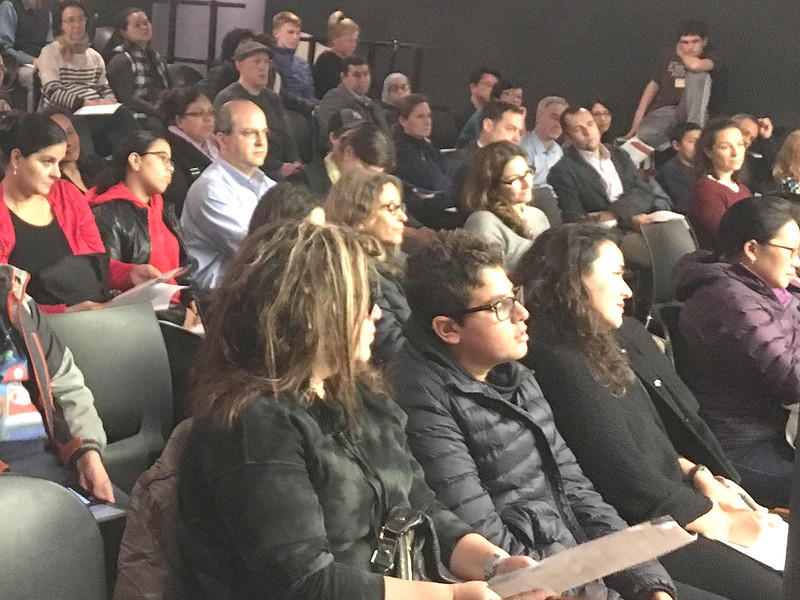
A week ago today, a lively crowd of students, teachers, and reporters gathered for the first-ever citywide Forum on Student Government, held at the UFT building in lower Manhattan and hosted by the New York City Students Union. The purpose was to discuss ways to create, improve and connect student governments in schools across the five boroughs. Turns out, our vision — to use student governments to create a powerful collective student voice — is bigger than one forum. Since Thursday, I feel hopeful that we might, some day, accomplish that goal.

Students shared their obstacles, strategies, and successes. Many were frustrated by student apathy, lack of cooperation from staff members, inadequate funding, and lack of effective communication with their student body. Students had reccomendations such as forming committees, presenting staff with the Student Bill of Rights, making bright posters and playing music through the loudspeaker to get people to pay attention. We also talked about ways to use social networking sites like Facebook and other internet resources to connect more people to school governance. My favorite moment was when a girl from Millenium turned to a boy from Bedford Academy, who was expressing his concerns about lack of efficiency, and said, “Have you tried forming committees? It worked really well for us.” It was as though she knew that during all our planning we dreamed of interactions just like that.

Student apathy can be frustrating. I truly believe it can only be combatted by student unity. Any students who couldn’t make the forum but would like to stay involved, please drop by a student union meeting (details and more information posted here). We are planning another forum in the Spring, and hope for an even bigger and better turnout; watch this blog for details whenever they’re set.

In the meantime, I hope to see all my fellow students this afternoon at the UFT’s save-the-schools rally — City Hall, 4 pm.

Editor’s Note: Can’t make the rally? Public School Parents Advocacy Committee is organizing an Armchair Protest today, to coincide with the rally. To participate, call 311 (or 212 NEW YORK, if you’re outside the city) and ask to file a complaint with the Mayor’s office about the proposed budget cuts to school funding. One caveat: planners say, be prepared to spend time on hold…

March 4, 2009

10 years of expanded after school

Written by Lindsey Whitton Christ @ 4:36 pm

joel-klein.png

A decade ago, 10,000 New York City children participated in daily after school programs, while today, 140,000 city kids attend “after school” every afternoon. This week, the massive expansion of these programs across the city was celebrated at an event honoring the ten-year anniversary of The After School Corporation (TASC), a non-profit that pairs schools and community groups to offer substantial after-school programs. Philanthropist George Soros, who established TASC with a $125 million donation, was the toast of the event, although a child’s version of Joel Klein (in both his human and superhuman form) got the most laughs during the screening of a short movie about the after school movement in New York.

bloomberg-klein.bmp

Watch the adorable clip for a feel-good few minutes (and more statistics).

The people at TASC describe the time between 3 pm and 6 pm as “the danger hours”, and they cite research that shows quality, educational programs that fill the gap between school time and post-work time help students do better during school hours.

With President Obama hoping to double the number of children with access to good after-school programs across the country, New York leads the way with the largest municipally-funded after-school system in the nation. And the images of spandex-clad Joel Klein and Mayor Bloomberg aside, the real heroes of the day are the after-school providers, who’ve made the past decade’s growth in New York City something everyone can celebrate.

March 3, 2009

Cheerleading as policy: a good idea?

Written by Jennifer @ 11:46 am

As every parent knows, it’s a blessing and a joy when your child is in a school she loves that also meets her educational needs. I’ve had that experience for my kids, and when I heard parents extolling Harlem Success Academy charter schools at their rally last Wednesday at PS 241, that same sense of satisfaction shone through.

I’ve heard that sense of school satisfaction from parents at numerous public schools in District 3. Yet to hear the Harlem Success parents say it, theirs are the only children who have chess and music and kids who love reading. This is not true. It’s also not true that PS 241, which the DOE has decided to close and hand over its real estate, is a failing school. It met its requirements for adequate yearly progress this year, according to the State Education Department, working in a difficult situation. It may be a weak school at present—the review of 241 at Inside schools ties its weakness to DOE policies, which resulted in a loss of major foundation funding in 2003—but that doesn’t mean giving its space away to Harlem Success is the best decision for the district.

The Community Education Council and President’s Council of District 3 have called for the DOE to stop making school-closing and charter-siting decisions without consulting the elected parent leadership. Tomas Hunt, Senior Policy Analyst in the office of Public Advocate Betsy Gotbaum, says “some unsavoriness of this sort is happening all over the city.”

Only last year, the DOE criticized District 3 schools for having too much crossover between zones—parents exercising too much choice. Now, Eva Moskowitz and her supporters assert that parents have not been made aware of their choices, and that’s why the public schools need to be turned over to her chain of charters. Her message: Give HSA the real estate quickly, even before Moskowitz’s first schools’ achievements have been measured, and don’t ask too many questions.

If we want to go the charter school route, why support one franchise over the others? Has anybody invited Kipp Academy or Democracy Prep, or potential new charters like the French American Academy, to apply to occupy PS 241’s beautiful building? DOE officials told our District Leadership Team that proposals had been submitted for new public schools, as well, but the DLT’s request to see these proposals went unanswered. Parent leaders would like to be part of such a discussion as the basis for responsible policy. The DOE has avoided public consultation on the use of school buildings, even though such consultation is mandated by state law. The Charter Schools Institute at SUNY seems more than willing to give their approval based on the patently staged cheerleading exhibition at PS 241 last week. That is not great policy-making.

Meanwhile, members of Harlem Parents United continued to attack those who disagree with them: A press release issued yesterday castigated District 5’s CEC as “so-called” elected parent leaders (”supposed to represent all parents in our community”) for “trying to deny parent voice” by slowing the spread of charter schools. Kyesha Bennett, who represents Harlem Parents United, is a Harlem Success parent, shoring up the perception that HSA wants to dominate the Harlem schools conversation. Note: In a democracy, elected officials are chosen by a majority of voters, which is how they’re elected. Other voters are entitled to have their own opinions. Rarely if ever do elected officials share the views of every single constituent.

January 29, 2009

Grassroots 101: Student government project

Written by Toni @ 8:14 am

toni_flyerThe New York City Student Union is starting the Student Government Project, which was developed to help create and improve student governments in high schools around the city.

On Thursday, February 26th we are launching this project with a forum to develop connections between existing student governments. We also want to collaboratively create a basis for what a successful student government is and how it is run in different institutions. And we’re hoping to “seed” student governments in schools where they do not already exist. Students in schools with successful student governments will share their experiences and give suggestions to students trying to start their own.

Please invite anyone you know who attends or works in a public school! (Let us know you’re coming: RSVP at union@nycstudentsunion.org. )

And of course… if you have connections.. we’d always love some press!

January 19, 2009

Happy Birthday, MLK

Written by Helen @ 11:20 am

On this National Day of Service, we hope that local food banks are bursting with volunteers and shelves are groaning under the collective weight of cans and other goods; that Habitat for Humanity work crews have run out of hammers; that coat and blanket drives are literally overwhelmed with the donated warmth of New York City’s residents.

But beyond today — and beyond tomorrow, too — opportunites to give back yawn open, waiting to be filled. Herewith, a few ideas for organizations and programs; perhaps a dash of inspiration, too, if you move from “I should…” to “I will.”

Food Bank NYC runs food banks, soup kitchens, nutrition education programs and more, and needs daily and weekly volunteers.

The American Cancer Society’s Charity Runner program matches able runners with challenged athletes — and organizes staffers at roadside Cheer Stations (for the more sedentary among us).

World Hunger Year needs grassroots volunteers for strategies to eradicate hunger and poverty.

Idealist and VolunteerMatch give people with time and energy to give places, programs, and folks to connect with — myriad opportunities, ongoing and one-off, professional and social, in a do-gooders double clearinghouse.

New York Cares organizes city volunteers for one-day citywide efforts, ongoing programs, and more, including opportunities for groups of civic-minded youngsters.

For families who love the city’s parks, NYC Parks Dept. needs volunteers for their Winter Jam on February 7th. Email April Rodriguez for details, and bundle up.

For urban gardeners, consider the Plant A Row project, which gives home-grown food to soup kitches and food banks that serve the poor.

January is National Mentoring Month: Find out more here, or contact the I Have a Dream foundation for information on Saturday tutoring in Long Island City — they aim to work with all the third-graders in the Ravenswood houses there.

And Donors Choose matches generous givers with teachers’ wish lists — have a look at the science, writing and classroom projects you can help to fund. (It’s a great way to honor a big birthday or anniversary, as many can chip in to a single project, and you’re not stuck with yet another objet d’questionable art.)

Caveat donator: This list is, by its very nature, incomplete. Please write us to mention projects you’re involved with. It’s a big world out there; it needs all the help we can give it.

January 14, 2009

18 degrees in Central Park. Time for summer camp.

Written by Helen @ 1:30 pm

Yes, it’s January, and the idea of dunking in a mountain lake is about as appealing as, well, water-boarding. But weather notwithstanding, it’s high season for summer-camp fairs, which can be great resources for families new to the city-kid summertime rituals. Even veteran camp families find new ideas at the fairs — with up to 100 camps represented, it’s hard to imagine they wouldn’t. Camp choices include day camps, sleepaway camps, and hybrid camps that host kids Monday through Friday, then ship ‘em home for the weekends.

Fairs well be held Saturday and Sunday from noon to 3pm, January 24th/25th on the Upper East and the Upper West Sides, and on February 7th/8th downtown and in Park Slope, Brooklyn. Particulars and more information here.

Bundle up. Think summer.

January 13, 2009

New autism after-school program

Written by Marni Goltsman @ 8:06 am

I just wanted to spread the word about a new after-school program for kids with autism.

Here’s what I know about it:

  • It has been specifically designed for the Nest kids at PS 178, but open to other kids as well (K through 2nd grade).
  • It’s brand new, runs Tuesdays from 3pm - 5pm from Tues. Jan. 20 to Tues. June 16. (Hopefully, it will grow into additional days as well).
  • It is up in Washington Heights (A or 1 train).
  • The main teacher is a social worker and second-year grad student at Columbia who has experience running programs for autistic kids. The other teacher is a certified Yoga instructor.
  • The cost is $500, and if a grant comes through, it could be significantly less.

We’re signing Brooks up and are hopeful that it will be an exciting program. For information, contact the program organizer, Victoria Neznansky (212-569-6200, ext. 204). She’s very committed to it and understands how much a program like this would mean to parents. If you’re interested, please call her.

January 12, 2009

As reading rates rise, our book club reminder

Written by Lindsey Whitton Christ @ 6:04 pm

For the first time since the Census Bureau began counting, the steady decline in fiction reading among American adults has reversed. Although just 52 percent of Americans reported having read a novel, short story, poem or play in the previous 12 months, “the proportion of overall literary reading increased among virtually all age groups, ethnic and demographic categories since 2002,” according to a New York Times analysis of the NEA study released today.

Although internet reading was included in the 2008 data, the NEA chairman Dana Gioia credited popular series like Harry Potter and Twilight, community-based reading programs like “The Big Read,”(with participating organizations in Manhattan, Brooklyn and Queens), and Oprah’s book club with helping spur the reading rise.

Insideschools’ book club may not be as big as Oprah’s and our first book is actually non-fiction, but we still hope that many of you have found time to read Paul Tough’s book about the Harlem Children’s Zone: Whatever It Takes: Geoffrey Canada’s Quest to Change Harlem and America. The book provides plenty of fodder for discussions about New York City, public schools, and national campaigns to eradicate poverty. When we sit down with Tough, we hope to ask him as many of your questions as possible. Please post questions on the blog comments or email them directly to me, Lindsey, over the next two weeks. If you’re feeling squeezed for time but still want to participate, you can read excerpts of the book in the New York Times Magazine (where Tough is an editor).

whatever-it-takes.jpg

For more information on the book and our book club, see the original post.

December 30, 2008

Curtain down on the La Guardia musical?

Written by Lindsey Whitton Christ @ 5:17 pm

Before New Years Eve celebrations begin, we wanted to point out a New York Times story that you may have missed while away from your computers during last week’s holiday rush. The premier high school for the arts in the city (and perhaps nation), Fiorello H. La Guardia High School of Music & Art and Performing Arts, chose to postpone its annual musical due to budget cuts and now may have to cancel the performance altogether. Now this is no ordinary high school musical - the budget is reported to have been somewhere between $45,000 and $70,000 for just three or four performances - and in a school with approximately 2,500 talented students, only a tiny fraction of those who audition are even able to participate. It seems that with all that talent, the show could still go on with fewer bells and whistles and a much smaller price tag. But regardless (and despite far greater tragedies related to school budget cuts), the symbolism of the city’s flagship arts high school struggling to afford its flagship production is worth noting as we enter a new year and contemplate education funding in the 2009 economy.

December 23, 2008

Student Government Project

Written by Toni @ 3:09 pm

Calling all students, teachers and administrators:

On the evening of Thursday, February 12th, members of the NYC Student Union are launching our citywide Student Government Project. This is an evening for students, teachers, and administrators from public schools to come learn about organizing and implementing effective student governments in their schools. It is also a day to begin communication between student governments and between the NYC Student Union and individual governments.

During the meeting, we will collaborate on revising the Student Union’s student government model and help create plans for improving or implementing successful student governments in different types of schools. Participants in schools with successful student governments will share their experiences and give suggestions to students trying to start their own. Students, teachers, and administrators will leave with helpful ideas, plans, tools, and support for the improvement or creation of student governments in their schools.

The meeting will be held at 5:00 p.m. at the UFT Building (50 Broadway between Exchange Street and Morris Street). For directions, check www.nycstudents.org. If you have any questions email Emily, Darien or myself.

Happy Holidays to all!

December 10, 2008

Confessions of an autism soccer mom

Written by Marni Goltsman @ 9:03 am


When it comes to mainstreaming your autistic child, is there a better litmus test than soccer?

If my son can enjoy the social component of being part of a team, if he can muster the athletic coordination it takes to pass and kick the ball, if he can appropriately process the echoing sounds of kids running and coaches yelling and balls bouncing in a large gymnasium, then doesn’t that mean all those sleepless nights of worrying will finally be over?

That is why for the past ten Sunday mornings, my husband has taken Brooks to the Y for a friendly, neighborhood soccer class, and that is also why we don’t listen when the last thing Brooks says before they walk out the door, every time without exception, is “But I don’t want to go to soccer.”

The reason we don’t listen is that Brooks has a long history of not wanting to do things: he didn’t want to talk, he didn’t want to feed himself, he didn’t want to be in the same room with other kids. And my husband and I have a long history of gently prodding him into the unwanted experience and then continuing the exposure until he starts to enjoy it. The hundreds of hours I have spent dragging him to Gymboree classes and bookstore readings and kids’ concerts have definitely paid off. So it seems like a no-brainer that my husband and I should keep doing what works.

But there are two problems with this approach. The first is a new problem: Brooks is getting older. It’s one thing to ignore a toddler’s protests—it’s quite another when a increasingly verbal 5-year-old describes to you exactly what he doesn’t like, and asks you point-blank why he has to do it. And the second is a an old problem that’s been around ever since he was diagnosed: How far can we push him without sacrificing his self-esteem? If this is simply too challenging for him at the moment, which may very well be the case, then why are we torturing him by having him face his deficits in front of us and his peers week after week? Should we instead be taking a break from soccer and working on something else? Or should we design a more appropriate intervention, like having his physical therapist work on ball skills with him one-on-one?

Brooks definitely benefited from this particular soccer program: see his grin when he accepted the trophy? And he was able to participate in and enjoy the practice drills. We learned long ago never to underestimate what Brooks would do for chocolate, but even the promise of S’mores ice cream did not motivate him to join in to the short games that ended each class. The unpredictable nature of all those kids running wild forced Brooks to the sidelines where he could manage only to observe while chewing on the neck of his shirt (a self-stimulatory behavior that he uses to cope with stress).

I wish we had the luxury of being able to concede that Brooks is simply one of those kids who isn’t into sports and that it has nothing to do with autism. Although this is a possible scenario, given Brooks’s history, it’s unlikely. Because of autism’s pervasive nature, and because intervention needs to come sooner rather than later to be most effective, our feeling is that it’s too dangerous for us to categorize any challenge as a typical one, even though it may well be.

As much as my husband and I would love to proclaim: “Brooks plays soccer!,” with all its delicious connotations about how far he’s come, the truth is that we’re not there yet. And we’ve decided not to continue the class into next term. He’s going to have to deal with team sports at some point, but he doesn’t have to do it now, not when he’s only 5 and he’s just moved to a new apartment and he’s just started kindergarten in a new school. We take these things case by case: we’ve made our decision, and we’re okay with it.

I say that now, but in the mail yesterday there was a brochure for a kids’ basketball league. Which I know will inevitably lead my husband or me animatedly asking Brooks: “How fun would it be to meet a whole bunch of new friends and play basketball?” Here we go again…

November 25, 2008

Student government

Written by Toni @ 5:28 pm

According to the Student Bill of Rights published by the DOE each year, students have the right to “organize, promote and participate in a representative form of student government.” Additionally, they have the right to “representation on appropriate schoolwide committees that impact on the educational process, with voting rights where applicable.”

It’s a shame, then, that most schools don’t have student governments, or don’t have effective ones. Many of the Student Governments that do exist in schools are generally in charge of bake sales and dances but have no real voice in their school. It’s hard to know whether this is because the students are unomotivated, because they recieve little cooperation from their school, or both.

The NYC Student Union has developed a student government model, as part of the Student Government Project, based on the idea that an effective student government is not a privilige but a right. Here’s what we’ve got so far:

A Good Student Government has direct contact with the principal of the school and an agreement by the principal to cooperate with the Student Government and respect their ideas that includes:

* A way to communicate with the student body (announcements, a newsletter) and a way for students to communicate with their government (voting, a suggestion box).

* A fair method of choosing student representatives that ensures enthusiastic and voluntary participation.

* Representation beginning on a smaller level (prefects, classes, grades) which expands to the whole government and the principal.

* Scheduled and consistent meetings in a space provided by the school.

* Fundraising for prioritized purposes derived from the desires of the student body.

* Representation on other, larger committees (school safety, School Leadershi Team, etc.)

* We’re still crafting this basic model. If you have revisions, suggestions or new ideas for us to consider, please let us know, by visiting the Student Union or commenting here, on this post.

November 18, 2008

“Other Options Day”

Written by Toni @ 4:42 pm

The NYC Student Union is launching a new project called “Other Options Day.” This is an educational day for all high school students to learn about options after high school if they can’t – or think they can’t – go to college, and for those who think about delaying college for a year or so. In many high schools with high levels of military recruitment, students are led to believe that there are no good alternatives to joining the military. Other Options Day is not anti-military; our goal is to broaden the playing field and show young people that there are other options besides college and military service. Our plan is to have booths from community colleges, jobs that don’t require college degrees, volunteering and intership opportunities, organizations like AmeriCorps, career counselors and anyone or anything else that seems appropriate.

This plan is in its preliminary stages, and we’re looking for more connections. If you know a person or group who might want to host a booth or assist us in another way, I’d love to hear about it. Also, if anyone spends a lot of time in schools and would be able to promote this day to students, that would be great. My email is toni@taty.org. Thank you in advance, and I’ll keep the updates coming.

November 14, 2008

Campaign for Better Schools rally on Sunday

Written by Helen @ 4:53 pm

A new coalition of parents, youth, community organizations and education advocates called the Campaign for Better Schools plans a rally this Sunday, November 16th at 1pm, at City Hall, to advocate for changes to mayoral control. The law is set to expire in the end of June, but will be discussed in Albany beginning in January.

Some of the groups involved include the Alliance for Quality Education, Advocates for Children, the New York City Coalition for Educational Justice, and the Coalition for Asian-American Children and Families. Email nycinfo@AQENY.org for particulars.

One of the campaign’s key goals is increasing the voices of parents, students and the community in educational decision-making; Sunday’s a good time to make your voice heard.

November 4, 2008

Greetings from Pennsylvania

Written by Helen @ 10:27 am

Our intrepid teen blogger, Toni Bruno, wrote in to say she won’t be blogging for Insideschools this week — she’s otherwise engaged, volunteering in Pennsylvania through this historic election. We’re grateful for her passion and civic engagement — and also that her parents and teachers see this young person’s drive to change her world as a valid reason to miss a couple of days of school.

Go Vote! From what we hear, wear comfy shoes and bring plenty to read — lines are long at many polling places, and have been since before 6AM this morning.

October 27, 2008

When desire drives learning

Written by Helen @ 11:14 am

In a gee-whiz, Those Amazing Suburbs story in today’s Times, readers learn of a swath of electives newly installed to inspire and engage high school students. While the merits of electives are beyond argument — who can complain about classes where a student’s own interest drives the learning or about a class that doesn’t culminate in yet another standardized exam? — it’s apparent that few are aware of the breadth of electives that are thriving at some (not all) of the city’s high schools, including jewelry-making, fine and practical art, robotics, ceramics (complete with best-selling author), computer networking, and cooking, to name a few.

It would be great if high-visibility media would seek out good working examples in the city’s schools to hold up as models, rather than yearn for the suburban ideal. In the meantime, if your child’s school offers something really great, let us know — excellence is worth celebration, even if the dedication that inspires it too often goes unsung.

October 7, 2008

Why Can’t We Be Friends?

Written by Toni @ 3:44 pm

News from Toni of the NYC Student Union; visit their blog for articulate, unique, and thought-provoking perspectives on student life in the city.

Yesterday, a friend and fellow student union member told me about a program called the Borough Students Advisory Council (BSAC). It is a DOE-run program that invites every single school in Manhattan to send two students to monthly meetings with other students and higher powers. The idea is to unite students from across the borough and discuss issues in their schools. It sounds ideal, right? It’s a chance to bring together students and give them access to unbelievable resources, connections with the DOE, contact information for every school and a place to meet every month.

Interestingly enough, their mission is almost identical to our mission at the NYC Student Union– the only completely student-run group working toward a collective voice of change in the public education system. So my question is this: Why have we never heard of BSAC? And why, when every school in the borough was invited to send representatives, do only about a dozen schools participate? If Chancellor Klein and Mayor Bloomberg are serious about student involvement, I think they could do a lot better than that.

Every week we meet as a student union and we are constantly frustrated by our limitations: lack of communication with the people in charge and lack of communication with more students around the city (two things that BSAC could offer). And now, as I am discovering, a serious lack of communication between different education activist groups. We are working in isolation for the same cause.

Our union proposed a couple of things today. The first one was a day where all education activists could get together and present their organization or cause. The second one was a wiki page for educational activists, allowing everyone to search for other groups that could work with them on projects, etc. We also considered the idea of using LinkedIn to connect all the people in this education world.

In the past week alone I have heard of two or three organizations with goals closely aligned with ours in the student union. We are trying to reach out to them; today, today two representatives from ICOPE came to our meeting and it was incredibly inspiring to talk to them. We are constantly impressed by the work of other groups trying to better our schools, and yet we rarely find the opportunity to collaborate with them. So contact us! students@lists.nycstudents.org.

Imagine someday all of us education activists will meet together and our concerns will live as one.

June 12, 2008

Game On

Written by Lindsey Whitton Christ @ 1:14 pm

I’m Lindsey Whitton Christ, the new Insideschools staff writer. Although I am new to the Insideschools team, I have used both the blog and the website for years, first as a social studies teacher at IS 143 and then as a journalism student at Columbia. I am thrilled to begin contributing! On a visit to PS 183 on the Upper East Side this week, I watched a group of excited fifth graders distress the edges of the paper on their own pioneer diaries, and I was reminded of my favorite computer game as a child, Oregon Trail. The students were undoubtedly so enthusiastic (they were falling all over each other to tell me everything they had learned about westward expansion) because the project let them imagine that they were pioneers experiencing the trail. The computer game had allowed me to do the same thing – although on a clunky 1980s Apple computer it was hardly the degree of computer simulation we are now used to. While computer games can be a distraction, they can also be a great tool for learning. With social studies, computers can help students to model life in the past and understand social history. Sandra Day O’Connor has even gotten in on the game. My seventh graders would have loved to use the website the former justice is helping develop about the American justice system. My sixth graders each spent a short time on computers doing an activity on mummification and then they talked about what they learned for weeks. And I know several, otherwise mature, adults who would never admit that they occasionally stay up late creating civilizations on their computer.During summer vacation when it’s too hot to go outside, which games do you encourage your children to play? And which (be honest) do you like to play with them?

June 9, 2008

After-School Activism: Remember the Budget?

Written by Helen @ 12:01 pm

If your kids aren’t booked solid after school with dance, baseball, Kumon and Kaplan — and especially if you’re a family that relies on after-school programs for enrichment, homework help, clubs, teams and more, the Kids Protest Project wants you, to speak out against budget cuts that may threaten the out-of-school extras that so many kids enjoy — and so many parents count on, every day.

Join students and parents from PS 75M, Central Park East II, PS 9/The Anderson School, Manhattan School for Children, Stuyvesant High School, Edward R. Murrow High School, the Computer School, and PS 59 as they deliver mail daily to Chancellor Klein’s office at the DOE. Better yet, organize a campaign at your school, and add your community’s voice to the fray.

May 13, 2008

Looking for a summer job? The city can help

Written by Admin @ 10:43 am

Every year, teenagers and their parents ask us at Insideschools how to find summer jobs. In fact, Judy recently answered a question about what kinds of work a 14-year-old might look for. An internship can often be a meaningful way to spend the summer both learning and working. And if your child is set on landing a paying job for the summer, the city can help.

Until May 16, kids can submit applications for the city’s Summer Youth Employment Program, which places young adults ages 14-21 in positions at community organizations, city agencies, and local businesses. The DOE’s Office of Special Education Initiatives will help teens with disabilities find jobs as well; to apply, complete the regular SYEP application and mail it by May 16 to John McParland, OSESI Placement and Referral Center, 145 Stanton Street, Room 223, New York, NY 10006.

April 3, 2008

Public schools awash in private school-ish activities

Written by Admin @ 3:45 pm

To provide public school students with the kinds of activities popular in private and suburban schools, we’ve got Chess-in-the-Schools, StreetSquash, and youth league soccer in Harlem. Now we learn that cricket recently became the DOE’s newest PSAL sport. It’s only a matter of time before pole-vaulting becomes a right, not a privilege, for the city’s public school students.

March 25, 2008

Student Thought: Massive

Written by Admin @ 7:07 am

That’s probably the only word I can use to describe last week’s protest: Massive.

Students, teachers, parents and administrators lined Broadway right next door to City Hall and the DOE, temporarily creating a new branch of our education system, one that was based on the needs and concerns of the real constituents of our community instead of the impractical ideas of the Klein-Bloomberg complex.

We called for a restoration of the city’s education budget, with signs reading, “Don’t Cut the Future Out of Your Budget!”, “Budget Cuts are Nuts,” and “It’s our Budget, Don’t Fudge it!

We called for a refocusing of our educational priorities: a shift from tests and worksheets, consultants and computer systems to project-based learning and a rebuilding of the relationships between teachers and students around our city.

Most of all, we called for respect.

We brought out the numbers, guys! Take heed!

In my time as a student activist, I have never seen so many students up in arms, taking to the streets. The NYC Student Union alone brought out over 500 students, thanks to the online organizing of freshman Rebecca Morofsky of Brooklyn (special shout out to her for a great job).

Students realize the direct impact these cuts are making on our schools and on our lives. We feel the powerful disrespect when the government fails to recognize that the future is at stake here. We have spoken.

Cross-posted at NYC Students Blog

March 19, 2008

Thousands turn out for Keep the Promises rally

Written by Admin @ 7:20 pm

Thousands of people braved the cold rain today to rally against the budget cuts outside City Hall. Tomorrow we’ll all have pneumonia but today we can relish the thought of parents, students, teachers, and principals united to call for sustained support for the city’s schools and their children. I didn’t pay much attention to the various firebrand speakers — with their presence and creative signs, members of the crowd made the strongest statements.(All photos Philissa Cramer/Insideschools)

March 4, 2008

The Money Mom: Children design charity fundraiser

Written by Admin @ 12:31 pm

Recently I served as a judge on a panel considering the proposals of 5th graders for a fundraiser at their school. These kids combined a statistics and economics lesson with a writing assignment — all for the purpose of raising money for charity.

The children surveyed schoolmates about what kind of fundraisers the community would prefer, analyzed the survey results, and then wrote persuasive essays, backed up by data, about why their proposal should be the one accepted over all the others. Options included a movie night, sports field day, a stuffed animal sale, and other things along those lines. The proposals were rendered anonymous by whiting out the authors’ names, and the panel of judges included parents, teachers, as well as kids from another class.

Later in the spring the kids will actually carry out the winning fundraiser and donate the proceeds to a charitable cause shown by the survey data to be one that the kids in the school care about a lot. Right now polar bears and global warming are the front-running causes. What a great piece of curriculum!

February 6, 2008

At least New Yorkers don’t have it this bad, right?

Written by Admin @ 10:13 am

The Times reports today from India:

This year, admissions for prekindergarten seats in Delhi begin for children as young as 3, and what school they get into now is widely felt to make or break their educational fate.

And so it was that a businessman, having applied to 15 private schools for his 4-year-old son, rushed to the gates of a prestigious South Delhi academy one morning last week to see if his child’s name had been shortlisted for admissions.

Alas, it had not, and walking back to his car, the fretful father wondered if it would not be better for Indian couples to have a child only after being assured a seat in school. “You have a kid and you don’t have a school to send your kid to!” he cried. “It’s crazy. You can’t sleep at night.”

January 31, 2008

City’s amazing students earning titles, winning championships

Written by Admin @ 8:06 am

With troubling news about school budgets percolating (more on this later), let’s focus this morning on the city’s exceptional students. Four students at Stuyvesant the most at a single school and one at Bronx Science were among the 40 national semifinalists in the prestigious Intel Science Talent Search. Kids at MS 318 in Brooklyn beat national chess champs Murrow High School for the city chess title. And kids at IS 98 in the South Bronx take LEGO robotics seriously, as do their peers at 59 other Bronx schools; they’re currently raising money to travel to Japan to compete.

January 29, 2008

8th Grader Izzy: The wait continues, but not for long

Written by Admin @ 8:08 am

Hey everyone! It’s been quite some time since I last blogged, mainly because all has been quiet on the high school frontier for a while now. I am currently waiting for the results of the specialized high school exam, which are due back next week (somewhere around Feb. 6), to tell me whether or not I made it into my first-choice specialized high school.

At the same time that I’m pretty jazzed about those results, I’m also anticipating the results of my application to non-specialized high schools. At this point, I will, quite frankly, be happy no matter where I get in. I have confidence that I made it into the small school in my neighborhood, and my excitement concerning acceptance to that school has only risen since I finally decided to put it first. Although I’ve heard rumors that it will be backbreakingly fast-paced, I’ve also heard wonderful things about the rich curriculum and able staff.

My one concern is that, if I do somehow make it into both the specialized high school and the regular school, which will I choose? Both schools are overachieving and will undoubtedly get me many places in my future career as a student, but I would have to make certain sacrifices in order to succeed in both places. One will allow for shorter travel time, but more club participation; the other, immense travel time, but possibly less competition among the student body. Only the test results (and some good thinking time!) will tell.

January 28, 2008

Brooklyn teacher gets kids excited about science, parents out of bed

Written by Admin @ 12:43 pm

Would you wait in the cold at 4:30 a.m. to sign up for more classes with your elementary school science teacher? That’s what parents from PS 261 in Brooklyn did this past week when Carmelo Piazza, known in the neighborhood as “Carmelo the Science Fellow,” opened registration for the 8-week summer program he runs. The New York Times reports that parents started lining up around 4:30 a.m., and the entire summer session was full less than 3 hours after registration opened at 9 a.m. Piazza sounds indefatigable (and possibly insane), teaching a full schedule, running after-school classes at his neighborhood science joint, and entertaining at weekend birthday parties. The city needs more teachers like him.

Student Thought: Mayoral control and the question for Albany

Written by Admin @ 11:34 am

It always surprises me how my fellow students always seem to take much more moderate and pragmatic positions on many of today’s more controversial education issues than I would expect.

At last week’s New York City Student Union meeting, the issue that came up was mayoral control of NYC schools, which Albany can either reinstate or let sunset in 2009. While much of what we hear on the issue from other members of the education community (parents, teachers, activists) is outright condemnation, most students were supportive of the idea of mayoral control.

I’ve been on the fence about the issue for a while now, but after hearing my fellow students arguments, I am convinced that mayoral control is not the devil after all.

For starters mayoral control assures that at least someone is responsible and accountable for the success and failure of our education system. It makes education an important issue in the municipal election with both the largest voter turnout and the greatest amount of press coverage and it also serves to keep education in the news because there are always reporters surrounding the mayor.

Mayoral control also centralizes education giving some hope for equal standards citywide and the possibility of important sweeping change.

Don’t get me wrong, I do believe it needs some changes. I just took my US History Regents and the idea of checks and balances comes to mind. Since the president has to get his Secretary of Education approved by Congress, why shouldn’t the mayor have to get the chancellor approved by the City Council? Makes sense right? I would also advocate that a Chancellor Selection Board be appointed comprising of teachers, parents, students and administrators to publicly review candidates for the position.

Up to now, most of what I have heard as criticism of mayoral control seems more to be criticism of what Bloomberg and Klein have done to our schools. What we have seen with the current Bloomberg-Klein Complex is a complete denial of some of the most important issues in education, especially class size. They have also shown a pattern of disrespect to many of the constituents of our education system and filled the department with bureaucrats, lawyers and businessmen instead of educators.

We know that we need a chancellor who has experience as an educator in the classroom and in the schools. We need one who understands the delicate processes of teaching and learning. So I say, instead of drifting back to decentralization and the disorganization and confusion that comes with it, why not demand a mayor who will give us just that, who will pledge to put an educator in charge of our schools. This in my belief is one of the biggest positives of mayoral control is that we the people can make this statement.

In 2009, Albany will have a tough decision to make. Mayoral control is an extreme system. It is likely to be very good or very bad because under it change comes much more easily. It does not tend towards moderation. However, in our current state of education, in which way too few of us students graduate and fewer leave our schools ready to support ourselves and become able participants in our democracy, we need a system that will enable change to occur. What we have had is not working. We need new solutions, new ideas. Mayoral control is the most effective way to implement the changes we seek in our schools.

So the question before Albany is this: Do we want to abandon a system that has such a potential for good, just because it hasn’t been used as such in the past six years?
–Cross-posted at NYC Students Blog

Slashing schools budget, Bloomberg shows he doesn’t get it

Written by Admin @ 8:09 am

The Campaign for Fiscal Equity ruling this summer raised our hopes that the city’s schools would finally receive equitable and more adequate funding, but it’s turning out not to be quite the banner year for school funding that some had hoped. First, Governor Spitzer reduced the amount of new money flowing to the city’s schools. Now, Mayor Bloomberg has proposed a $324 million reduction in the city’s education budget, representing a 1.3 percent cut.

According to the Post, Bloomberg sees the cuts as an inducement for principals to spend more efficiently. Speaking as the business leader who amassed a fortune of nearly $12 billion (or $324 million, 37 times), Bloomberg said,

“I’m sorry. You can always cut 1.3 percent. In fact, it’s healthy to go and say let’s cut a little bit and force the principals and the teachers and the administrators to say, ‘Is this program worth it?’”

Bloomberg’s sentiment is, of course, offensive to principals and teachers and administrators who are struggling to provide high-quality educations under difficult circumstances and who certainly don’t think anything they’re doing is worthless (except maybe confiscating cell phones and administering standardized tests under DOE orders). And more than that, it’s offensive to children for whom every art class, field trip, and ounce of enrichment means something, even if those expenditures don’t always immediately translate into improved “performance.”

Elected leaders often have to make difficult decisions that adversely affect their constituents. We understand. But they don’t have to sound happy about it.

January 25, 2008

Middle School Muddle: Taking a look at after-school programs

Written by Liz Willen @ 9:23 am

When choosing a middle school, what happens after hours is critical in a city where space is scarce and fields are threatened.

Parents mulling middle school options spend a great deal of time comparing math and science programs, class size and school philosophies. They also can’t help noticing the wide disparity of sports and after-school programs and activities

Extras like robotics and rock bands can be big factors for working parents. Who wouldn’t prefer having their kids in fun, structured activities in school instead of hanging out in city parks, unsupervised?

Kids care a lot about these offerings as well. My 5th-grade son is absolutely swayed by the promise of track, soccer and swim teams.

After school sports are even more critical at a time when the few athletic fields available to New York City kids are threatened by politics - as at Randall’s Island - or by development, as at Pier 40, where a huge rally is planned this Sunday at noon to save the fields from development.

So far, no middle school we’ve toured can compete with the offerings at M.A.T. in Chinatown, detailed in a great piece last week in the Downtown Express. The promise of the long-awaited community center that will be available free for all students at IS 289 will also be welcome.

But only M.A.T. offers a climbing wall (a great metaphor for middle schoolers, who literally climb them anyway) along with a surfing club and a tremendous track and field program. John De Matteo, the school’s ambitious athletic director, is building a really impressive program where 65 percent of all students participate in a sport.

To his credit, De Matteo has already met with the principal of Tompkins Square Middle School to explain how M.A.T. can support 16 sports and 38 teams. He plans to meet with other middle school principals to talk about how they can model their programs after M.A.T. as well.

De Matteo is happy to share his insights because he is so convinced that it makes a huge difference in the lives of middle schoolers.

“I believe that being on a structured sports team which teaches children how to work with their teammates, build sportsmanship, build community and character and motivate to improve grades will be one of the most important opportunities for our children to have,” he says.

Any advice M.A.T. can offer middle school principals will be a positive step for all New York City public schools. Space, money and scheduling issues all interfere with the creation of after school programs. Just last week, hundreds of kids and parents crowded into PS 3 in the West Village, pointing out the critical need for more schools in Chelsea and the Village. Kids wondered why luxury condos are cropping up everywhere when schools are not.

There are not enough good public schools in the city. We also need fields, after school programs and sports. Parents are going to have to make a lot of noise to make sure we get them.

In the meantime, let’s offer support and encouragement to the educators and visionaries who are creating, pushing and sharing programs that mean so much to our kids.

January 24, 2008

DOE considering making more time for more testing

Written by Admin @ 12:29 pm

Next year, kids at 10-15 schools will have more time in school if all goes according to plan for The After School Corporation, which at the chancellor’s urging has bought into a national push to give up on traditional school hours.

According to the Daily News, TASC is planning a pilot in which kids might go to school through the summer or until 6 p.m. daily in an effort to extend the amount of time they’re learning. In addition to having more time for academics (and, presumably, testing), TASC President Lucy Friedman told the Daily News the new schedule will allow schools to preserve art, music, and sports programs that have been pushed out during the regular school day. TASC says the pilot will honor the teachers’ contract, although it’s difficult to imagine how it could, and it can’t be a good sign that UFT President Randi Weingarten has already called the pilot “another one of these secretive plots.”

The Daily News notes that the idea for the pilot germinated in conversations with Chancellor Klein. Nationally, there is a growing movement to extend school time; the National Center on Time and Learning was launched in October (with some funding from Klein favorite the Broad Foundation), and the issue even got discussed during a Democratic presidential debate this fall. Many charter schools already have longer school schedules.

January 17, 2008

Student Thought: Our role as students

Written by Admin @ 11:17 pm

What is our role, the students’ role, in our society?

As it stands now we are the constant object of the education discussion sentence. My English teacher told me (and mind you, this was last year… in my junior year of high school) that a simple sentence contains three parts: the subject or actor, the verb or action, and the object or that which is acted upon.

As in: “The Department of Education (that’s the subject) puts (the verb) children (the object) first (I guess that’s an adjective).”

In the American education debate, we are acted upon by many subjects: The Department of Education, which treats us like products, numbers that need to be manipulated so that it can look good; the city, which treats us as criminals who need to be babysat by the NYPD for a couple of hours a day; and our teachers, whom people assume can snap their fingers and turn us into brilliant astrophysicists ready to herald in a new age of American economic glory.

In debates about the issues, class size for example, we always hear about how current conditions make teaching impossible. What about learning? Do you think it’s any easier to learn in a class of 34 than it is to teach? Since when has learning become a passive action? Just because it contains no plosive sounds and seems to flow off the tongue a bit easier doesn’t mean it’s any smoother of a process. Learning is not an exact science. It takes hard work, intense concentration and in today’s schools, quite a bit of luck.

If our education systems are truly trying to put “Children First,” then it is time for us to become the subject of our education. People like Joel Klein need to stop asking, “Are our teachers teaching?” and instead ask, in the words of the Bard, “Is our children learning?”

To refocus this picture, we students need to take a more active role in our schools. That is the key mission of the New York City Student Union, a citywide, student-founded, student-run organization. Since its creation in 2006, the union’s goals have been to act as a powerful collective voice for New York City’s students, to give students a say in the decisions made about them, and to provide communication between students from all over the City.

Each Monday, these students from small schools, impact schools, specialized schools and others, meet to examine the problems in our city’s schools and come up with student-generated solutions to them. For example, we’ve advocated the need for smaller classes to the governor and other state officials. We testified before the New York City Council against the cell phone ban, and most recently we’ve lobbied the Department of Education on improving its new progress reports and student surveys.

Additionally we work on student empowerment projects such as our Student Government Project, in which we are researching the state of student governments around the city and look to develop an effective student government model so that students can have a greater say in their individual schools, and the NYC Students Blog, the first-ever student-run blog about the NYC education system, which features the voices of seven student bloggers, representing every borough, giving their take on education issues.

I believe that the only way to make students the subject of the education debate is for us to take a more active role in larger education politics and the goings on of our own schools. We must remember that we are the learners. That is an honorable position to be in. We are not products or tools or criminals. We are potential incarnate.

Cross-posted on the NYC Students Blog

January 10, 2008

Randall’s Island playing fields deal being argued today

Written by Admin @ 2:31 pm

Six months after filing suit over the city’s deal to lease most of the Randall’s Island playing fields to private schools, Harlem residents are enjoying their first day in court today. Norm Siegel, the lawyer for the plaintiffs, is trying to expand the lawsuit to make it a broader attack on the city’s proclivity to issue no-bid contracts. But the Sun reports that “in the end, the case will turn on a narrow issue: whether the city circumvented the community board and City Council in approving the lease agreement.” It’s probably best for the plaintiffs that the key legal issue is technical and not moral: contradicting their claims, the head of the Randall’s Island Sports Foundation says the deal will create even more access for public school families than they had in the past. Construction on the fields began this summer.

December 29, 2007

Scenes from the Penny Harvest display

Written by Admin @ 10:18 am


Yesterday, I went to Rockefeller Center so you don’t have to. But maybe you should — the Penny Harvest display really is impressive. Equally impressive: overhearing parents tell their kids to “put those coins down!” in dozens of world languages. The display is up through the end of the year.

June 17, 2007

After school programs in trouble citywide

Written by Admin @ 11:53 pm

More than 100 schools are slated to lose their after school programs in the fall, the New York Times reports today. Statewide, 207 schools are being forced to cut their after school programs because the federal grant that funds them is running out. By the time schools were informed that they would not be able to renew the after school grants, it was too late for them to find other funding sources. In the city, 118 schools are looking at cutting their programs — these include IS 238 in Queens, PS 20 in the Bronx, and Lower East Side Preparatory High School, all of which the Times profiles. The Queens Tribune has some backstory on the timeline and blame game of the current funding crisis. We’re hoping it gets resolved and schools are able to sustain the after school programs they’ve developed — and we especially hope that other schools do not find themselves in the same position next year when their funding runs out.

For more information on this crisis and other after school news, check out the After School Corporation, a non-profit organization dedicated to promoting and sustaining after school programs in New York.

Powered by WordPress