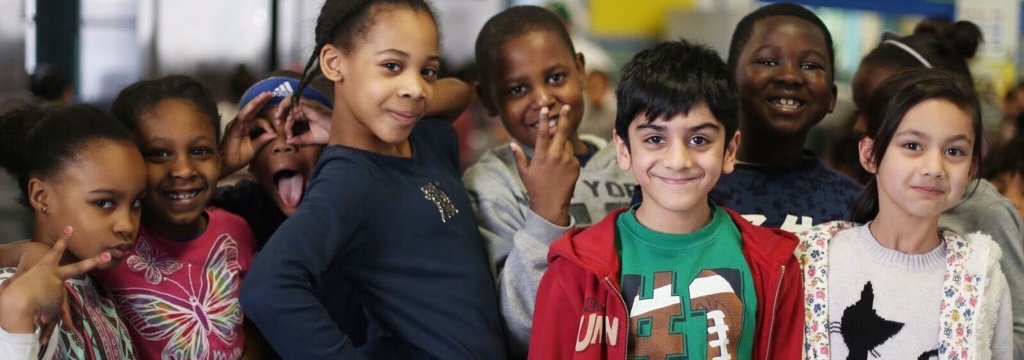
P.S. 163 Alfred E. Smith

163 West 97 Street
Manhattan NY 10025 Map
Phone: (212) 678-2854
Website: Click here
Principal: Virginia Pepe
Neighborhood: Upper West Side
District: 3
Grade range: PK thru 05
Parent coordinator: Andi Vayda
PC phone: (347) 563-5230

What's special:

A consistent approach, solid teaching, dance for everyone.

The downside:

The students who struggle the most need more individual help.

Statistics

Enrollment:
Attendance:
Free Lunch:
Admissions: Neighborhood school/gifted program
Ethnicity %:
Reading:
Math:
English Language Learners:
Special Education:

Insideschools review

It's no accident that the security guard at P.S. 163 is humming and kids break into dance on the playground (and every so often skip down the hall). Music and movement are common languages in a school where kids with a wide range of abilities come together to learn. Although the school has four distinct strands: dual language, gifted and talented, general education and special education, the classrooms are mingled throughout the building and kids are mixed-up in weekly clubs. Some dance classes, taught by National Dance Institute instructors, are split in half and different halves are combined so kids can get to know each other in the sessions. "Here, everyone's a dancer," said Virginia Pepe, who has a clear vision for the school. "No one is left out."

Teachers follow the "workshop model" from Teachers College Reading and Writing Project. The workshop begins with a "mini-lesson," like those we saw in 3rd grade classrooms on the importance of using transition words in writing. In the gifted and talented class, the teacher wrote down a long paragraph, moving quickly to keep up with her students' rapid-fire ideas. In the general education class, the teacher had to urge a bit more to bring out ideas. Although the resulting paragraph was shorter, the aim was exactly the same. Dual language teachers delivered lessons in Spanish (alternate days are in English). After each mini lesson, kids usually spread out to the tables and try it themselves and then gather to share and hear the teacher sum up the lesson.

The workshop model is also used to some extent in science, social studies and the Everyday Math Program. Fourth graders in the science lab listened to a review of words like "amplify," "vibration" and "energy" and watched a demonstration before trying an experiment on sound. Classroom teachers support the lab work by reading books about sound and having kids write about it. For added continuity, new teachers have mentors in the building. There is still room for creativity, like one teacher who wrote a big math challenge in which students had to figure out the price of her family's Thanksgiving dinner.

Overall, we saw energetic teaching and kids who were paying attention. One or two teachers were too loud and too talky, but most combined talking and listening skillfully. Administrators and teachers were kind – crouching to eye level or placing a calming hand on a restless child's shoulder.

Parents said more trained adults would be helpful for the kids who are struggling the most, especially in the younger grades. "We are in the middle class squeeze," said dual language parent Carrie Reynolds. "We're not quite poor enough for Title I money but not quite as rich as other schools in the southern part of the district." Given more money, they would spend it on academic intervention. Parents who train to be "learning leaders" help fill this gap, as do student teachers.

Once a week children participate in clubs. The clubs we saw – macramé, math, guitar and basketball – looked like lots of fun. Principal Pepe is a proponent of activity and outdoor recess even in winter months.

Special Education: Integrated co-teaching classes have general and special needs children mixed together with two teachers, one of whom is certified to teach special education.

Admissions: PS 163 is a neighborhood school. Students are admitted to the gifted and talented classes according to Department of Education standards. (Lydie Raschka, December, 2011.)

Please post comments

  • Give specific examples. Tell us why “this school rocks” (or doesn’t)
  • No profanity. No racial or ethnic slurs. No personal attacks
  • Criticism is fine but don’t be nasty.
  • Flag inappropriate comments. (Hover your cursor over comments to see flag)
  • There is tons of outdoor play space at P.S. 163 and kids get to go outside to play even in winter. (photos by Lydie Raschka)
  • and work hard to make lessons interesting.
  • Many of the teachers at P.S. 163 are lively
  • many learning games and hands-on materials for math and science.
  • Inside, the trailers are cozy. Kids have a block corner and
  • Kindergarten classes are located in trailers out back.
  • Four lunch periods make for a calmer lunch room, but 5th graders must eat late in the day. However, they have snack time.
  • Parents are active and run a summer reading program among other things.
  • Principal Virginia Pepe listens closely as a child tells her she'd like to go on a class trip.
  • Children have classroom jobs.
  • Bathrooms are clean, open and brightly painted.
  • Independence is encouraged. Children sign out when they need to use the bathroom.
  • The coach serves as an unofficial mentor for kids in the basketball club.
  • Although most children change clubs each semester, this guitar club can be taken for two semesters in a row.
  • Each child gets to work on his/her own project.
  • The goal in the macrame club is to make a snowflake.
  • A volunteer from the Courant Math Institute at NYU leads the math club.
  • "How many ways can you make one-half?"
  • In the math club, Izzi cards are used to learn about fractions.
  • During clubs, classroom teachers meet to plan lessons.
  • Weekly clubs are enjoyable and offer another way to learn.
  • children will do an experiment to learn more about sound.
  • After a mini lesson on the mysteries of "sound" in the science lab
  • The Everyday Math program uses a mix of paper-and-pencil and hands-on activities where kids can count objects or play math games.
  • and a modern map, for a social studies lesson about the city.
  • Kids pour over a map of historic New York City
  • In a dual language classroom, children refer to charts filled with words in Spanish and English.
  • A selection of Spanish books is especially useful for kids enrolled in the dual language program.
  • The library is run by parent volunteers.
  • Class changes are orderly but not rigidly silent.
  • in a classroom with a mix of general ed and special needs children.
  • A skip counting lesson is led by two teachers
  • accompanied by live music.
  • All children get classes in movement and dance
  • In a gifted and talented class, the example is longer, but the goal of the lesson is the same.
  • In the general education class, the example is shorter and simpler.
  • A teacher presents a mini lesson on how to use transition words to connect ideas in writing.
  • Teachers begin with a "mini lesson."
  • For most subjects, the school follows the "workshop model."
  • Inside, the doors are jelly bean colors.
  • from brownstones, new housing developments and public housing projects in the area.
  • the Alfred E. Smith School serves children
  • On the Upper West Side, between Central Park and Riverside Park,

Find another elementary school

Take our poll

Should teachers make more money?